Subtraction Within 10 Worksheets
12 printable pages. 80 subtraction sums within 10, with the taken-away objects crossed out rather than erased, so both the starting group and what is left stay visible.
- Pages
- 12
- Ages
- 5-7
- Paper size
- A4
- Black ink only
Free to print at home, at school, and in a classroom of thirty.
80 sums, the taken-away objects crossed out, answers at the back
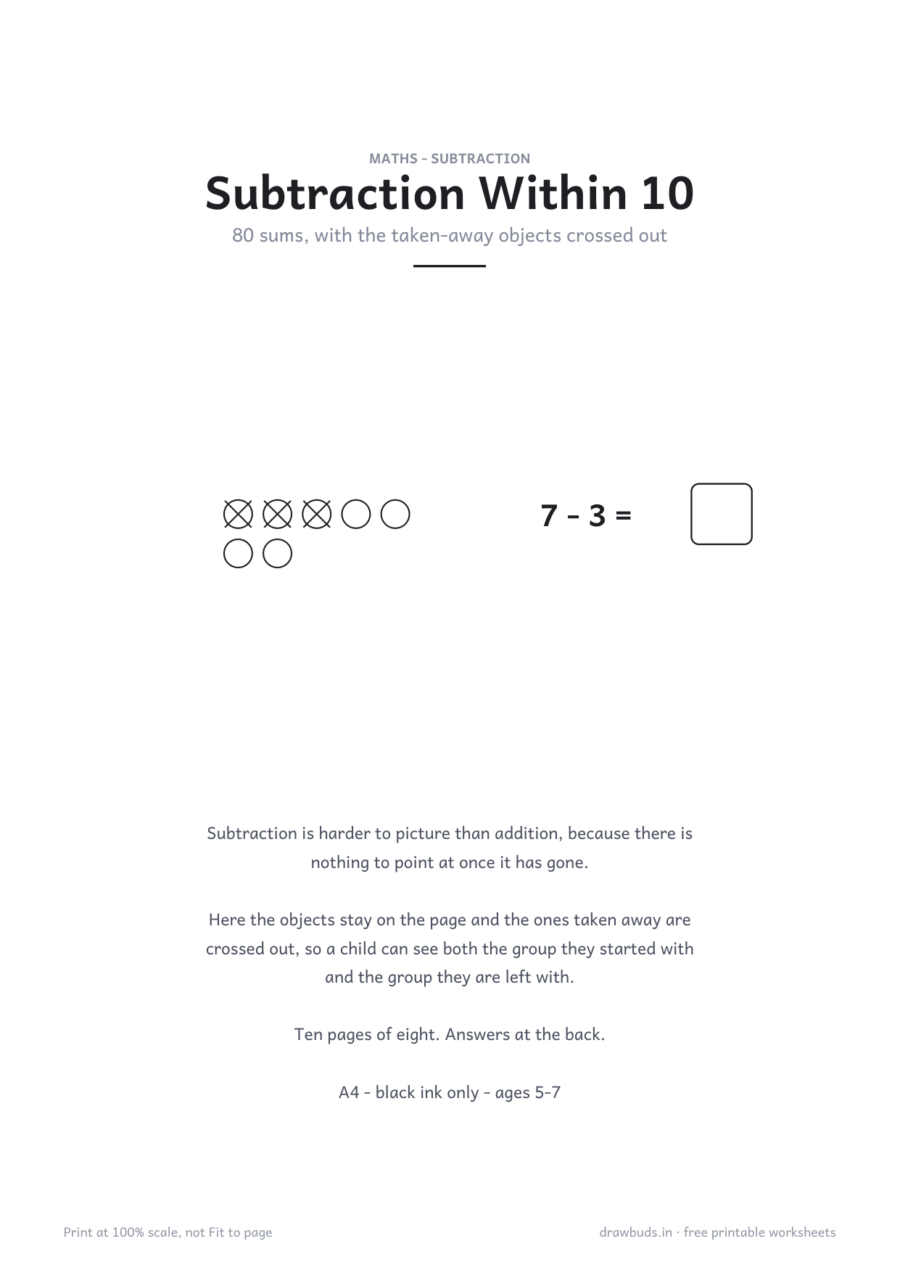
Subtraction is harder to picture than addition, and the reason is simple: once something has been taken away there is nothing left to point at. A child asked what 7 − 3 is has to hold seven in their head, remove three from it, and report the remainder, with no picture to check against.
So nothing is removed on these pages. Seven circles are drawn, three of them are crossed out, and both groups stay on the paper.
What is on each page
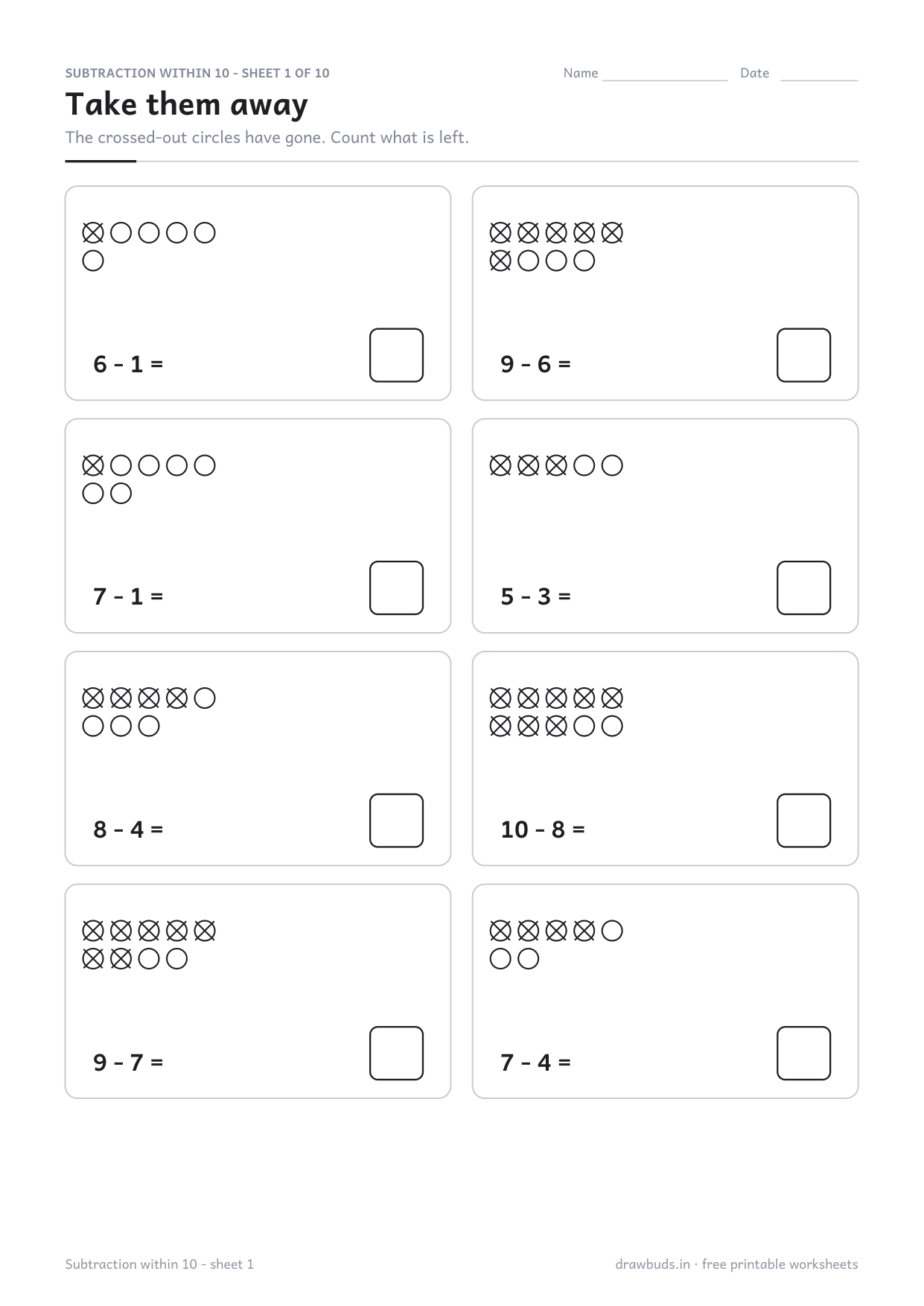
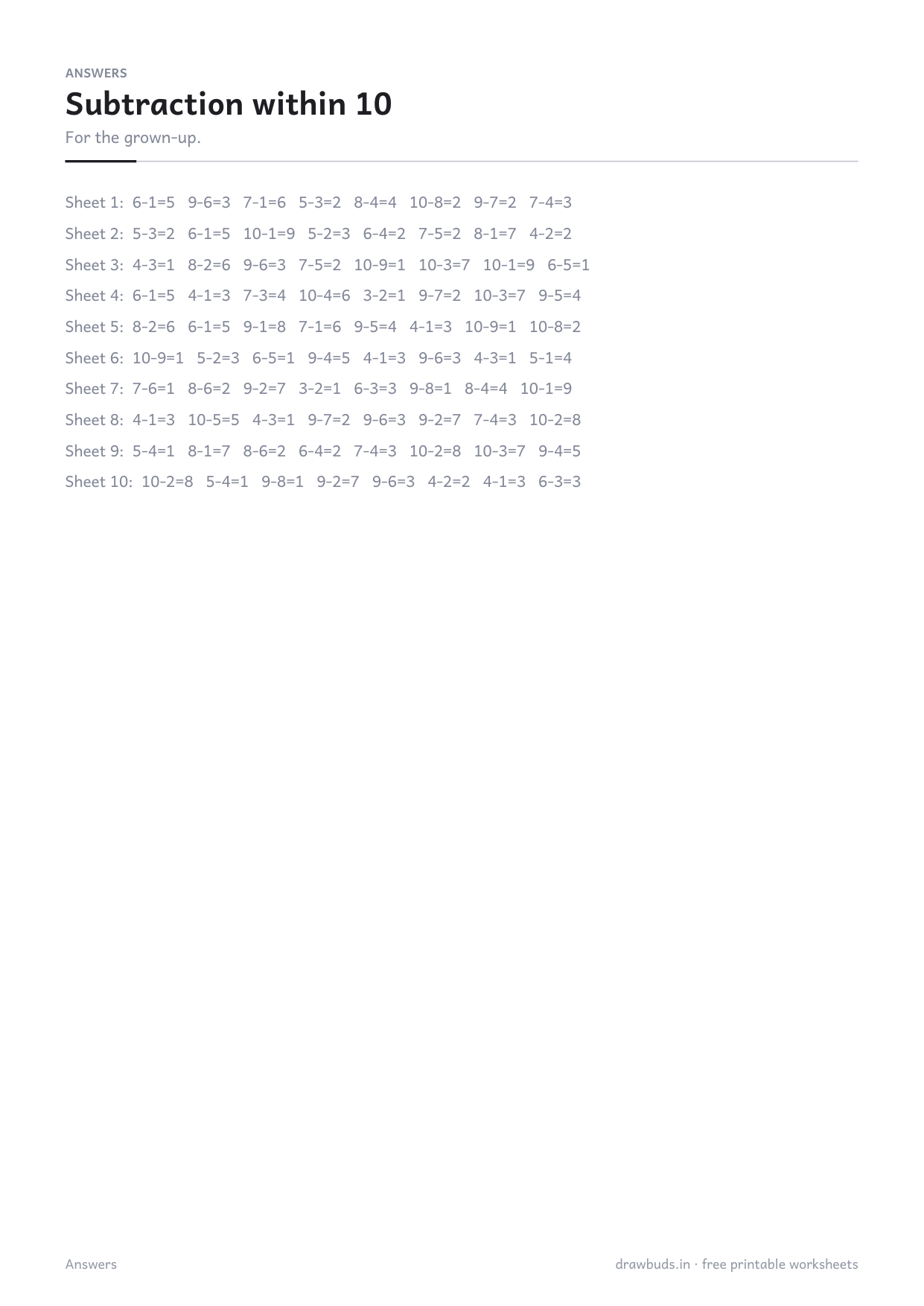
Eight sums in two columns, each with its circles above and an answer box beside it. Ten sheets, 80 sums, no repeats within a sheet, and every answer at the back.
Take away, or find the difference
Subtraction means two different things and children meet both in the same year. Take away is what this book shows: start with seven, remove three. Difference is the other one: how many more is seven than three. The crossed-out circles teach take away, which is the one that comes first and the one that matches the words most children hear at home.
When difference is introduced later, More, Less or Equal is the book that sets it up, because it lays two groups side by side rather than inside one another.
Cross out, do not rub out
If a child wants to work these out with real objects — buttons, pasta, counters — push the taken-away ones to one side of the table rather than putting them back in the box. It matches what the page does, and it means the answer can be checked by counting rather than by asking.
Where it usually goes wrong
Reversing the sum. A child who cannot do 3 − 7 will often quietly answer 4 instead, because the digits are there and 7 − 3 works. Watching for that is worth more than any amount of extra practice; it means the order of the numbers has not landed yet.
What comes next
Addition Within 10 if this book is too hard, and Number Bonds to 10 if it is too easy — a child who knows the bonds can do every sum in both books without counting anything.
Printing this one correctly
In your printer dialog set Scale to 100% or Actual size, not Fit to page. Fit to page shrinks the tracing letters and they stop matching the size a child's hand is learning.
Plain paper is fine for crayons and pencils. If your child uses felt pens, 100 gsm paper stops the ink bleeding to the next sheet.