Addition and Subtraction Within 20 Worksheets
Addition and subtraction within 20 worksheets: make 10, doubles, bridging through ten, fact families and missing numbers, with answers. Free PDF.
- Pages
- 28
- Ages
- 5-7
- Paper size
- A4 and US Letter
- Black ink only
Same worksheets, two paper sizes. Free to print at home, at school, and in a classroom of thirty.
Make 10, doubles, bridging through ten, fact families, missing numbers, answers
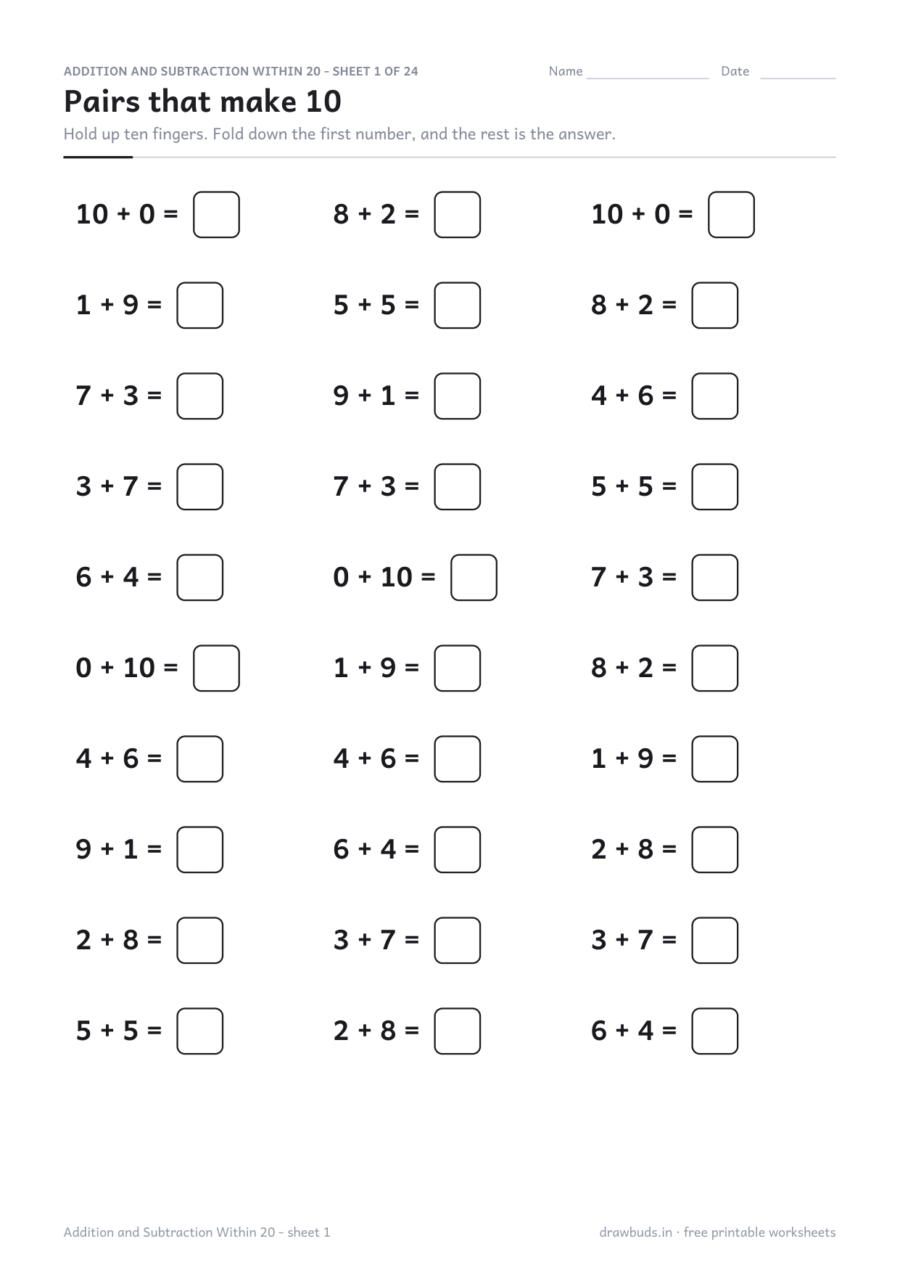
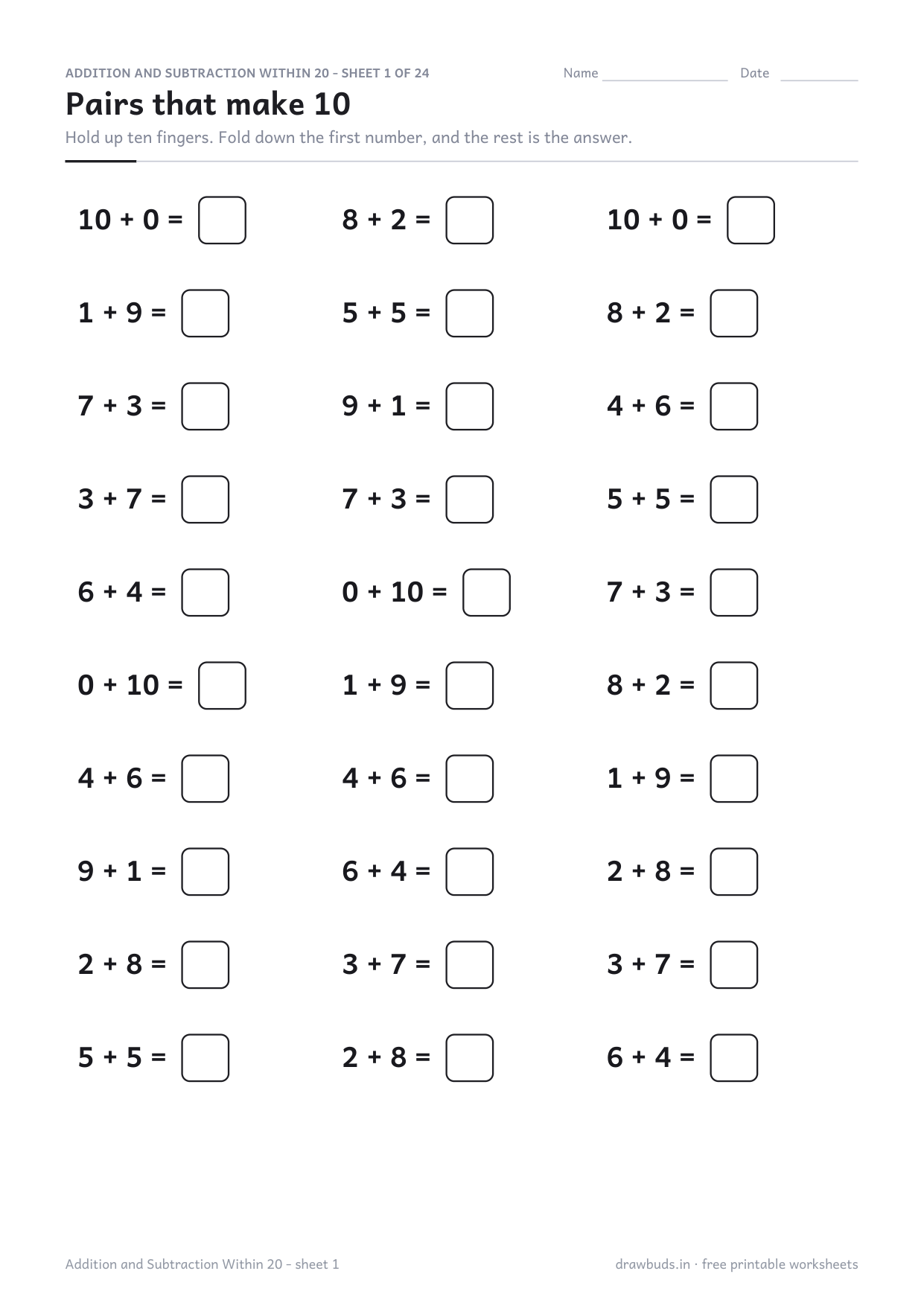
These addition and subtraction within 20 worksheets are built around one move: bridging through ten. 9 + 6 is hard if it is counted and easy if the 6 is split into 1 and 5, because 9 + 1 lands on a ten and 10 + 5 needs no work at all. Sheets 1 and 2 drill the pairs that make 10 for exactly that reason, and everything after them uses it.
What is in the 28 pages
- Sheets 1-2: the pairs that make 10, then the same pairs as missing numbers.
- Sheets 3-4: doubles and near doubles.
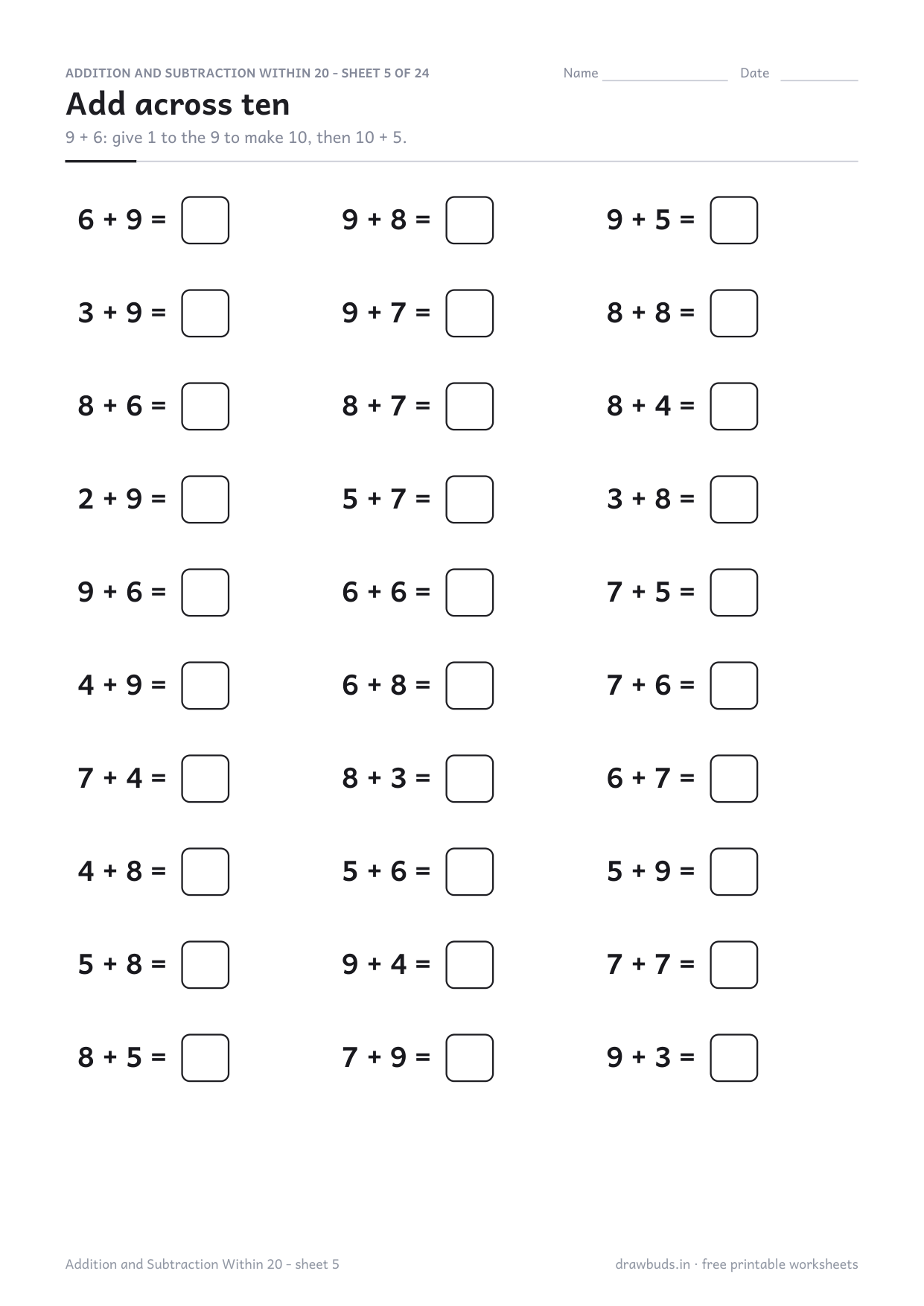
- Sheets 5-8: add across ten, where every sum has to bridge.
- Sheets 9-12: take away across ten.
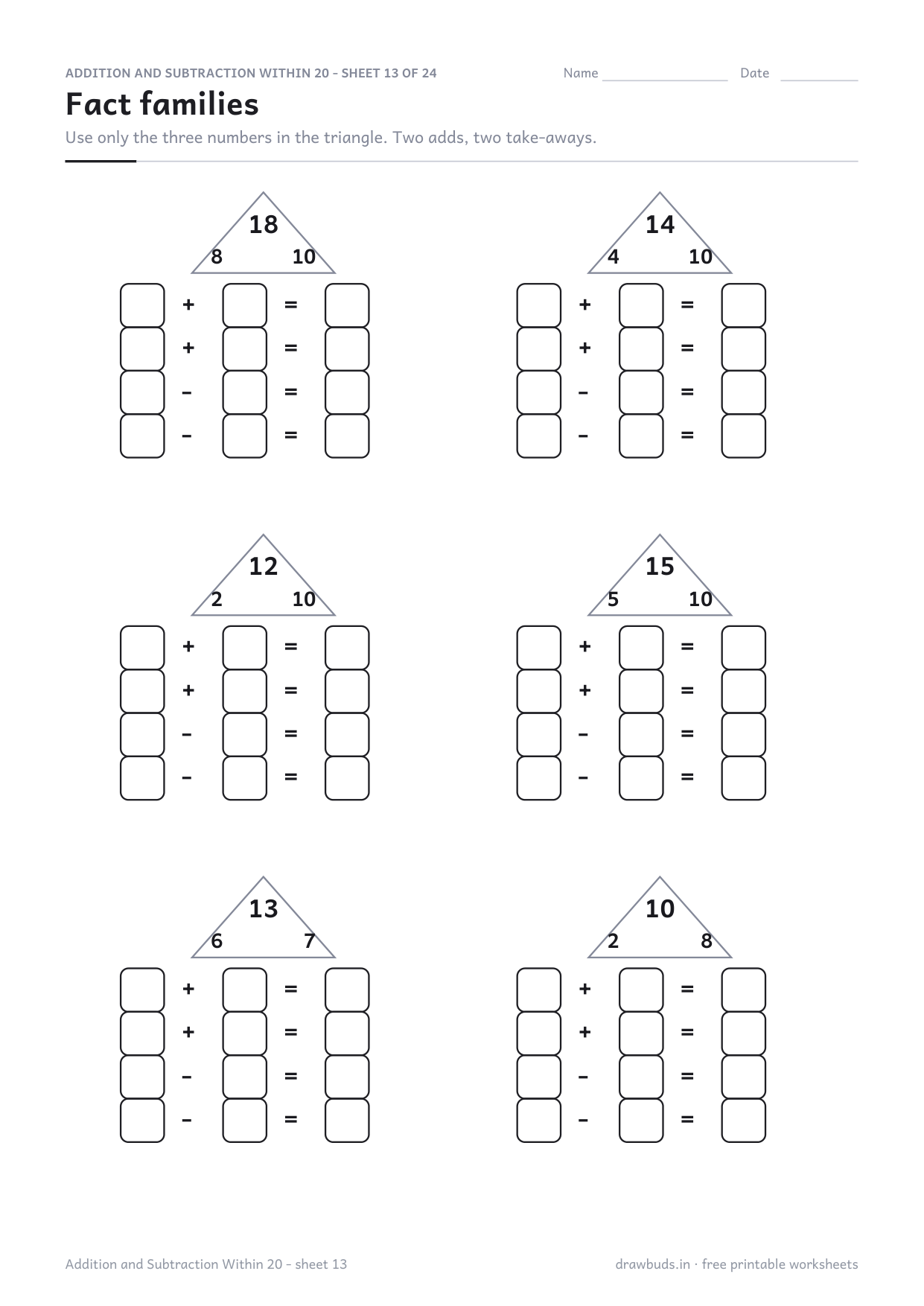
- Sheets 13-16: fact families, three numbers making two additions and two subtractions.
- Sheets 17-20: missing numbers.
- Sheets 21-24: mixed review to 20.
- Last three pages: every answer, sheet by sheet.
Why making 10 comes before anything else
A child who knows every pair to ten without thinking has the whole book. A child who does not will count on fingers through all 24 sheets, get the right answers, and learn nothing that transfers. Two sheets on the pairs looks thin on a 24-sheet book, and it is the part to repeat if anything is shaky. Printing sheet 1 twice is a better use of paper than moving on.
Doubles are a shortcut, not a separate topic
Sheets 3 and 4 put doubles next to near doubles on purpose. 7 + 7 is usually known by heart, so 7 + 8 is that answer and one more. The sheet pairs them so the child sees the relationship instead of treating 7 + 8 as a fresh fact to memorize.
Fact families, and what they fix
Sheets 13-16 give three numbers and ask for two additions and two subtractions from them. This is where subtraction stops being a separate skill. A child who sees that 6, 8 and 14 make one family answers 14 – 6 by remembering 6 + 8, which is far more reliable than counting backwards, and it is the groundwork for the missing-number sheets that follow.
Class 1, class 2, or grade 1
Indian schools cover sums within 20 across class 1 and class 2. US schools do it in grade 1 into grade 2, England in year 1 and year 2. If sums within 10 are not yet secure, addition within 10 worksheets and subtraction within 10 worksheets come first, and number bonds to 10 worksheets is the book that makes the bridging work.
Printing this one correctly
In your printer dialog set Scale to 100% or Actual size, not Fit to page. Fit to page shrinks the tracing letters and they stop matching the size a child's hand is learning.
Plain paper is fine for crayons and pencils. If your child uses felt pens, 100 gsm paper stops the ink bleeding to the next sheet.