Counting Money Worksheets: Dollars and Cents
Counting money worksheets: pennies, nickels, dimes and quarters, mixed coins to a dollar, bills, making amounts and change, with answers. Free PDF.
- Pages
- 20
- Ages
- 6-8
- Paper size
- A4 and US Letter
- Black ink only
Same worksheets, two paper sizes. Free to print at home, at school, and in a classroom of thirty.
18 sheets: pennies, nickels, dimes, quarters, mixed coins to a dollar, bills, change, a shop, answers
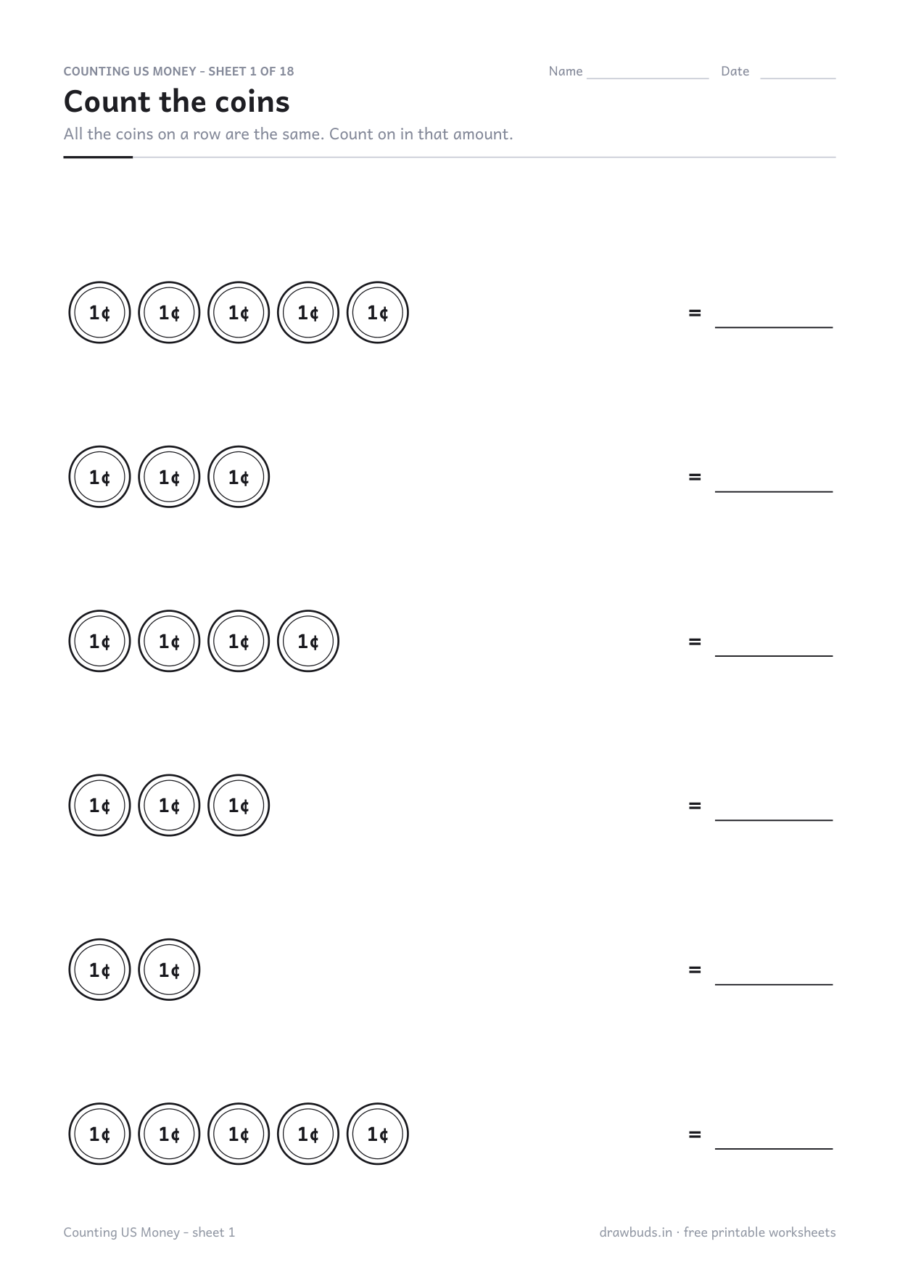
These counting money worksheets have to deal with something the rupee never asks of a child: US coins are not sized by what they are worth. A dime is smaller than a nickel and worth twice as much, and the names carry no number at all. A child cannot reason their way to the value of a quarter, so sheets 1 to 4 take one coin at a time until each one is known on sight.
What is in the 20 pages
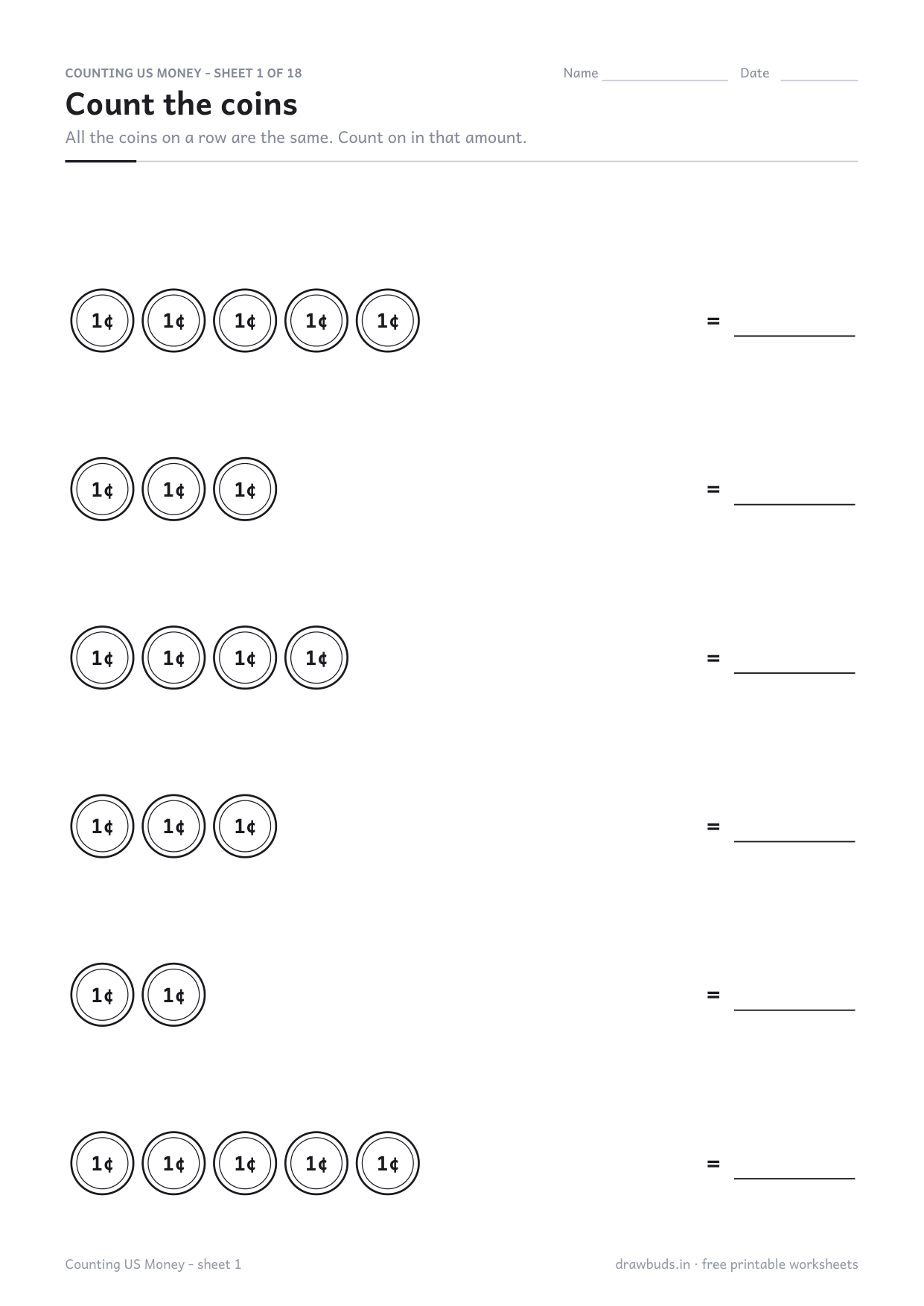
- Sheets 1-4: one kind of coin at a time, counted on.
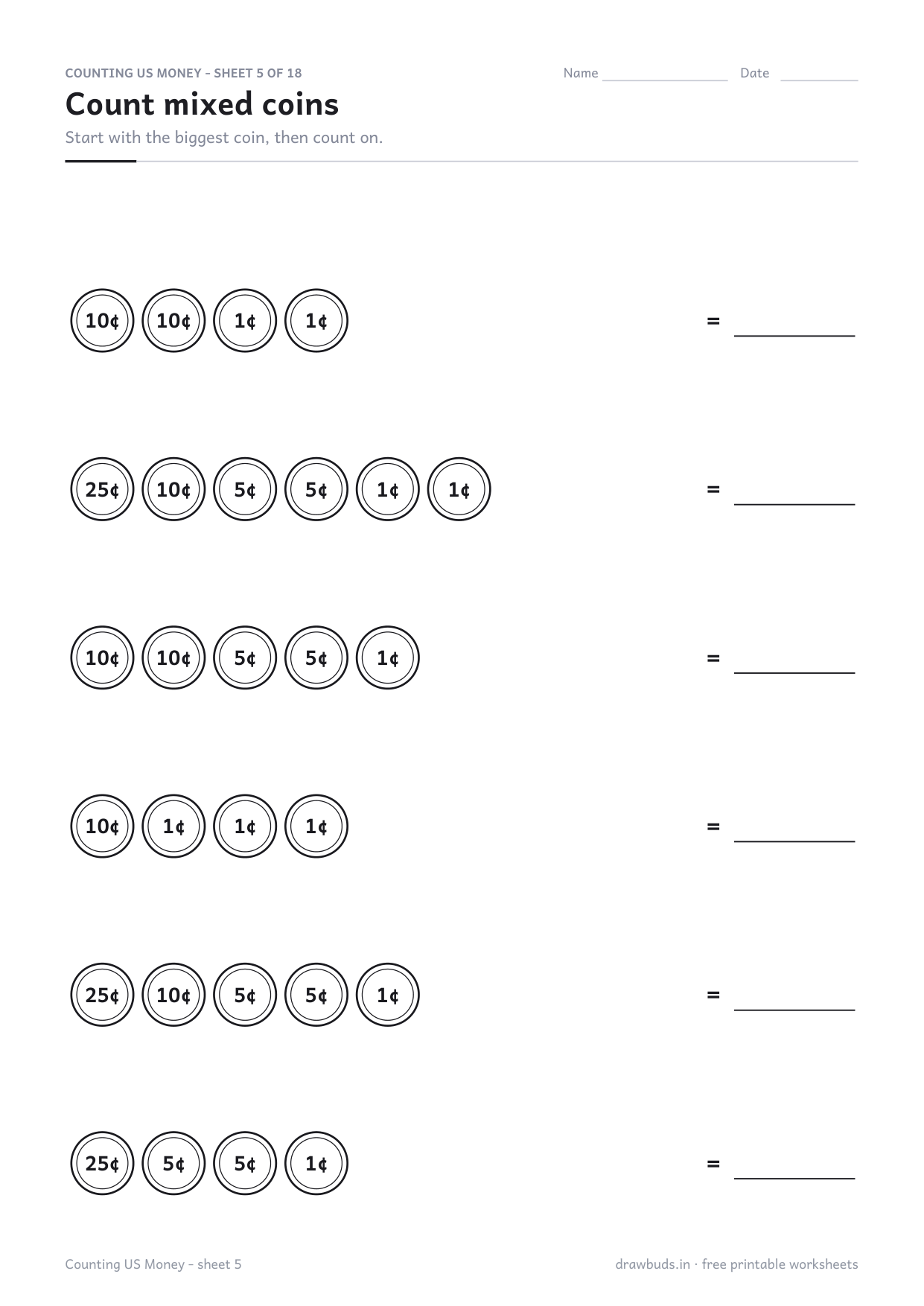
- Sheets 5-8: mixed coins up to a dollar.
- Sheets 9-10: count the bills.
- Sheets 11-12: bills and coins together.
- Sheets 13-14: make a given amount.
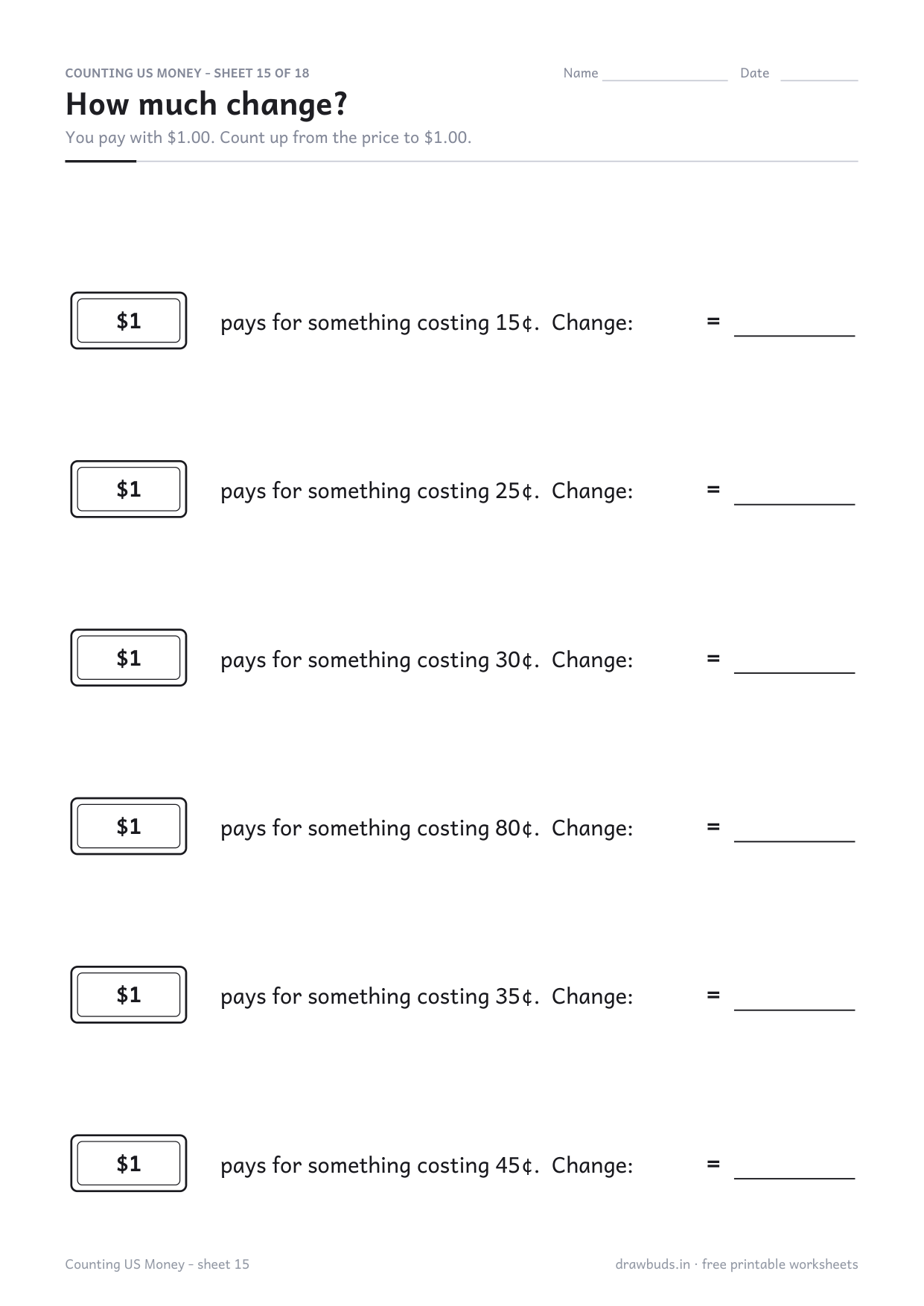
- Sheets 15-16: how much change.
- Sheets 17-18: at the shop.
- Last page: every answer, sheet by sheet.
Quarters first, then count on
On the mixed sheets the habit is to start with the quarters, then the dimes, then nickels, then pennies, and count on from the biggest. The alternative, counting whatever is nearest first, means switching between counting in 25s, 10s, 5s and 1s in no order, and that is where the mistakes come from rather than from the adding.
Counting on in fives and tens is the real skill
Three dimes and two nickels is 10, 20, 30, 35, 40. A child who can skip count in fives and tens finds this easy and a child who cannot will count forty individual cents. If the mixed sheets are slow, the problem is not money, and skip counting by 2, 5 and 10 is the book to fix it with.
Change by counting up
Sheets 15 and 16 count up from the price to the amount handed over rather than subtracting. An item at 68 cents paid with a dollar goes 70, 75, 100, which is two pennies, a nickel and a quarter. No borrowing across a zero, which is the step that makes written subtraction hard at this age.
Grade 1 and grade 2
US schools name the coins in grade 1 and count mixed amounts and change in grade 2. These sheets stop at a dollar on the coin pages so the totals stay inside two digits. For the rupee version of the same eighteen sheets, see counting Indian money worksheets, and the arithmetic underneath is in addition and subtraction within 20.
Printing this one correctly
In your printer dialog set Scale to 100% or Actual size, not Fit to page. Fit to page shrinks the tracing letters and they stop matching the size a child's hand is learning.
Plain paper is fine for crayons and pencils. If your child uses felt pens, 100 gsm paper stops the ink bleeding to the next sheet.