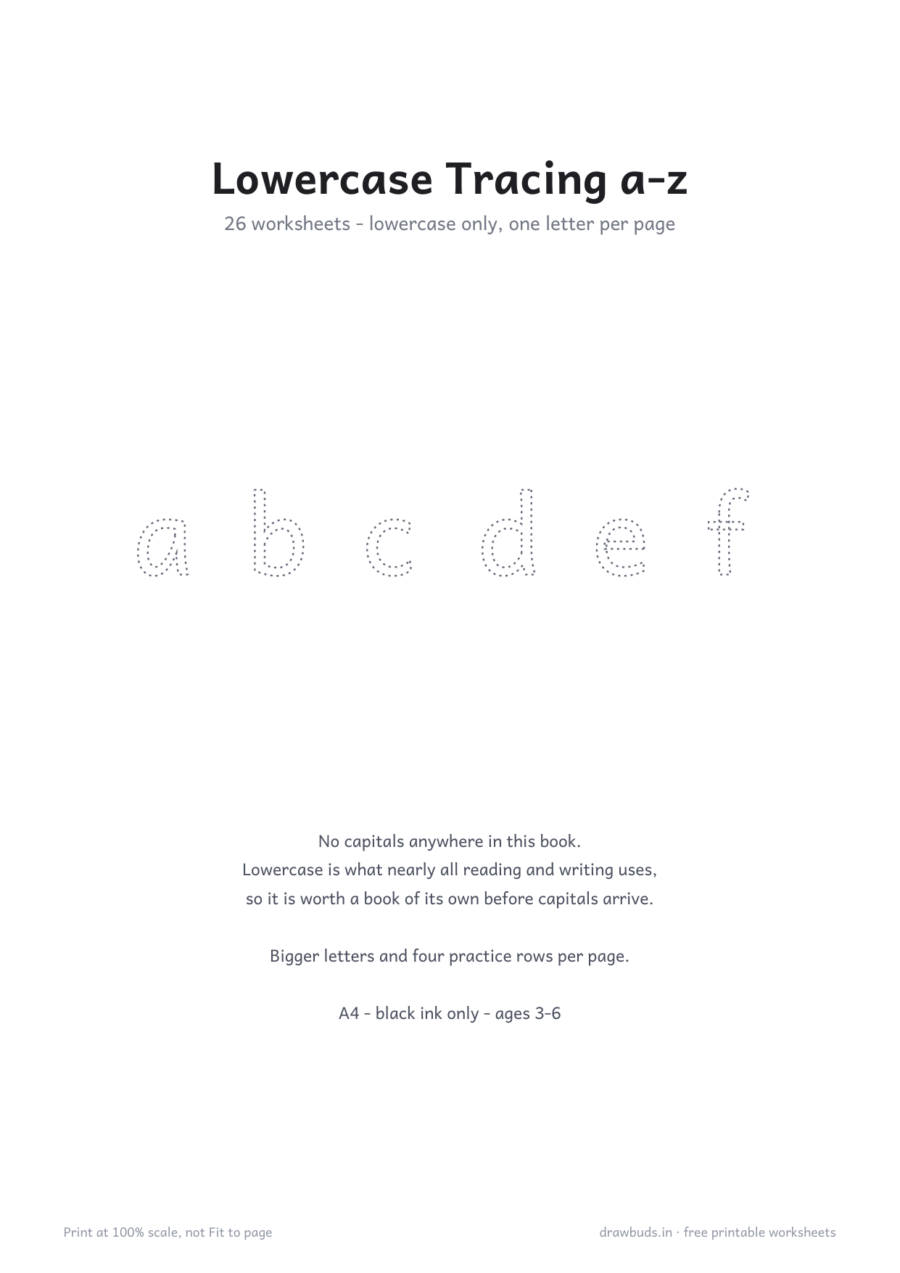
Lowercase Letter Tracing a-z
27 printable pages of lowercase letters only, with five practice rows per page. Lowercase is what almost all reading and writing uses, so it is worth a book of its own.
- Pages
- 27
- Ages
- 3-6
- Paper size
- A4
- Black ink only
Free to print at home, at school, and in a classroom of thirty.
Lowercase only, five practice rows per page
Nearly every alphabet worksheet teaches capitals first, because capitals are easier to draw. Then the child meets a book, where about 95% of the letters are lowercase, and has to start again. This book skips the detour: there is not a single capital letter in it.
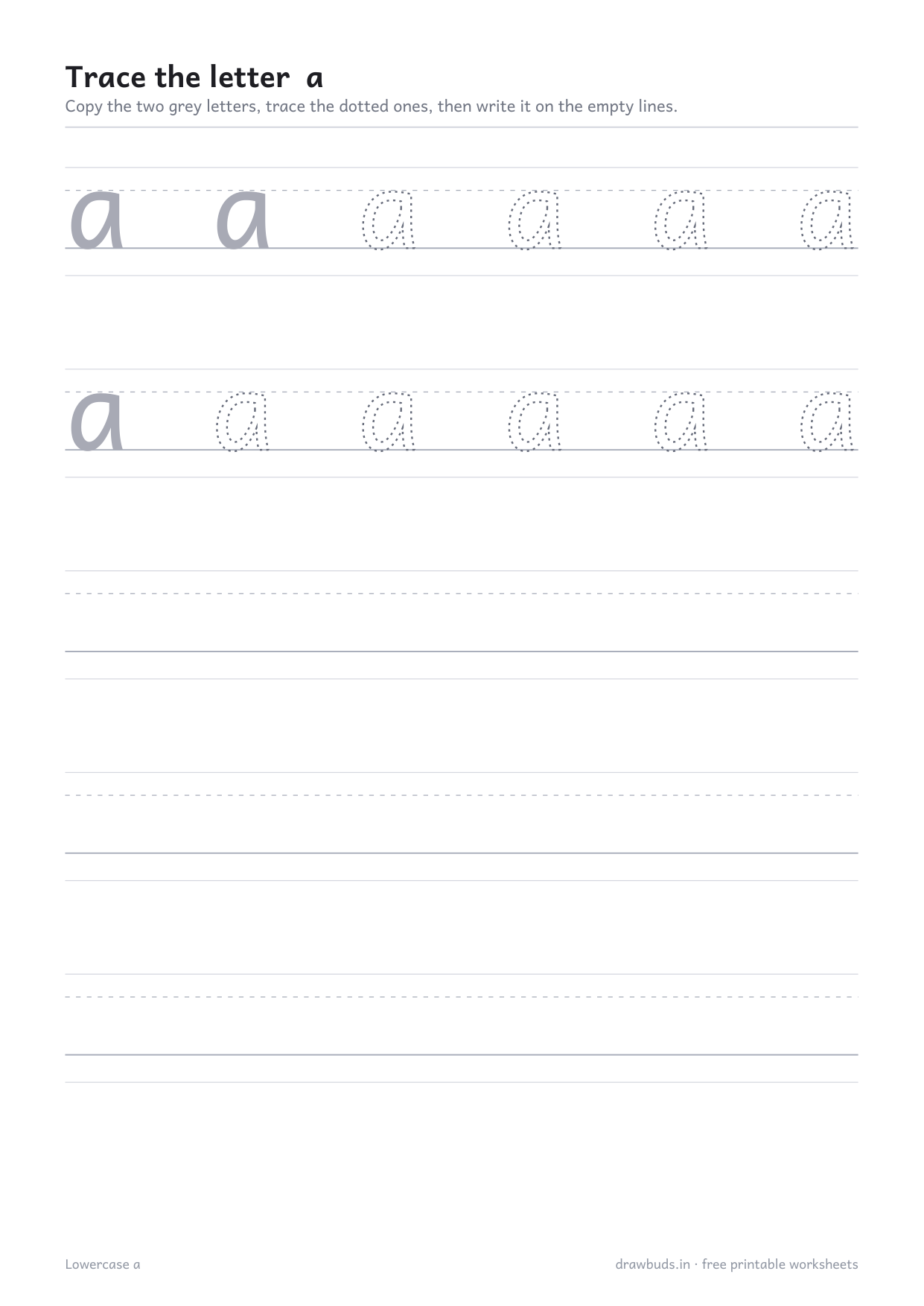
What is on each page
One letter, five rows of it. Two grey letters to copy and four dotted ones to trace on the first row, one grey and five dotted on the second, then three empty ruled rows. The letters are larger than in the A-Z alphabet book because a lowercase a at capital size is a much smaller shape to control than an A.
The letterforms
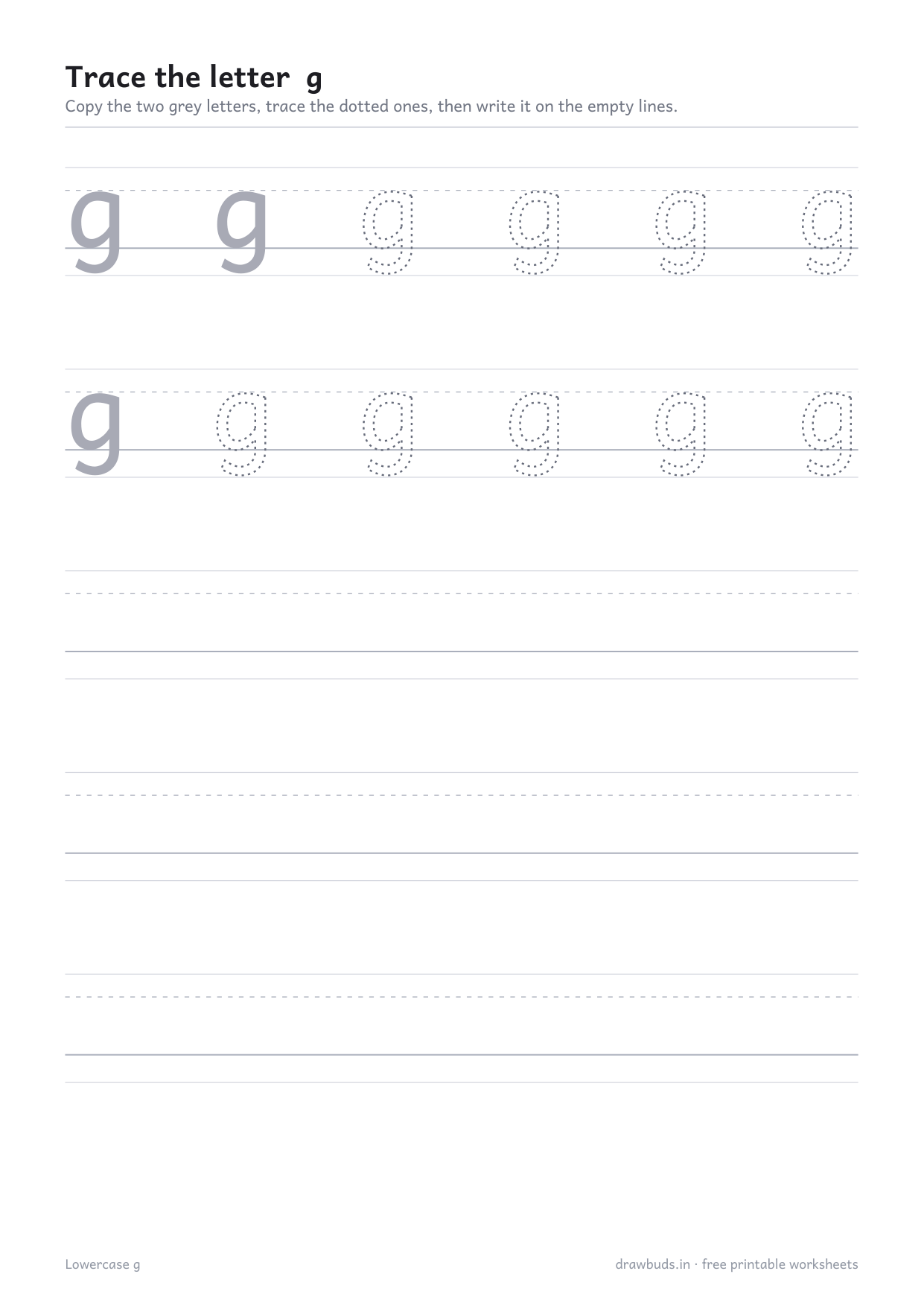
The book is set in Andika, a typeface SIL designed for beginning readers. Its a is a single-storey circle and stick, and its g has an open tail rather than a closed loop. Those are the shapes a child is taught to write. Most printable worksheets use an ordinary text font, whose two-storey a is a shape nobody writes by hand and every child then has to unlearn.
The four hard letters
b and d are mirror images, and so are p and q. Working through the alphabet in order puts b and d twenty-four pages apart, which is deliberate — practising them side by side is what plants the confusion in the first place. If a child already reverses them, do the b page for a week before going anywhere near d.
Where the letters sit
The four-line rule is solid at the baseline, dashed at the x-height, and faint at the ascender and descender lines. Lowercase is the reason the rule has four lines: o stops at the dashed line, h goes up to the faint one, g drops below the solid one. A single baseline cannot teach any of that.
What comes next
When single letters are steady, CVC Words Tracing joins three of them into words a child can actually read.
Printing this one correctly
In your printer dialog set Scale to 100% or Actual size, not Fit to page. Fit to page shrinks the tracing letters and they stop matching the size a child's hand is learning.
Plain paper is fine for crayons and pencils. If your child uses felt pens, 100 gsm paper stops the ink bleeding to the next sheet.