Alphabet Tracing Worksheets A-Z
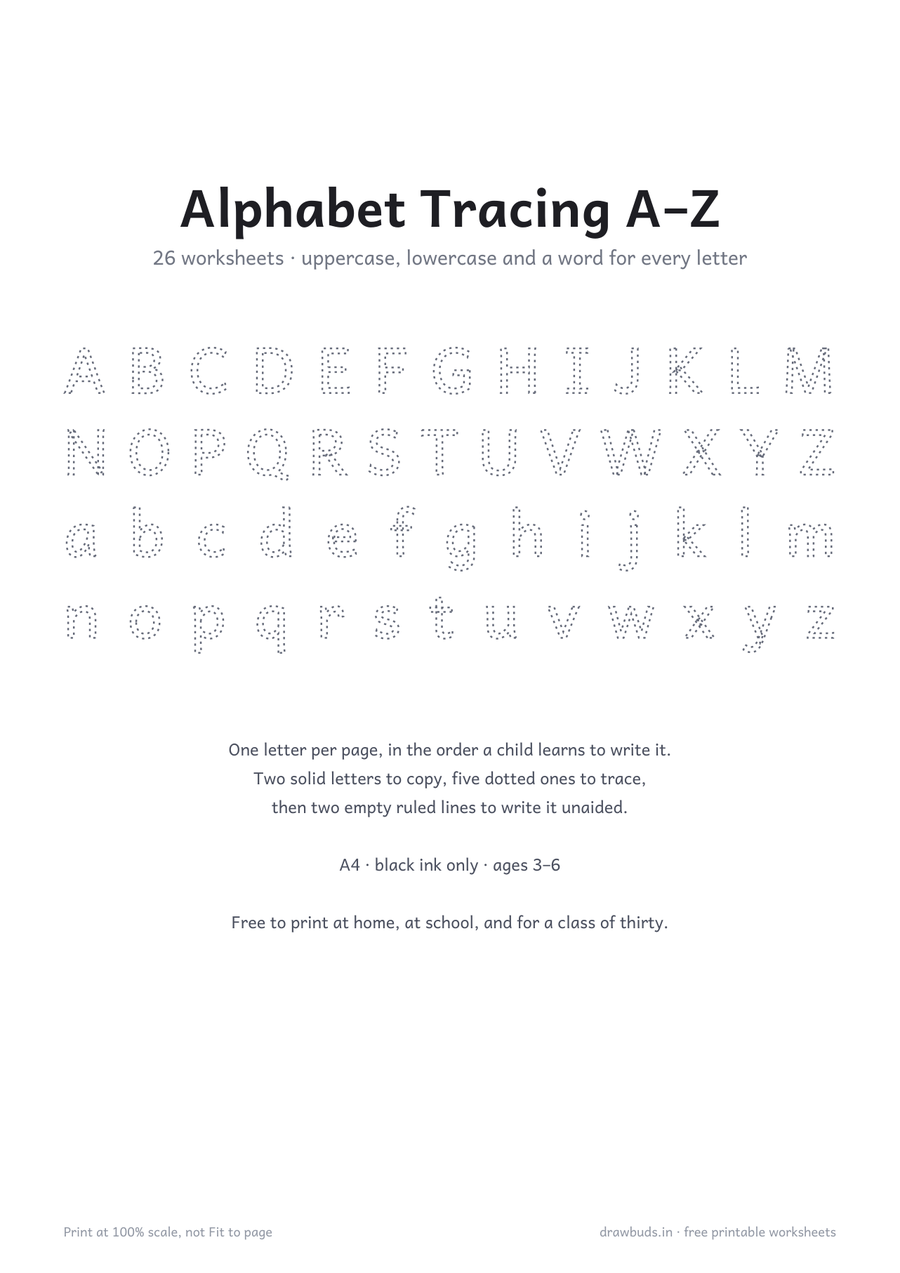
26 printable pages, one per letter. Capitals, lowercase and a word to trace, on four-line handwriting rules — then blank lines to write it unaided.
- Pages
- 27
- Ages
- 3-6
- Paper size
- A4
- Black ink only
Free to print at home, at school, and in a classroom of thirty.
Four-line handwriting rules · dotted tracing letters · one letter per page
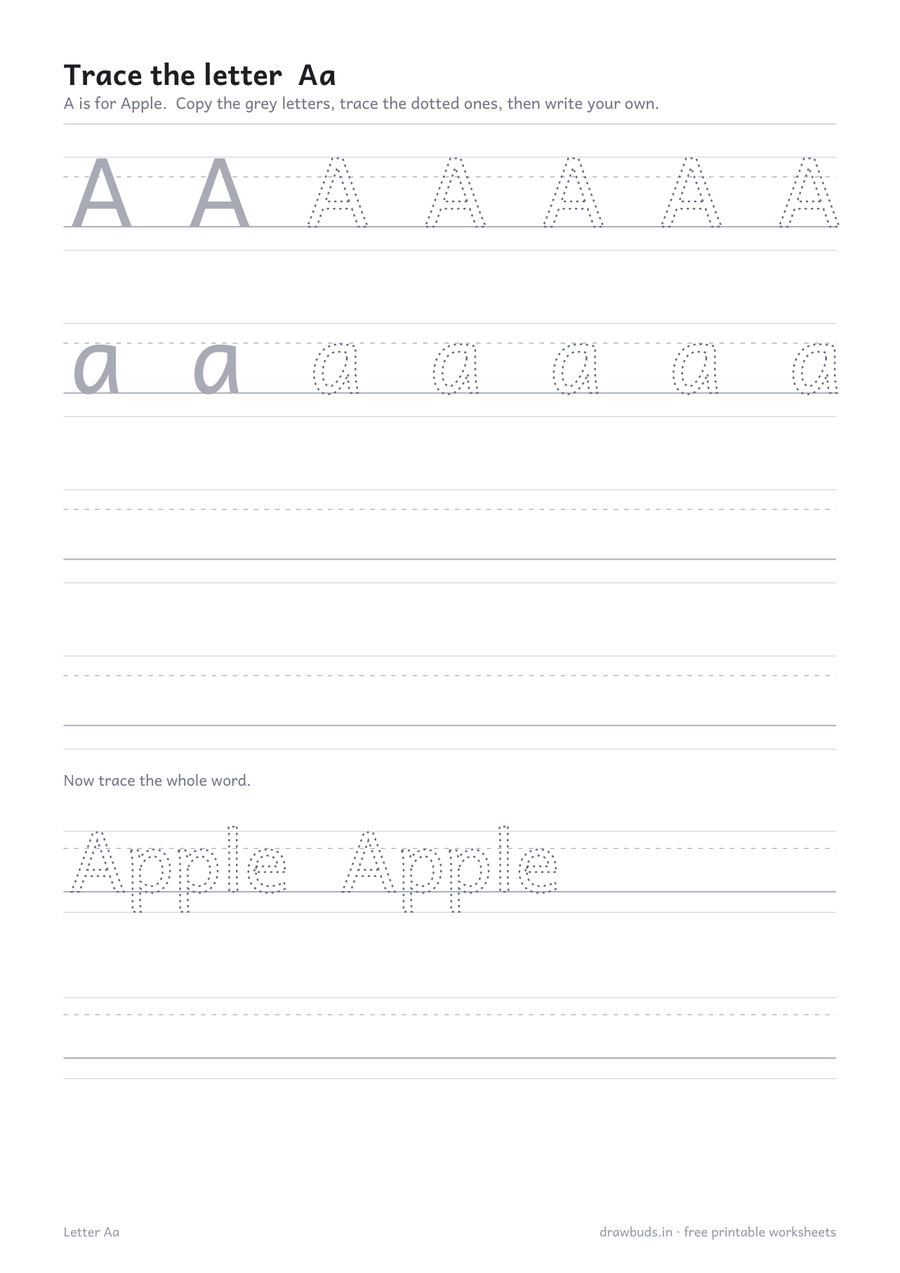
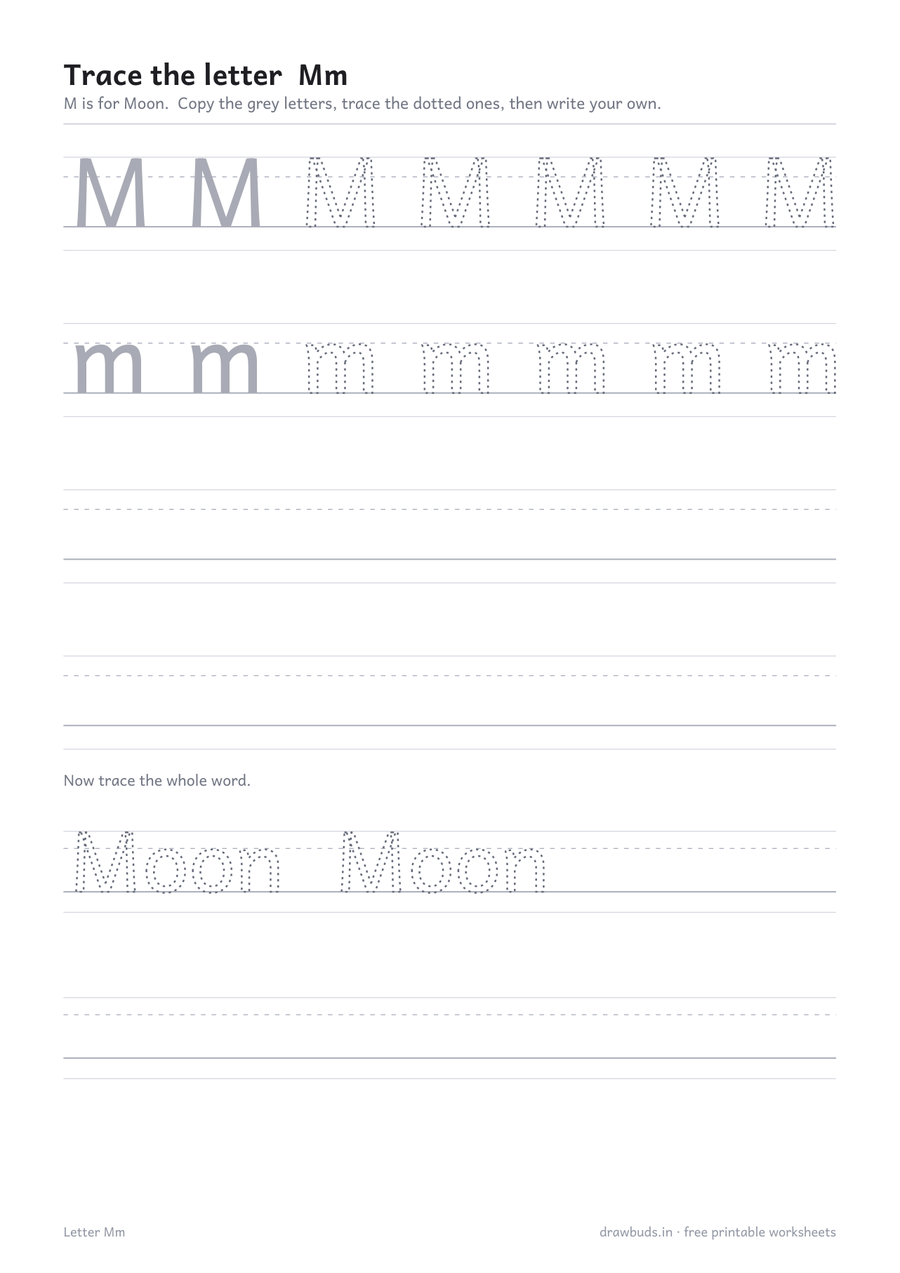
Every page in this book teaches one letter, and only one letter. The child copies two grey letters, traces five dotted ones, then writes the letter twice on empty ruled lines with no shape underneath. That last step is the one most tracing sheets leave out, and it is the step where tracing turns into writing.
What is on each page
- A capital row and a lowercase row. Both are on the four-line handwriting rule: solid baseline, dashed midline for the x-height, faint ascender and descender lines.
- Two empty ruled rows — the child writes the letter unaided.
- A word row. The letter is traced inside a real word (A is for Apple, B is for Ball), because an isolated letter shape is harder to remember than a letter that means something.
The words used, letter by letter
Apple, Ball, Cat, Dog, Egg, Fish, Goat, Hat, Ink, Jug, Kite, Leaf, Moon, Nest, Owl, Pen, Queen, Rain, Sun, Tree, Umbrella, Van, Web, Box, Yak, Zip. All are short, concrete and drawable, so the same list works as a first drawing prompt once the writing is done.
The letterforms
The book is set in Andika, a typeface SIL designed for beginning readers. Its a is a single-storey circle-and-stick and its g has an open tail — the shapes a child is actually taught to write by hand. Most printable worksheets use a standard text font, whose two-storey a is a shape no one writes and every child then has to unlearn.
How to work through it
One page a day, in alphabet order, is the usual pace at ages 3 to 4. If a child already knows some letters, do the letters in their own name first — a child will practise their own name long after they have lost patience with the letter Q.
Let them trace with a crayon or a thick pencil before a normal pencil. A thick barrel needs less grip strength, so the hand tires later and the shapes stay steadier.
Using it in a classroom
Print and copy it as many times as you need. There is no watermark across the working area and no per-copy limit; the only thing on the page besides the exercise is a single line of small grey text in the footer.
Printing this one correctly
In your printer dialog set Scale to 100% or Actual size, not Fit to page. Fit to page shrinks the tracing letters and they stop matching the size a child's hand is learning.
Plain paper is fine for crayons and pencils. If your child uses felt pens, 100 gsm paper stops the ink bleeding to the next sheet.