2 Digit Addition and Subtraction Worksheets
2 digit addition and subtraction worksheets: 144 mixed column sums, with and without regrouping, plus and minus on every sheet. Answers included. Free PDF.
- Pages
- 14
- Ages
- 6-8
- Paper size
- A4 and US Letter
- Black ink only
Same worksheets, two paper sizes. Free to print at home, at school, and in a classroom of thirty.
144 mixed column sums with T and O headings, regrouping and none, answers
These 2 digit addition and subtraction worksheets put both kinds of sum on the same sheet, six of each, in no set order. A child who has done a page of addition and then a page of subtraction never has to look at the sign, so a mixed test catches them out: 63 – 59 worked as an addition, or 28 + 69 with the ten never carried.
What is in the 14 pages
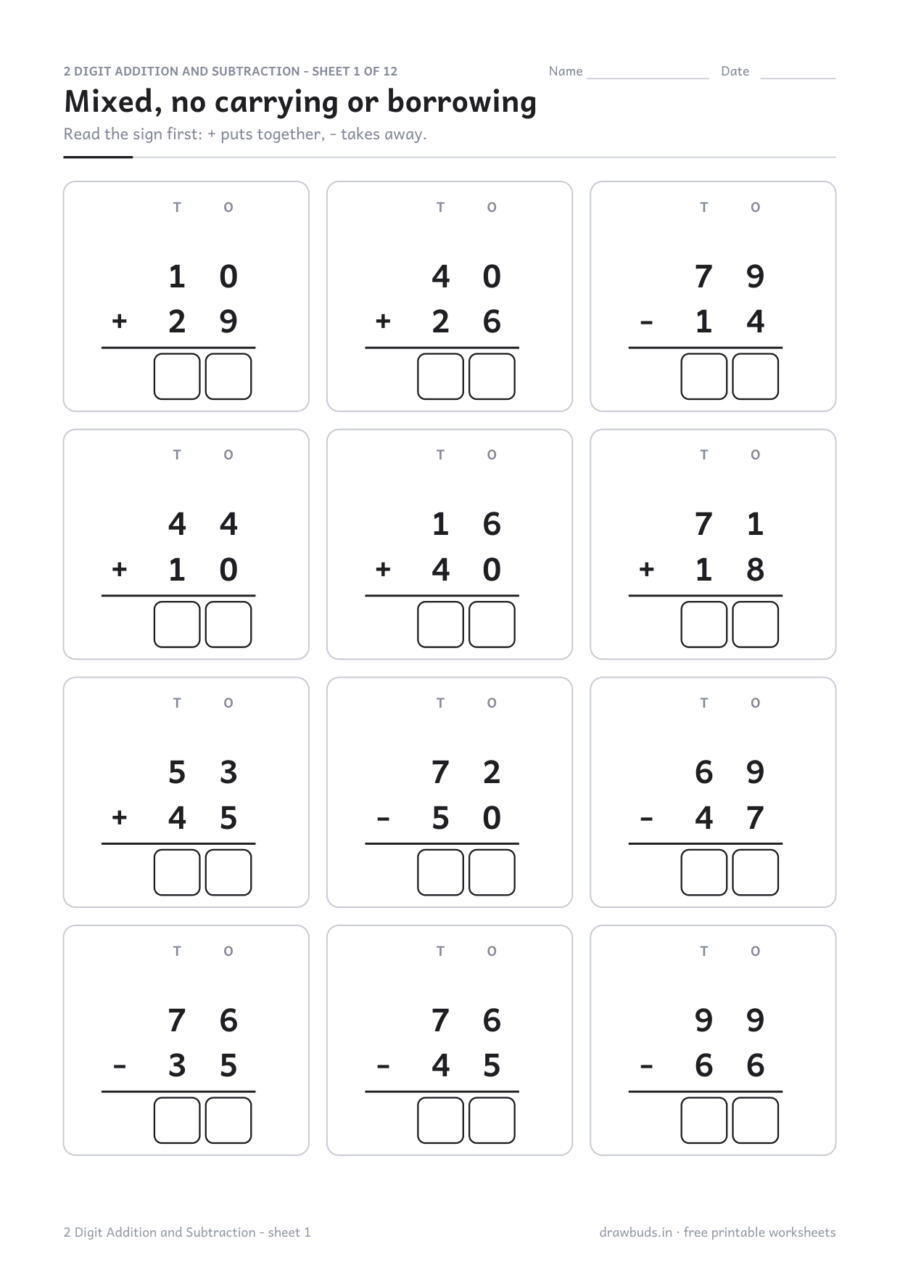
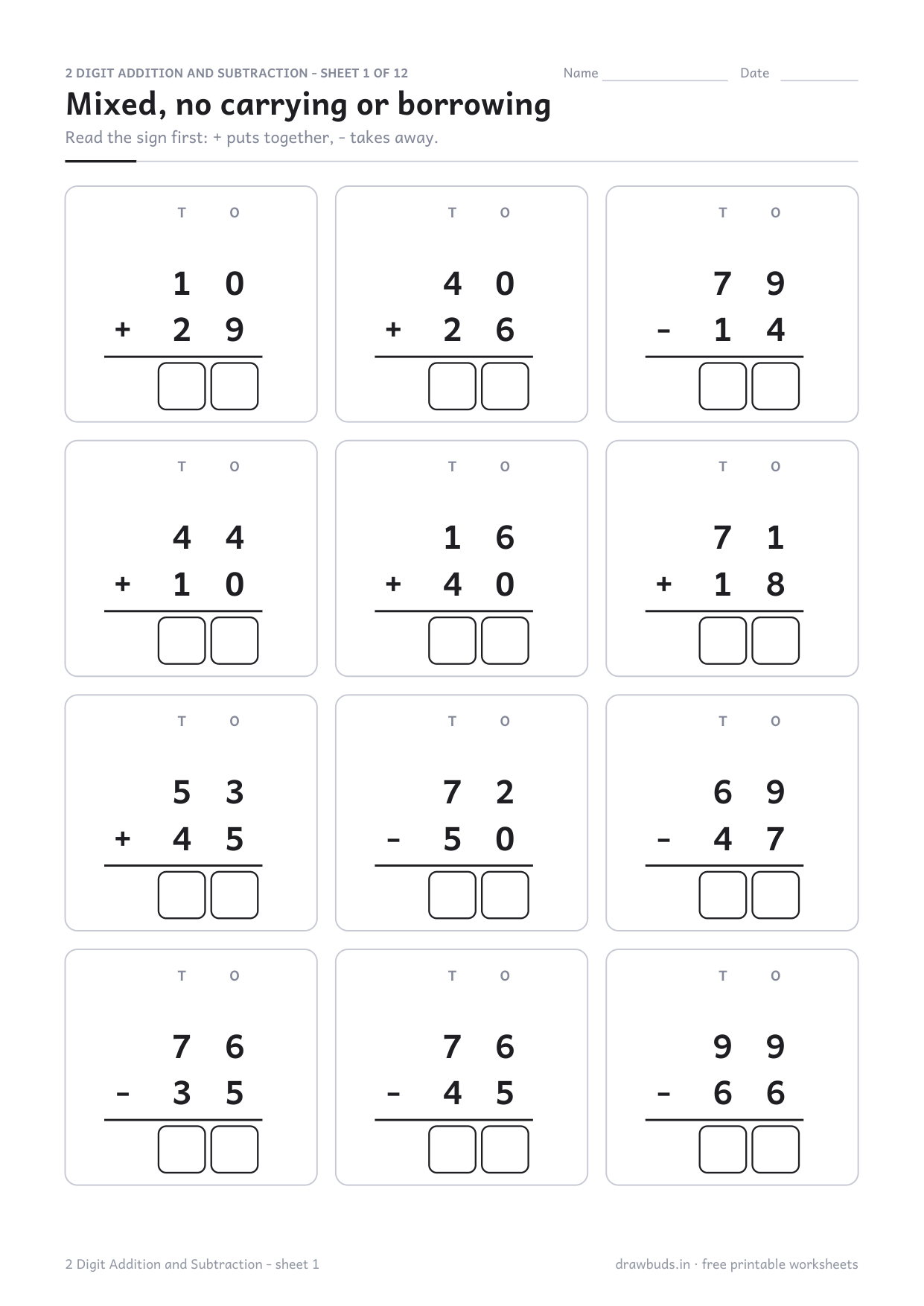
- Sheets 1-4: mixed sums with no carrying and no borrowing, such as 10 + 29 and 79 – 14.
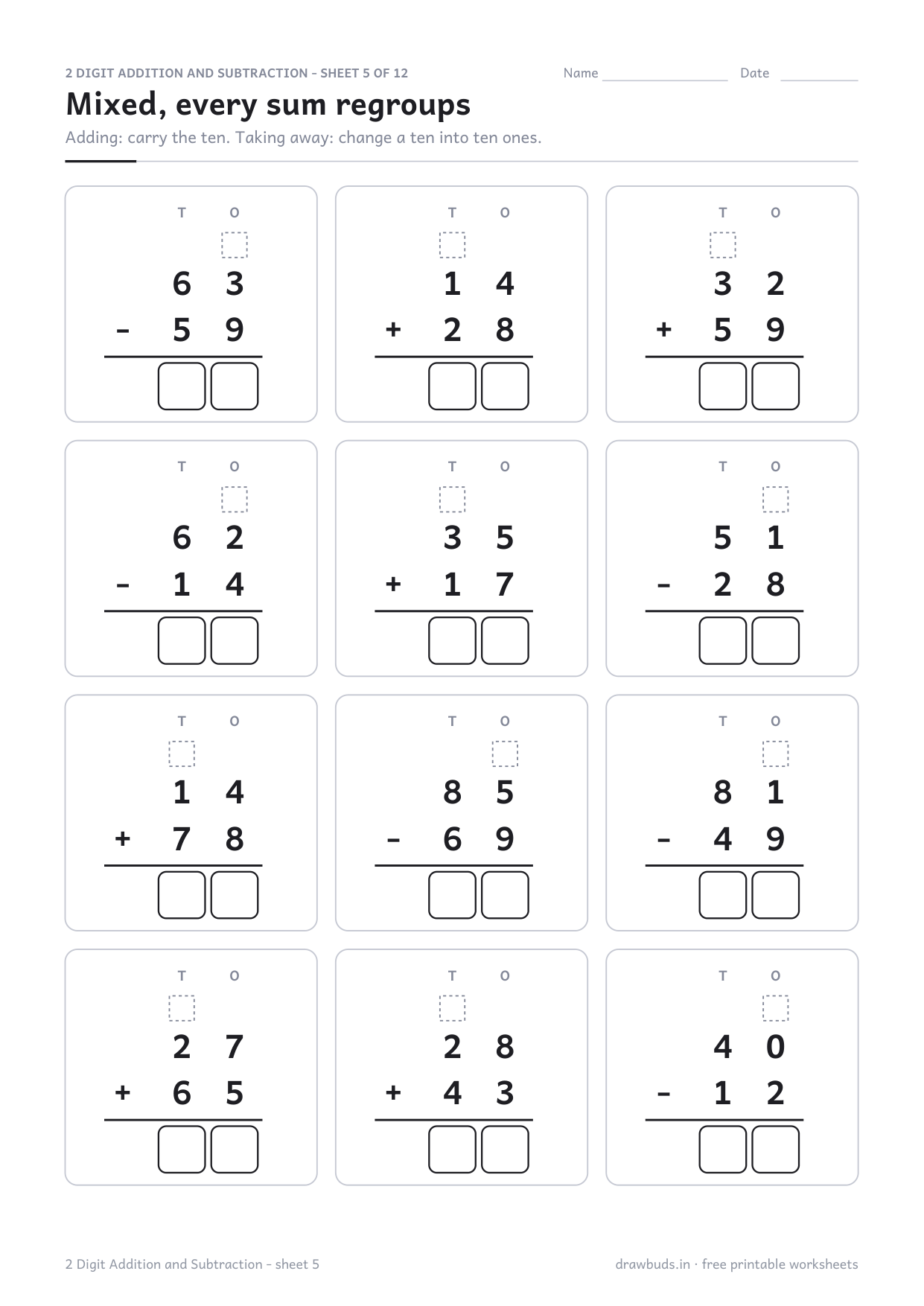
- Sheets 5-8: every sum regroups. Additions carry a ten (14 + 28) and subtractions change a ten into ten ones (63 – 59).
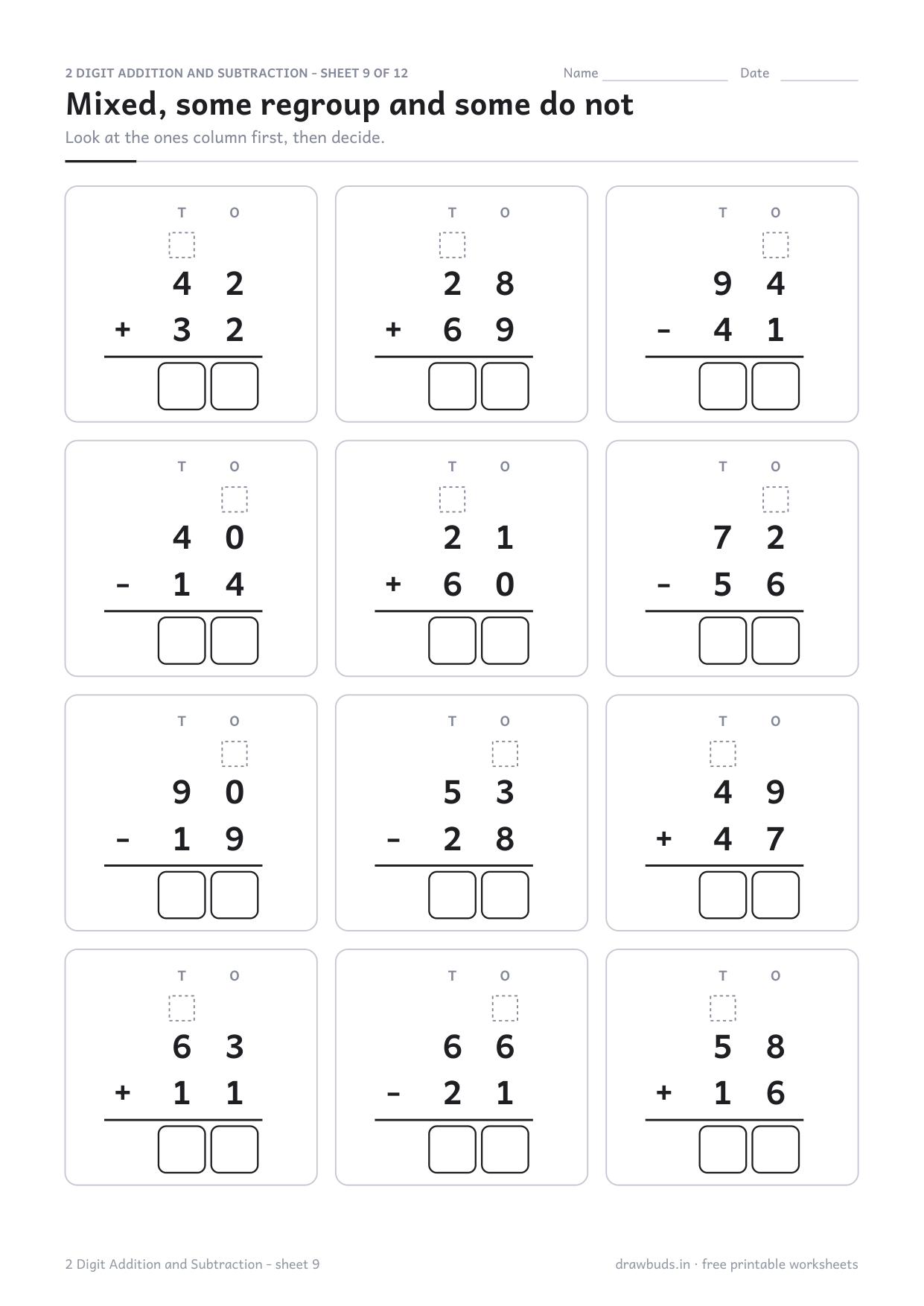
- Sheets 9-12: about half the sums regroup and half do not, so the child has to decide each time.
- Last page: every answer, sheet by sheet.
Twelve column sums a sheet, 144 in all, none repeated. Every number has two digits, every answer stays below 100, and no subtraction goes below zero.
Why the sign comes first
The tip at the top of sheet 1 is: read the sign first. On these sheets the sums are laid out exactly alike, two numbers under T and O headings and two answer boxes, so the plus or minus sign is the only clue to what to do. Ask your child to point at the sign and say “add” or “take away” before writing anything. Keep doing it until your child looks at the sign without being asked.
Carrying and borrowing on the same page
From sheet 5 each card has small dotted boxes above the columns. In an addition the box over the tens is where the carried ten goes: 14 + 28 makes 12 ones, so 2 is written in the ones answer and 1 in the box over the tens. In a subtraction the box is for the exchange: in 63 – 59 there are not enough ones to take 9 from 3, so one of the 6 tens becomes ten ones, the 6 is crossed out and 5 written above it, and 13 – 9 gives 4.
Both moves are called regrouping, and children often mix them up. On one sheet the difference is easy to point to: carrying adds a ten to the next column, borrowing takes one away from it.
The last four sheets: does this one regroup?
On sheets 9 to 12 the boxes are on every card, but only some sums need them. Sheet 9 opens with 42 + 32, which needs no carry, followed by 28 + 69, which does. The way to tell is to look at the ones column first. For an addition, if the two ones add up to 10 or more, carry. For a subtraction, if the top ones digit is smaller than the bottom one, borrow. Checking first saves the rubbing out that comes from finding the carry halfway through a sum.
Who it is for
The sheets suit children of about 6 to 8, usually in class 1 or class 2, who can already add and take away within 20 and know that 47 is 4 tens and 7 ones. If carrying or borrowing is still new, start with the single-skill books first: the 2 digit addition worksheets and the 2 digit subtraction worksheets teach each move on its own, and this book then mixes them. For place value practice, the tens and ones worksheets come before both.
Printing
Print at 100% scale, not Fit to page, so the answer boxes stay large enough for small handwriting. The book comes as an A4 PDF and a US Letter PDF with the same sheets. Black ink only.
Printing this one correctly
In your printer dialog set Scale to 100% or Actual size, not Fit to page. Fit to page shrinks the tracing letters and they stop matching the size a child's hand is learning.
Plain paper is fine for crayons and pencils. If your child uses felt pens, 100 gsm paper stops the ink bleeding to the next sheet.