Division Worksheets: Sharing and Remainders
Division worksheets: sharing pictures, equal groups, division facts in table order, missing numbers, remainders and word problems. Free PDF.
- Pages
- 27
- Ages
- 7-9
- Paper size
- A4 and US Letter
- Black ink only
Same worksheets, two paper sizes. Free to print at home, at school, and in a classroom of thirty.
Sharing pictures, equal groups, division facts, missing numbers, remainders, word problems, answers
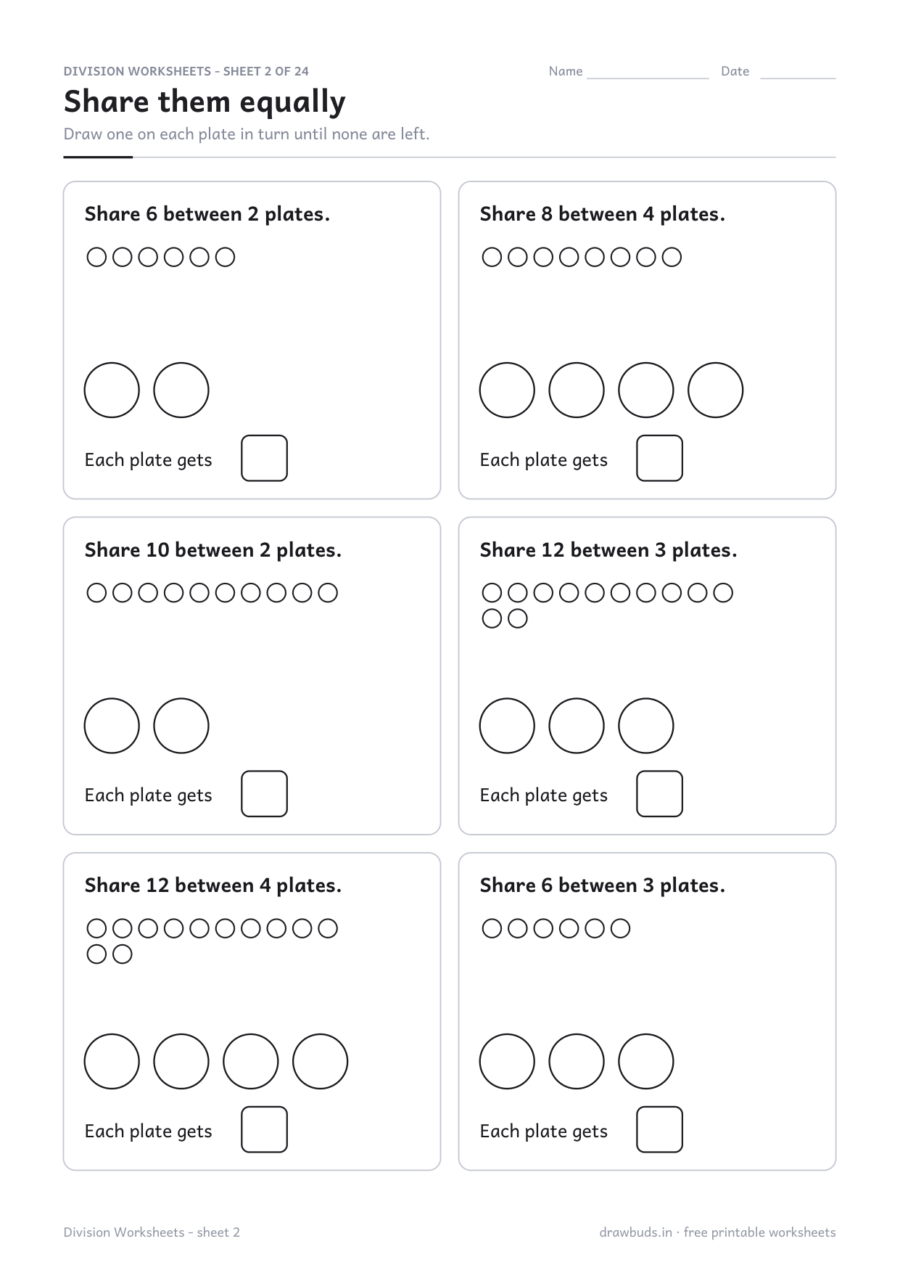
These division worksheets start with plates to draw on rather than a division sign, because sharing out twelve counters between three plates is a thing a child can do a year before they can read 12 / 3. The symbol arrives on sheet 9, by which point the picture it stands for is already familiar.
What is in the 27 pages
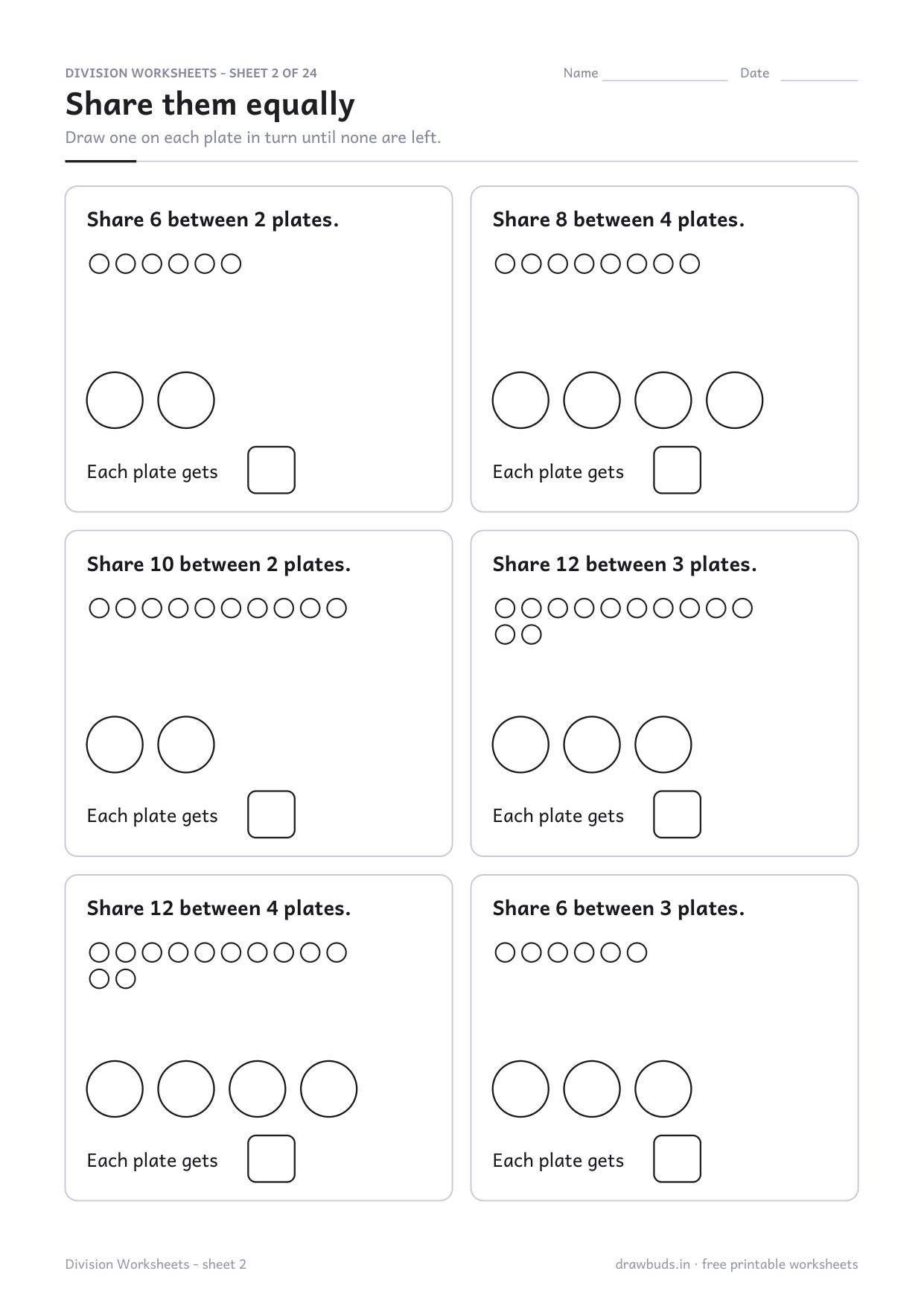
- Sheets 1-4: share them equally, drawing the objects onto the plates.
- Sheets 5-8: ring equal groups, the other way of seeing the same thing.
- Sheets 9-12: turn it round, a known times-table fact written as a division.
- Sheets 13-16: division facts in table groups, 2, 5 and 10, then 3 and 4, then 6 and 8, then 7 and 9.
- Sheets 17-18: find the missing number.
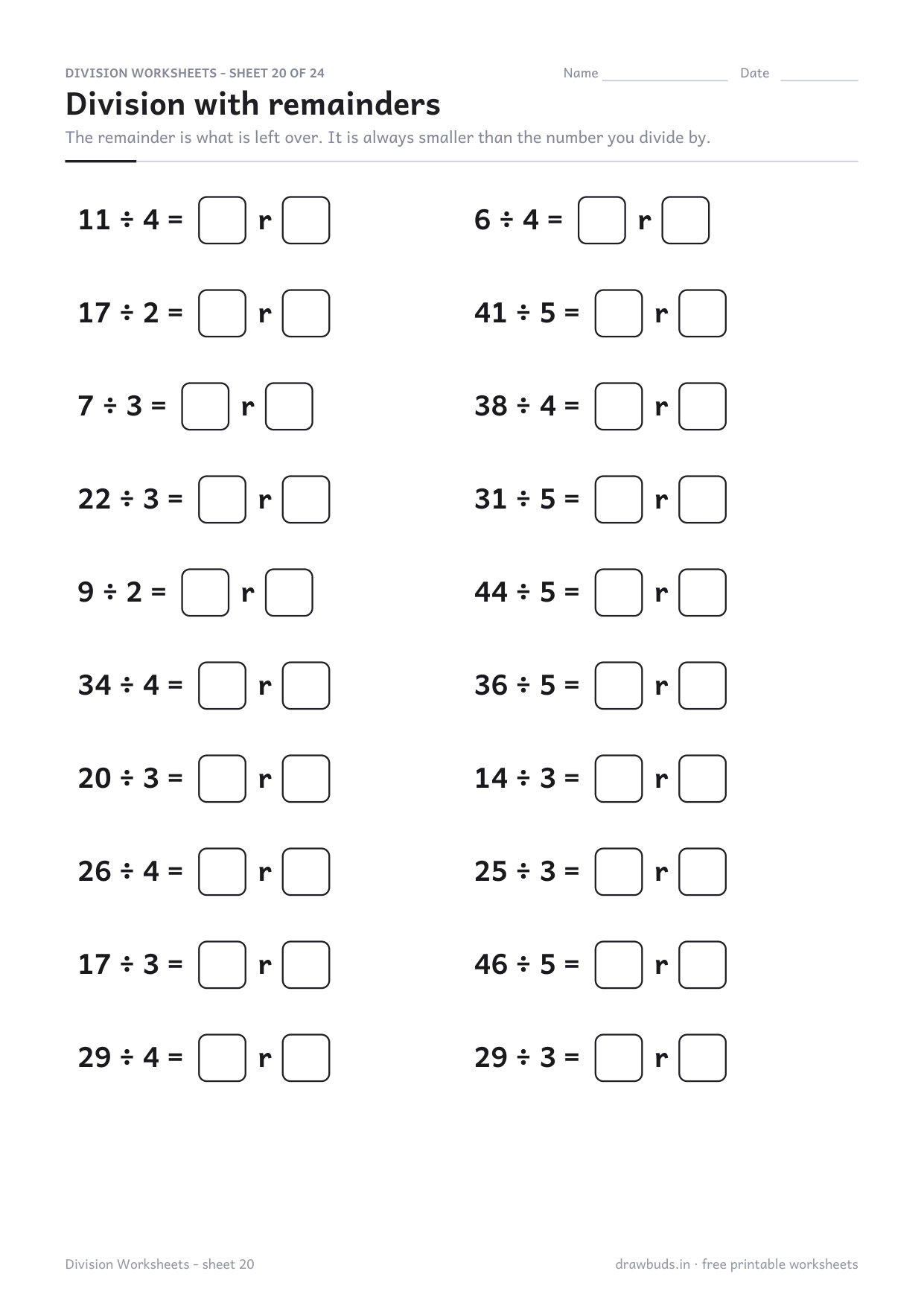
- Sheets 19-22: division with remainders.
- Sheets 23-24: word problems.
- Last two pages: every answer, sheet by sheet.
Sharing and grouping are not the same question
Sheets 1-4 share twelve things between three plates and ask how many each plate gets. Sheets 5-8 take the same twelve things and ring groups of three, asking how many groups there are. Both are 12 / 3 and both give 4, but a child solves them differently, and the second one is the one that leads to remainders. Most sets teach only the sharing picture, which is why a remainder later looks like a mistake rather than a leftover.

Turn it round, before division facts
Sheets 9-12 take a multiplication a child already knows and write it backwards. If 4 x 6 = 24 is secure, then 24 / 6 is not new information, it is the same fact read from the other end. Doing this explicitly for four sheets saves a great deal of guessing later. It also means this book depends on the tables, so if those are shaky, multiplication tables 1 to 10 is the book to finish first.
The remainder is always smaller than the divisor
That one sentence is what sheets 19-22 exist to install. A child dividing 17 by 5 who answers 2 remainder 7 has not made an arithmetic error, they have stopped one step early, and no amount of re-checking the division will show them why. Asking whether the remainder is smaller than the number being divided by catches it every time, and four sheets is enough for the question to become a habit.
Class 2, class 3, or grade 3
Indian schools introduce division in class 2 as sharing and formalise it in class 3. US schools meet it in grade 3. Long division is not in this book and should not be: it is a written method that assumes everything here is already automatic. Word problems close the set on sheets 23 and 24, because deciding that a question is a division at all is a separate skill from doing one.
Printing this one correctly
In your printer dialog set Scale to 100% or Actual size, not Fit to page. Fit to page shrinks the tracing letters and they stop matching the size a child's hand is learning.
Plain paper is fine for crayons and pencils. If your child uses felt pens, 100 gsm paper stops the ink bleeding to the next sheet.