Before, After and Between Numbers Worksheets
Before, after and between numbers worksheets: 192 boxes to fill within 20, 50 and 100, with the tricky tens like 39 and 40. Answers included. Free PDF.
- Pages
- 15
- Ages
- 4-7
- Paper size
- A4 and US Letter
- Black ink only
Same worksheets, two paper sizes. Free to print at home, at school, and in a classroom of thirty.
12 sheets, 192 items: the number before, after and between, within 20, 50 and 100, answers
These before, after and between numbers worksheets ask one small question 192 times: which number comes just before this one, just after it, or in the gap between two. Each item is a row of boxes with one left empty, so a child writes a single number and moves on.
What is in the 15 pages
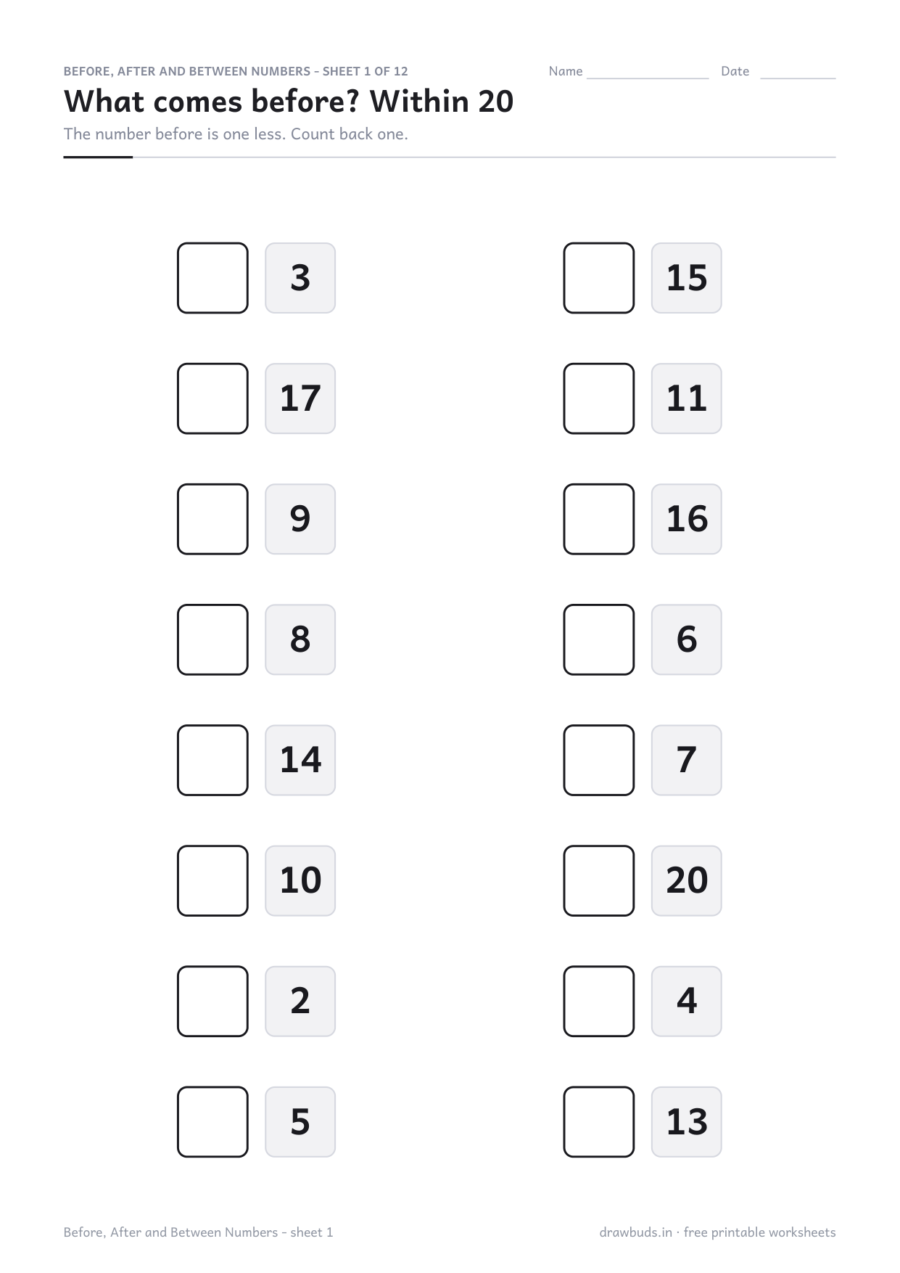
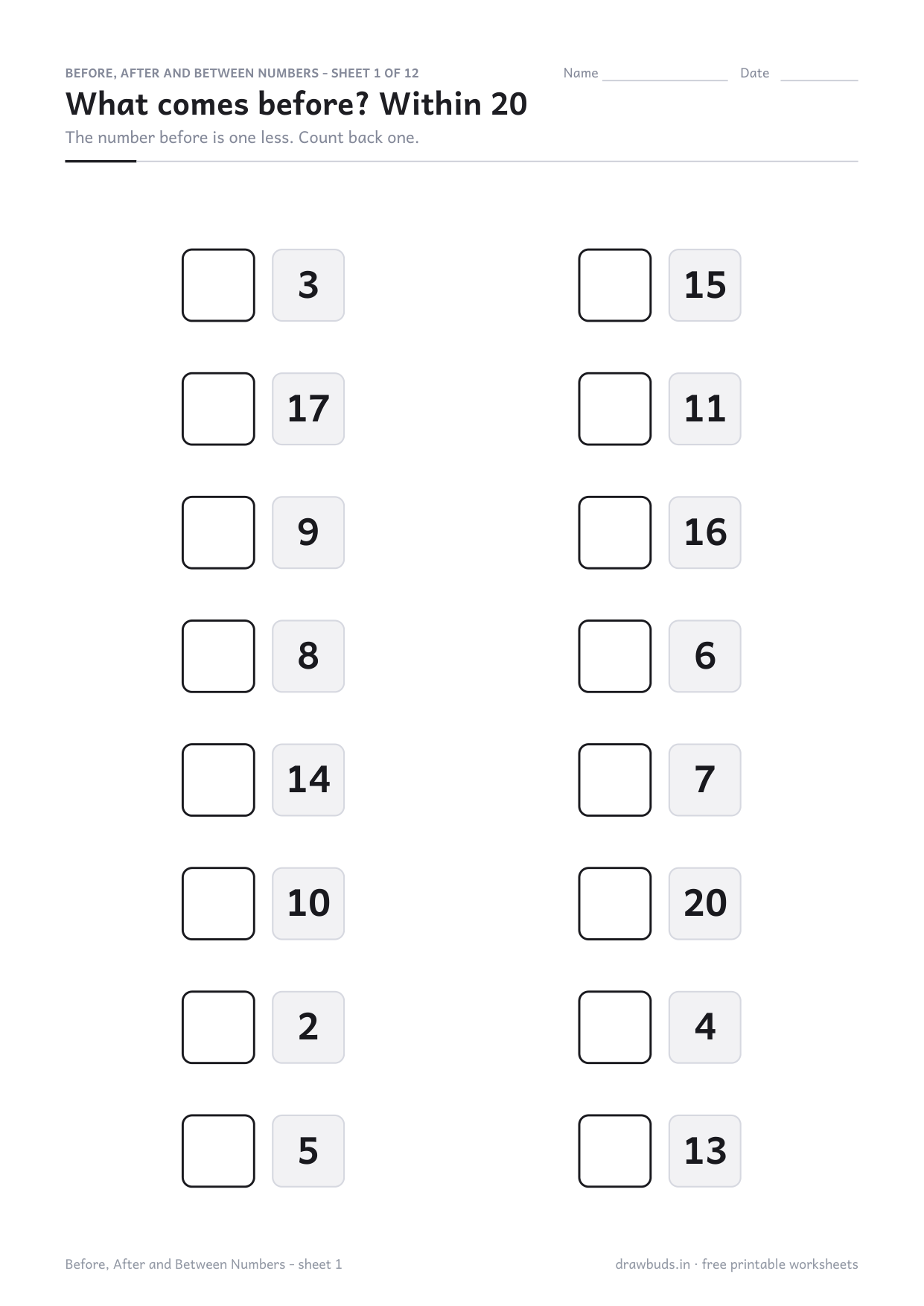
- Sheets 1-3: the number before, first within 20, then within 50, then within 100.
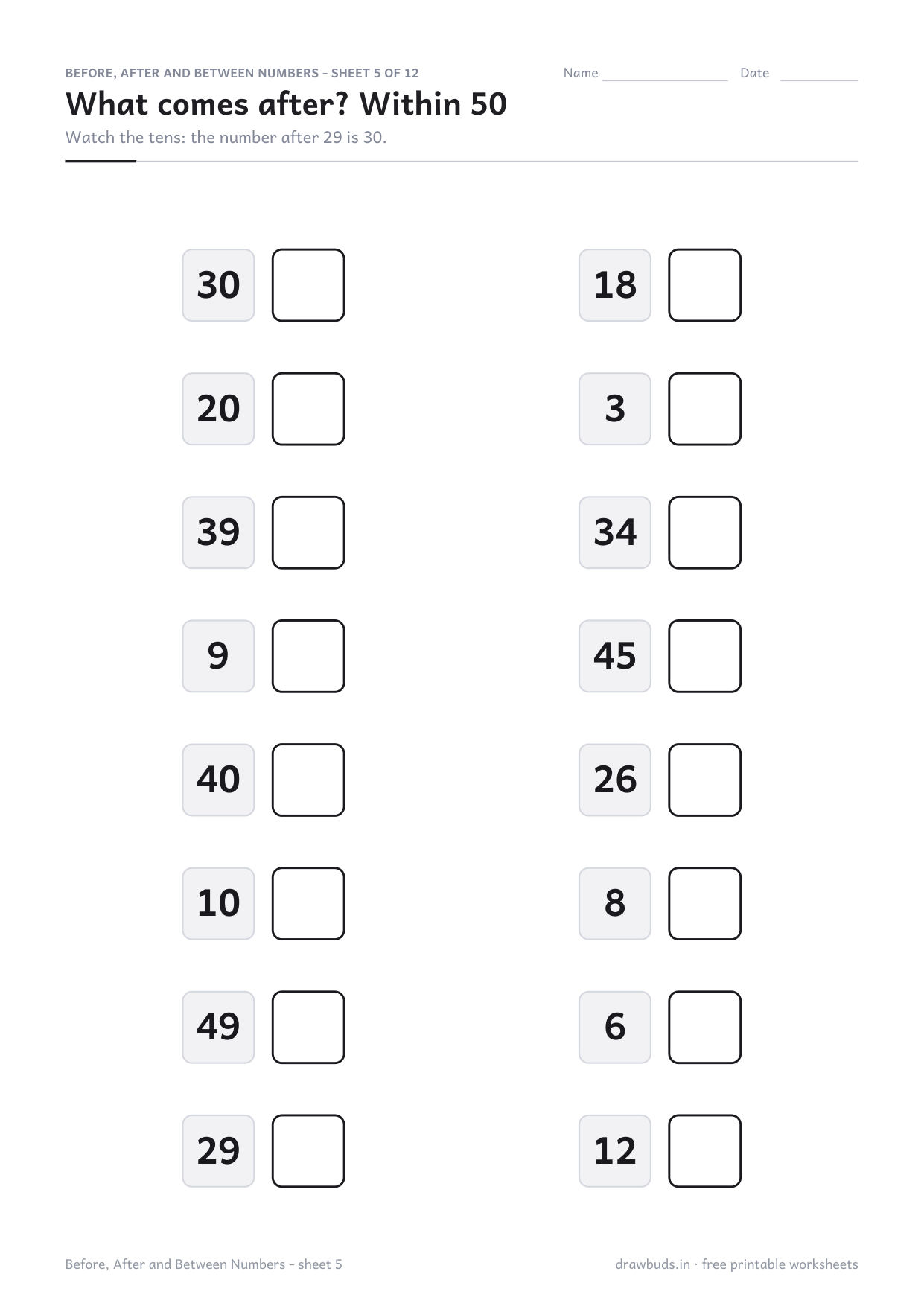
- Sheets 4-6: the number after, climbing the same way.
- Sheets 7-9: the number between, such as 8, 9, 10 or 45, 46, 47.
- Sheets 10-11: both boxes empty, so the child writes the number before and the number after.
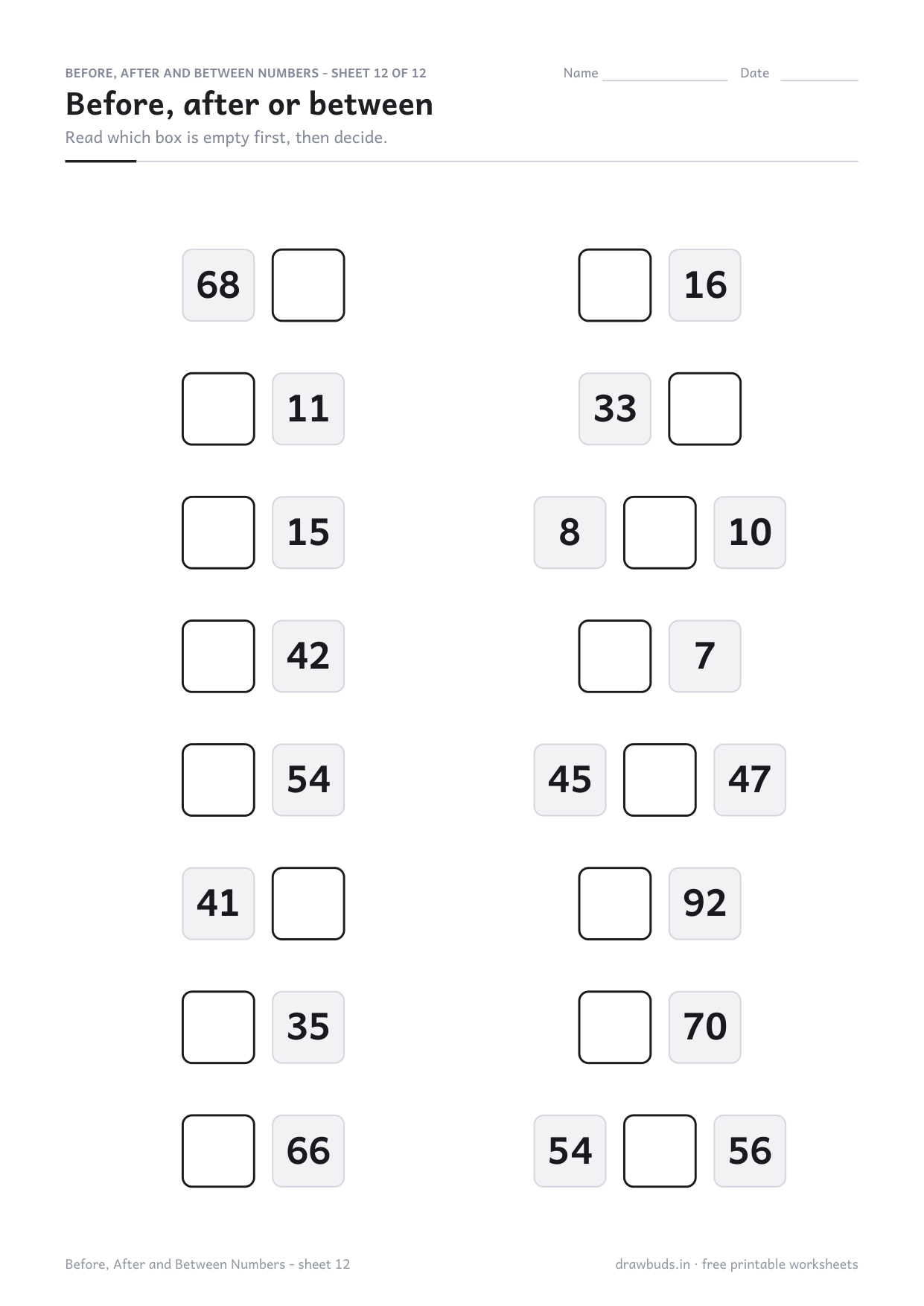
- Sheet 12: a mix of all three, so the child has to read which box is empty first.
- Last two pages: every answer, with the missing number in brackets, listed down the left column and then the right.
Where children slip: the tens
Counting on by one is easy until the ones digit runs out. A child who knows that 24 comes after 23 may still write “310” after 39, or go back to 38 by mistake. Sheet 2 (before, within 50) and sheet 5 (after, within 50) are built so that about half the numbers end in 9 or 0, and sheet 11 does the same for both boxes at once. On sheet 2 the child meets 20, 30, 40 and 49 in the first column alone.
If a child gets stuck, say the number out loud and count back or on by one, using fingers if needed. A 1 to 100 chart beside the sheet helps for the first few days.
Before, after, between: the same idea three ways
The number before is one less. The number after is one more. The number between two numbers that are two apart is one more than the smaller one. Sheets 1 to 9 keep these apart on purpose, three sheets each, so the child only has one rule in mind at a time. Sheet 12 then mixes them, and that is the real test, for example 68 with an empty box after it, an empty box before 11, and 8 and 10 with a gap in the middle.
Who it is for
The sheets suit children of about 4 to 7, in UKG, class 1 or class 2, who can already count to 20 and read two digit numbers. For counting a whole run of numbers, try the missing numbers 1 to 100 worksheets. To practice writing the numbers themselves, start with the number tracing worksheets 1 to 100.
Printing
Print at 100% scale, not Fit to page, so the boxes stay large enough for small handwriting. The book comes as an A4 PDF and a US Letter PDF with the same sheets. Black ink only.
Printing this one correctly
In your printer dialog set Scale to 100% or Actual size, not Fit to page. Fit to page shrinks the tracing letters and they stop matching the size a child's hand is learning.
Plain paper is fine for crayons and pencils. If your child uses felt pens, 100 gsm paper stops the ink bleeding to the next sheet.