3 Digit Subtraction Worksheets: Borrowing
3 digit subtraction worksheets: 288 column sums in six stages, ending with borrowing across a zero. Exchange boxes and answers. Free PDF.
- Pages
- 27
- Ages
- 7-10
- Paper size
- A4 and US Letter
- Black ink only
Same worksheets, two paper sizes. Free to print at home, at school, and in a classroom of thirty.
288 column sums under H, T and O in six stages, exchange boxes, answers
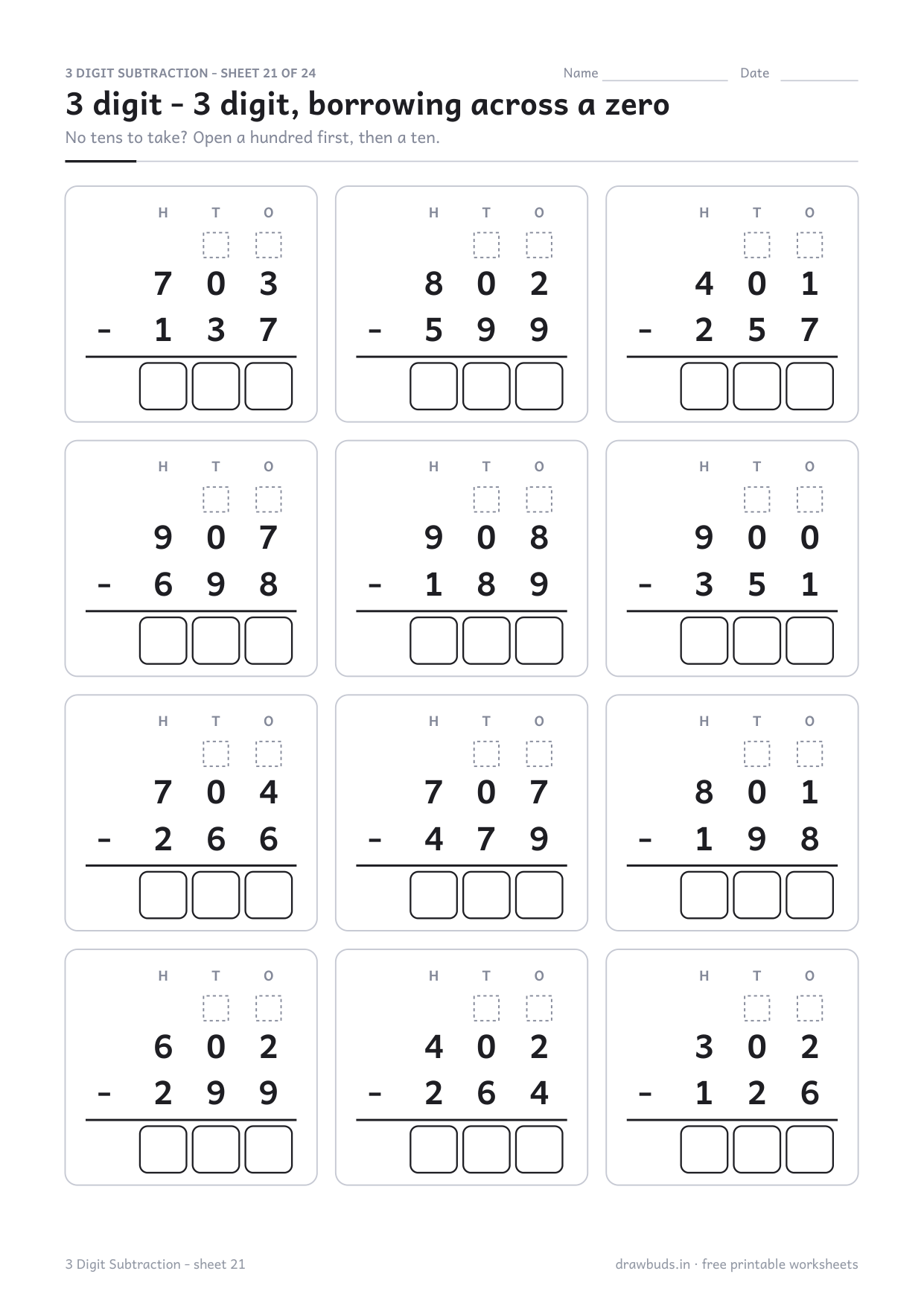
These 3 digit subtraction worksheets end where most sets stop short: 703 – 137, where there is no ten to borrow because the tens column is a zero. A child has to open a hundred into ten tens first, then open one of those tens into ten ones. It is the hardest thing in primary subtraction and the last four sheets are nothing else.
What is in the 27 pages
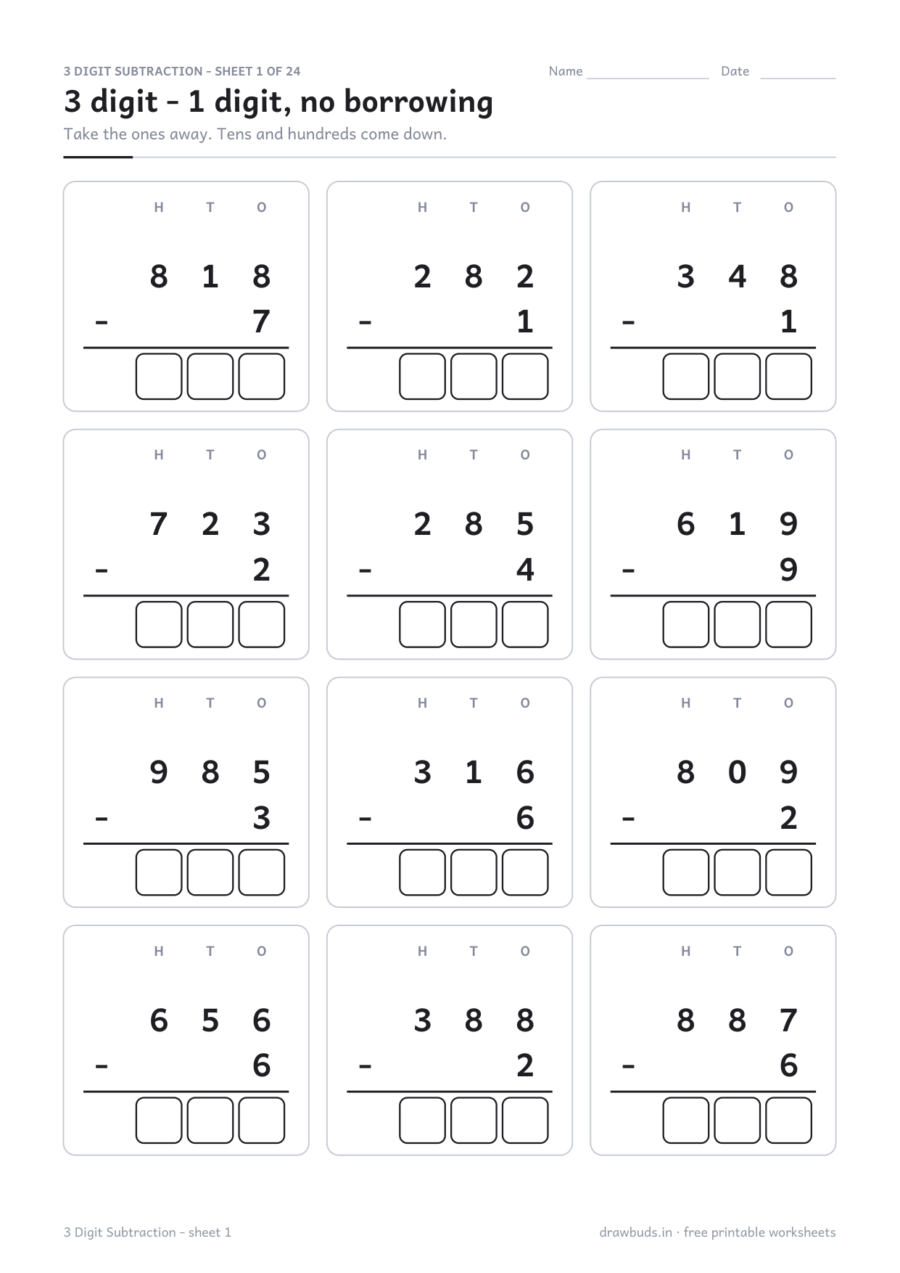
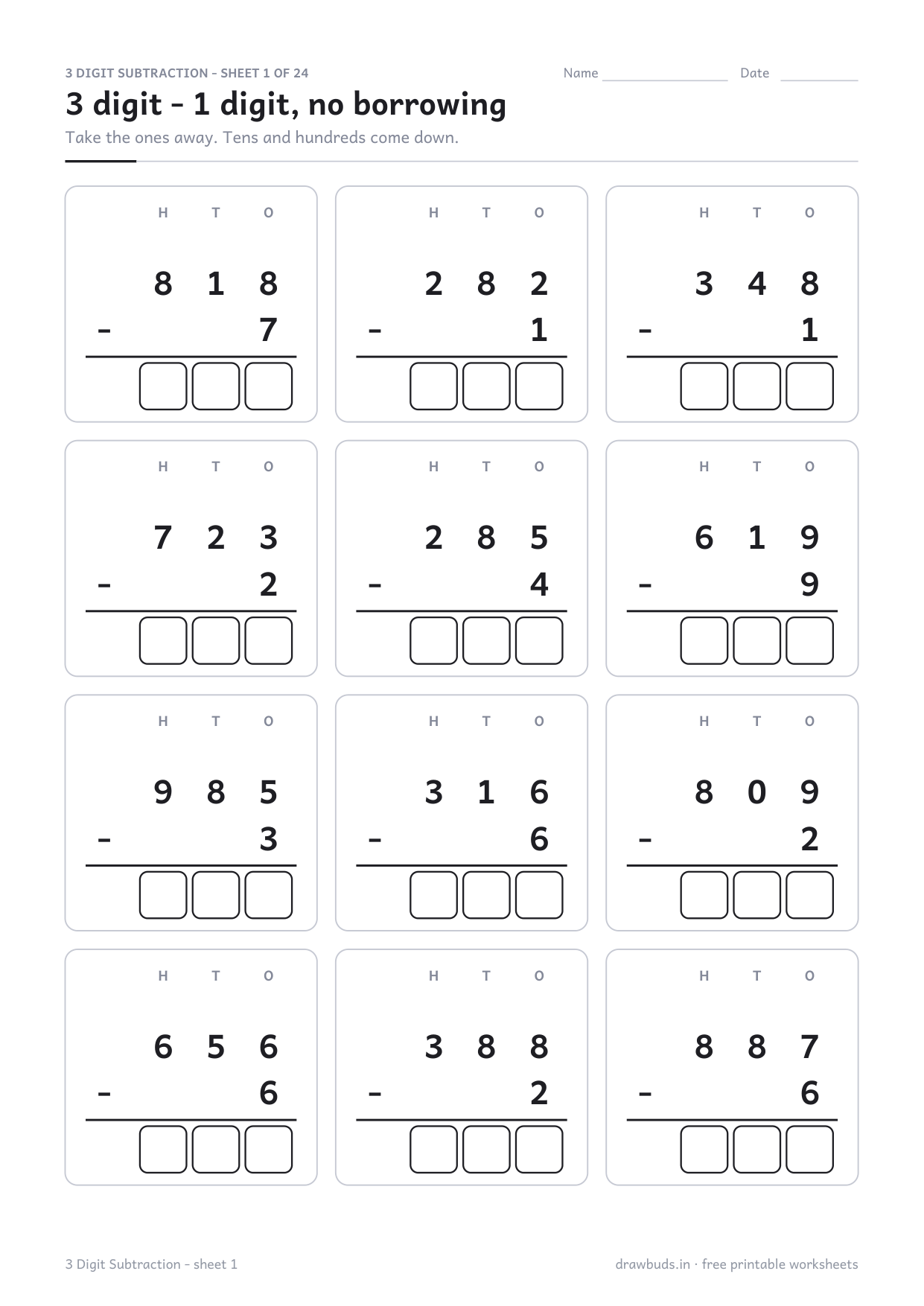
- Sheets 1-4: 3 digit – 1 digit, nothing to exchange (818 – 7).
- Sheets 5-8: 3 digit – 2 digit, nothing to exchange (767 – 13).
- Sheets 9-12: 3 digit – 3 digit, nothing to exchange (587 – 150).
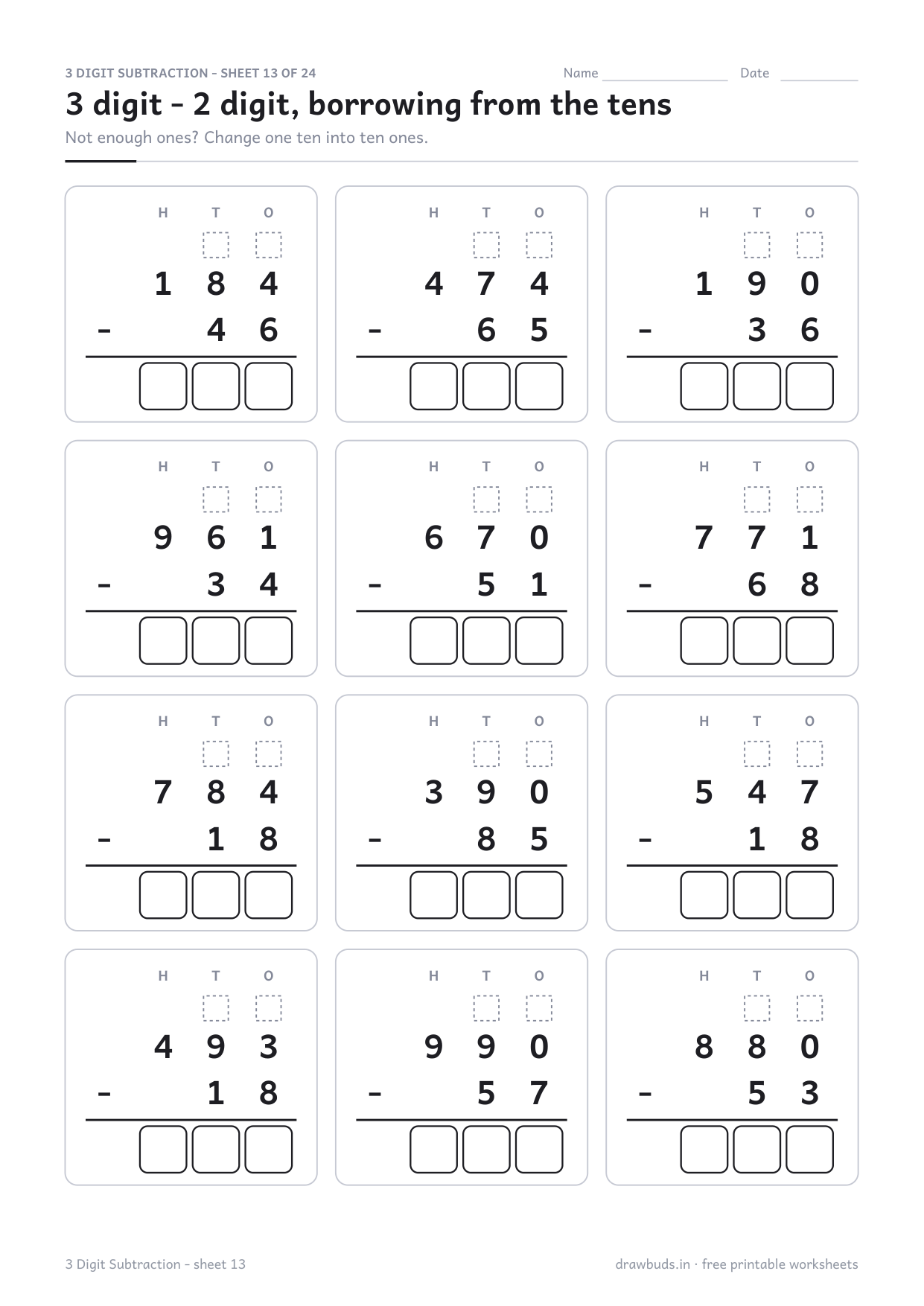
- Sheets 13-16: borrowing once, from the tens (184 – 46).
- Sheets 17-20: borrowing twice, from the tens and the hundreds (923 – 157).
- Sheets 21-24: borrowing across a zero in the tens (703 – 137).
- Last two pages: every answer, sheet by sheet.
Twelve sums a sheet, 288 in all, none repeated. Every answer is positive, so a child is never left with a sum that cannot be done the way they have been taught.
The zero that stops everyone
802 – 599 is the sum that separates a child who understands exchanging from one who has memorised a sequence of moves. They need 9 ones and have 2. The rule they know says take a ten, and there are no tens. What actually happens is that one hundred becomes ten tens, so the 0 becomes 10, and then one of those tens becomes ten ones, so the 2 becomes 12. Two exchanges, in that order, before a single digit is written in the answer.
A child who can do 923 – 157 and freezes on 802 – 599 has not forgotten anything. They have hit the first sum their rule does not cover. That is why it has four sheets of its own rather than appearing twice near the end.
Exchange boxes above the ones and the tens
From sheet 13 a dashed box appears above the ones and the tens, which is where the exchanged amount gets written down. Sheets 1-12 do not show them. Writing the exchange rather than holding it in the head is what makes the method survive contact with a four-digit sum later, and it is also the only way an adult marking the page can see where a wrong answer went wrong.
Where the shorter number sits
On sheet 5 a sum reads 767 – 13, with the 13 under the tens and the ones and nothing under the hundreds. No leading zero, because lining the digits up by place is the lesson rather than an obstacle to it. If that gap causes hesitation, tens and ones worksheets are the thing to do first.
Class 3, grade 2 or year 3
Three-digit subtraction is class 3 in most Indian schools, grade 2 into grade 3 in the US, year 3 in England. Borrowing across a zero is often held back to class 4, which is why so many sets leave it out. Print sheets 1-12 first whatever the class, and only move on once the no-exchange sums are quick rather than merely correct.
If two-digit borrowing is still being worked out, 2 digit subtraction worksheets come first. For the same six stages in addition, see 3 digit addition worksheets.
Printing this one correctly
In your printer dialog set Scale to 100% or Actual size, not Fit to page. Fit to page shrinks the tracing letters and they stop matching the size a child's hand is learning.
Plain paper is fine for crayons and pencils. If your child uses felt pens, 100 gsm paper stops the ink bleeding to the next sheet.