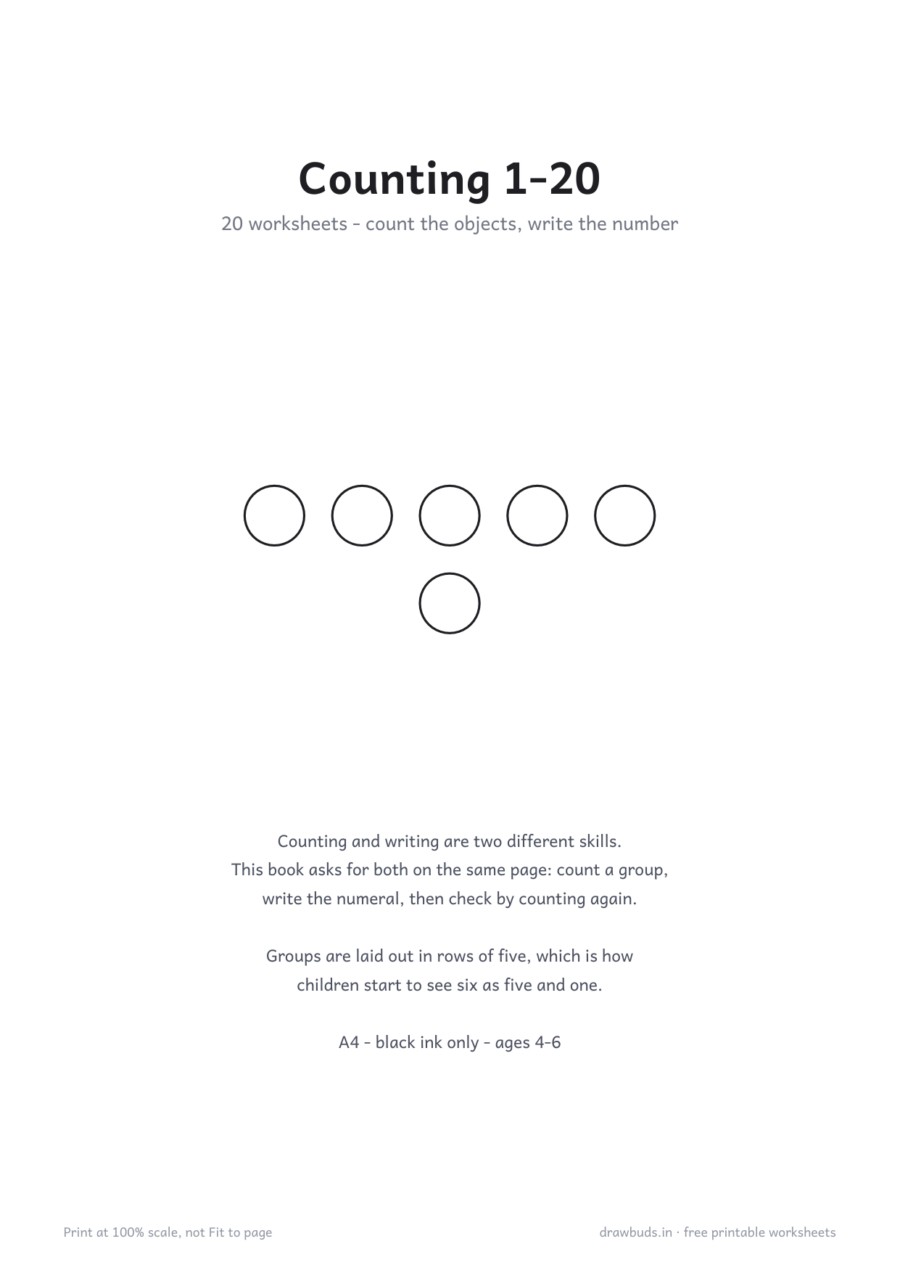
Counting Worksheets 1-20
21 printable pages. Count a group of objects, write the number in the box, then trace it — counting and writing practised as the two separate skills they are.
- Pages
- 21
- Ages
- 4-6
- Paper size
- A4
- Black ink only
Free to print at home, at school, and in a classroom of thirty.
Groups laid out in rows of five, a box to write in, then the numeral
A child who can recite one to twenty cannot necessarily count seventeen things. Reciting is a song; counting is touching each object once and once only, and stopping. This book separates them: every page starts with a group to count and ends with the numeral written down.
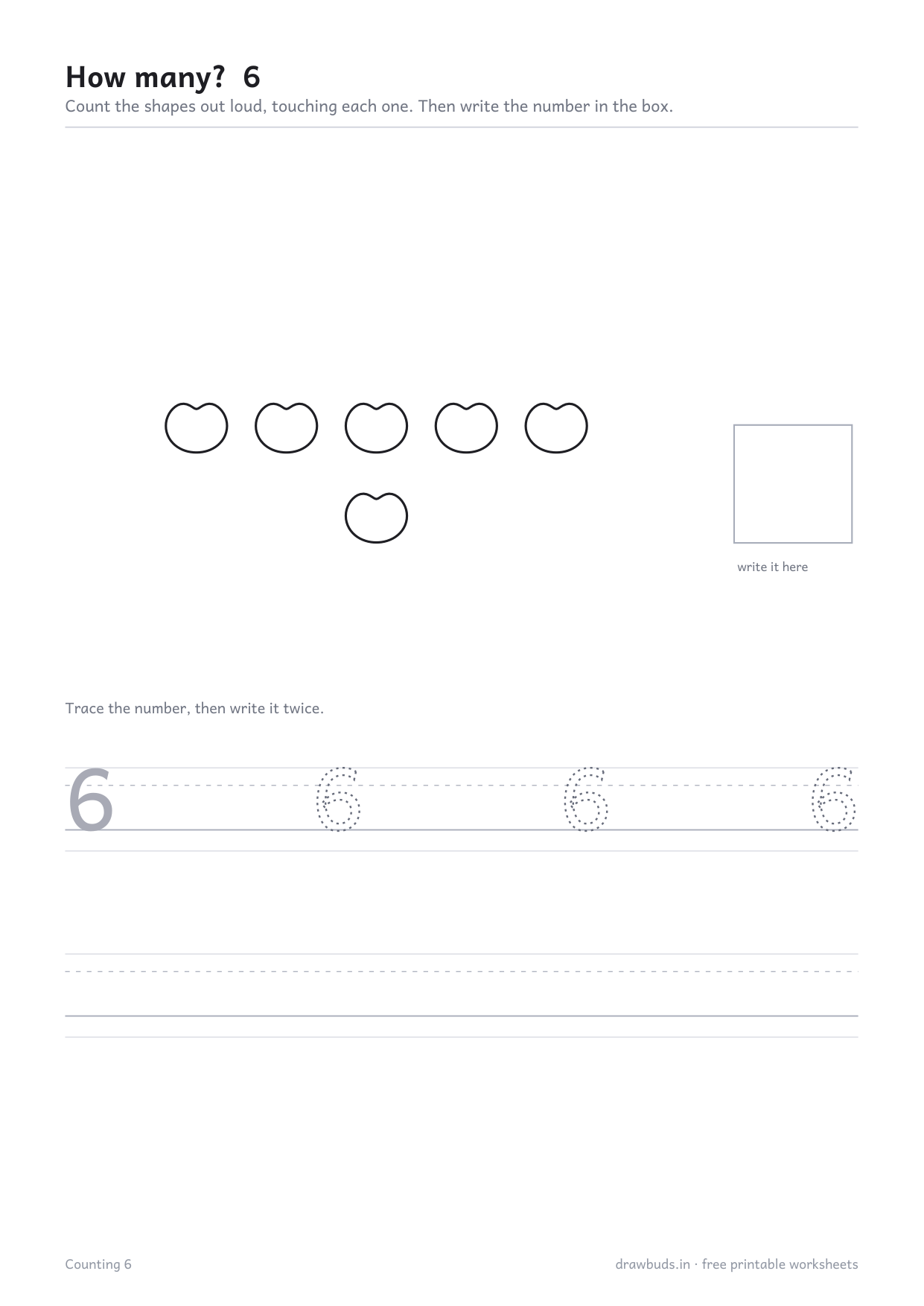
What is on each page
- A group of shapes, arranged in rows of five.
- A box to write the answer in, with no guides at all.
- A tracing row for the same numeral, then a blank ruled row.
The shape changes from page to page — circles, stars, hearts, squares, triangles, apples — so the count is of a quantity rather than of one familiar picture.
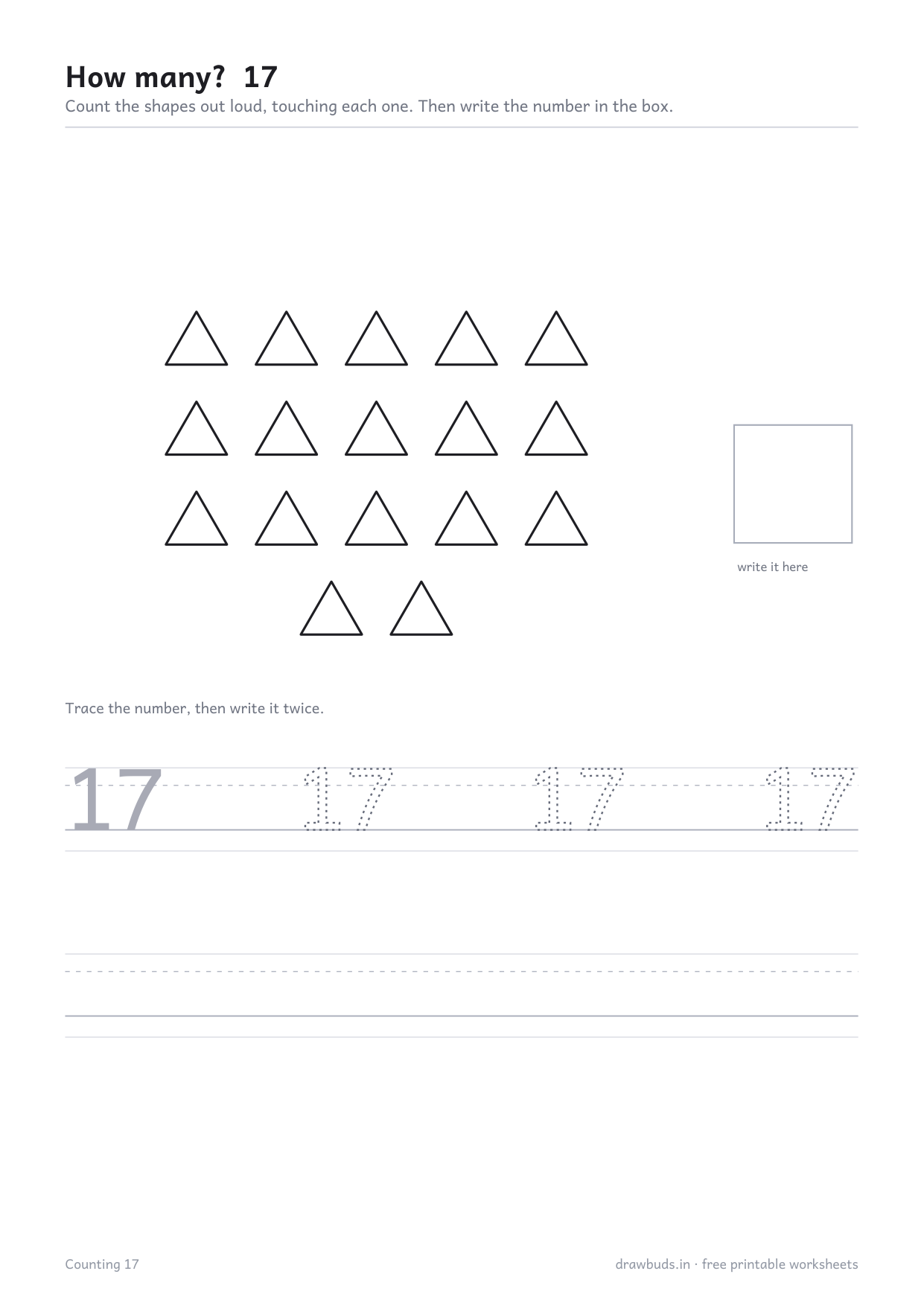
Rows of five, and what they teach
Seventeen circles scattered on a page get counted twice and answered wrongly. In rows of five they get seen as three fives and a two. That is subitising, and it is the step between counting one at a time and doing arithmetic. It happens on its own if the layout allows it.
Touch every object
The single most useful instruction here is to make the child touch each shape as they say the number. Counting by eye is where the double-counts happen, and the habit of touching disappears by itself once the count is reliable.
Where it usually breaks down
Almost always at 13 to 16, and almost always because the child is chanting rather than counting. If page 14 goes wrong but page 4 is fine, the problem is the number words, not the counting — Number Words one to twenty is the book for that.
What comes next
Number Tracing 1-20 if the numerals themselves are still shaky.
Printing this one correctly
In your printer dialog set Scale to 100% or Actual size, not Fit to page. Fit to page shrinks the tracing letters and they stop matching the size a child's hand is learning.
Plain paper is fine for crayons and pencils. If your child uses felt pens, 100 gsm paper stops the ink bleeding to the next sheet.