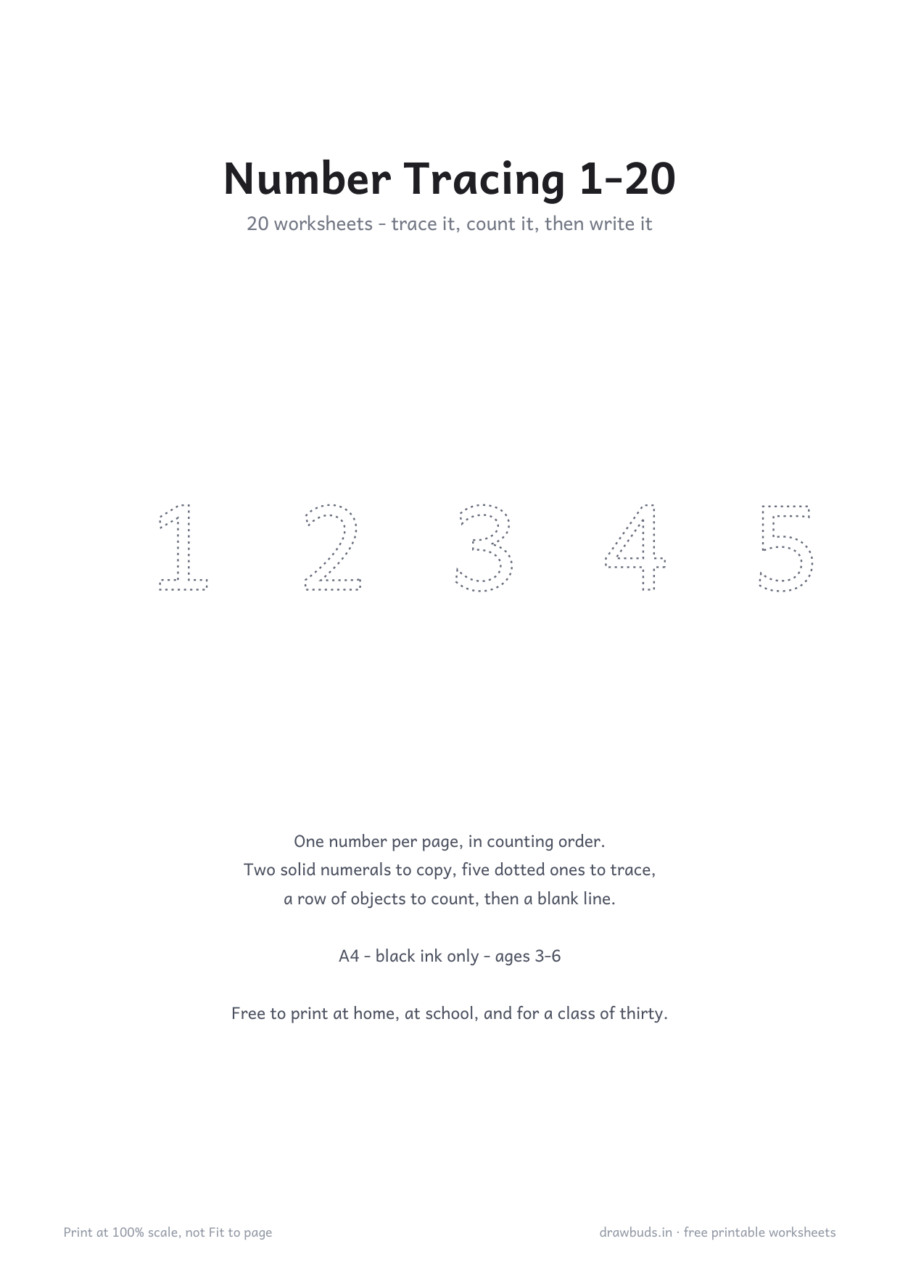
Number Tracing Worksheets 1-20
21 printable pages. Trace the numeral, count a group of objects, then write the number word — the three things a child has to join up before a number means anything.
- Pages
- 21
- Ages
- 3-6
- Paper size
- A4
- Black ink only
Free to print at home, at school, and in a classroom of thirty.
Numeral, objects to count and the number word on every page
Most number tracing sheets stop at the shape of the numeral. A child can trace a perfect 7 and still not know that 7 means seven things. Every page in this book asks for all three: trace the numeral, count a group, and write the word.
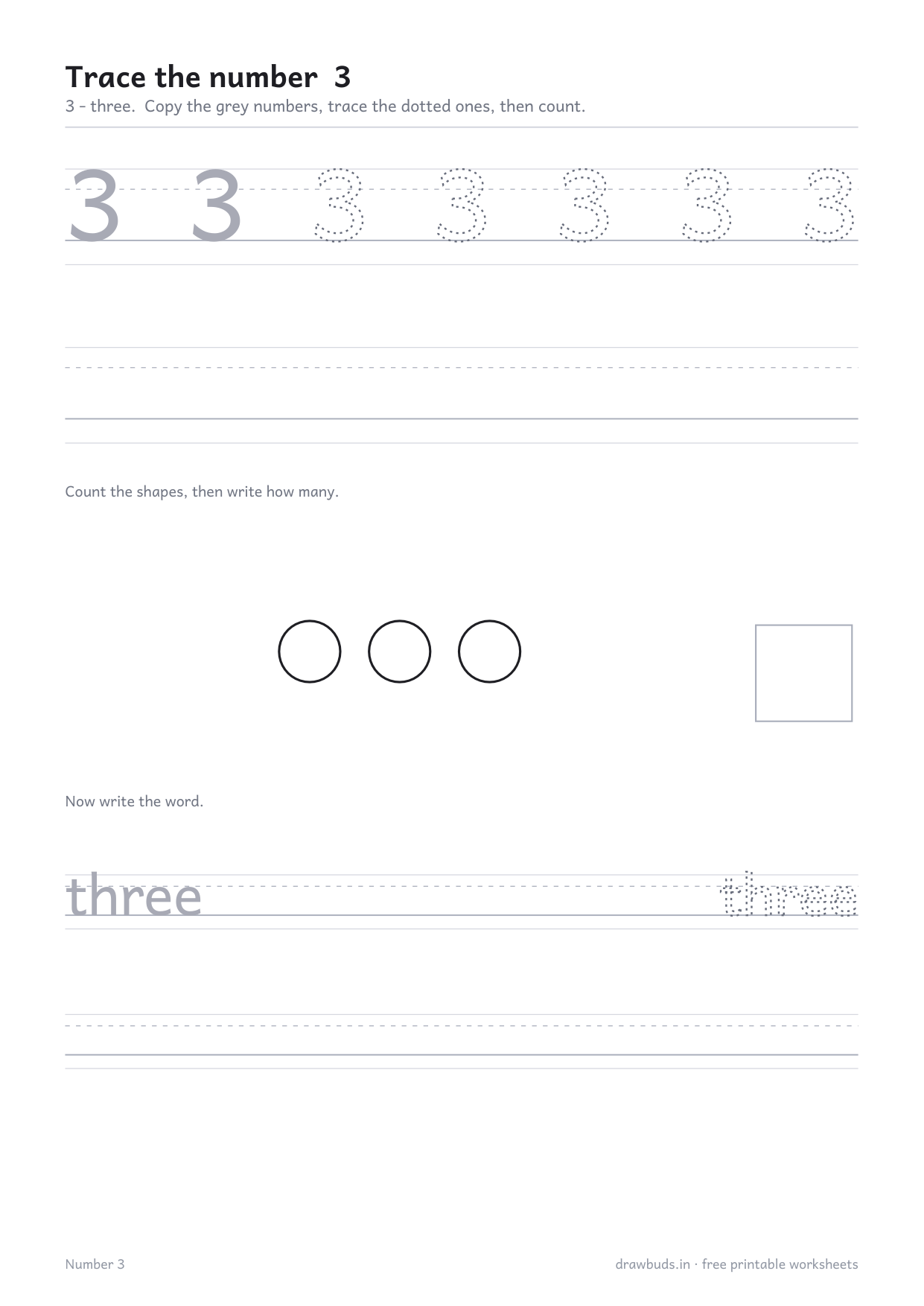
What is on each page
- Two grey numerals to copy and five dotted ones to trace, on the four-line handwriting rule.
- An empty ruled row to write the numeral unaided.
- A group of shapes to count, laid out in rows of five, with a box to write the answer in.
- The number word — one, two, three — on its own ruled row.
Why the shapes are in rows of five
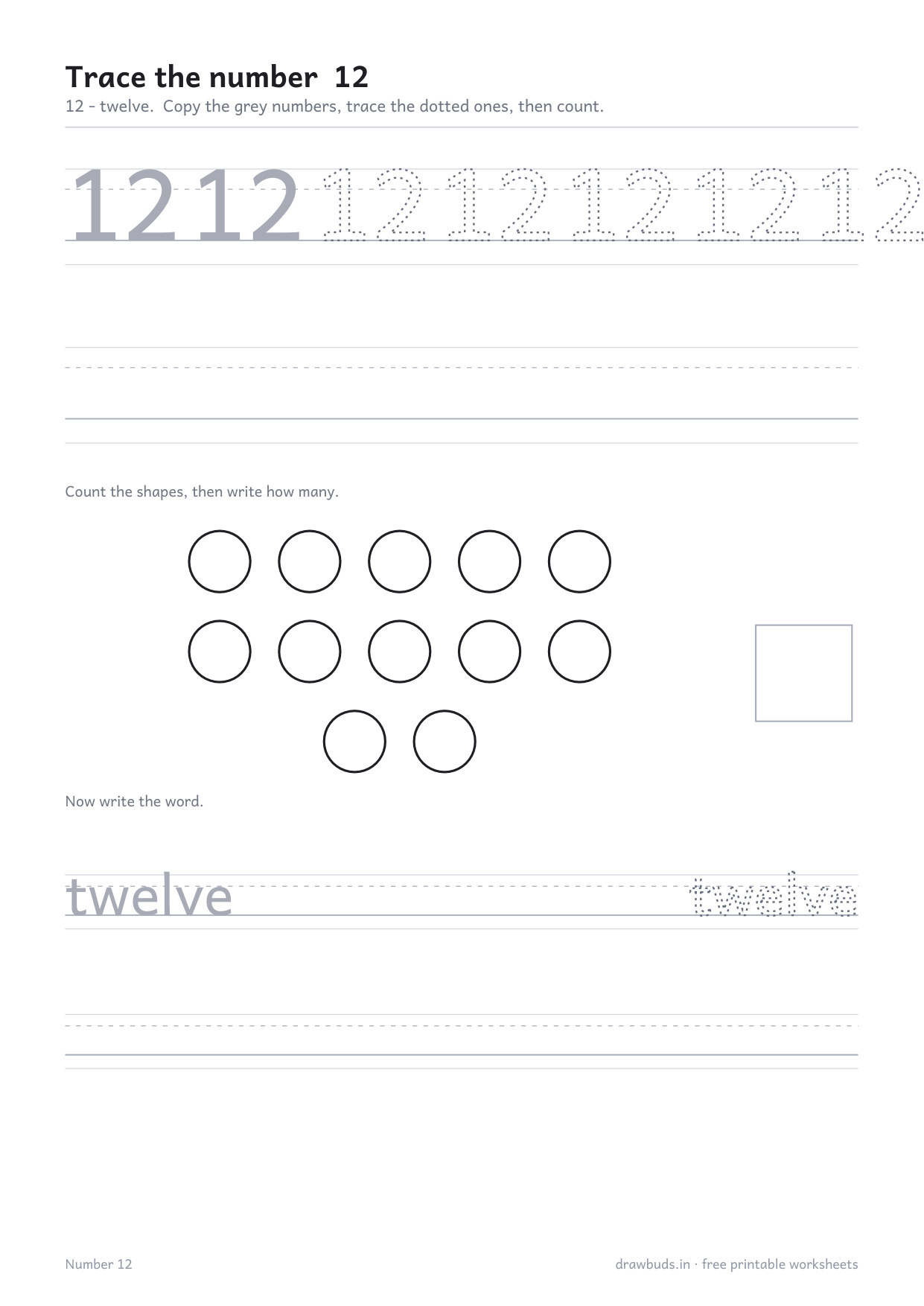
Sixteen circles scattered across a page get counted wrong, recounted, and counted wrong again. In rows of five they get read as three fives and one, which is the beginning of place value. It costs nothing to lay them out that way and it saves the argument about whether the answer was 15 or 16.
The order to work through it
Straight through, 1 to 20, one page a day, is the usual pace at ages 4 to 5. If a child already recognises numerals up to 10, start at 11 — the teens are where the trouble actually is, because eleven and twelve do not say what they are and thirteen to nineteen say themselves backwards.
Printing it
Set Scale to 100%, not Fit to page. Fit to page shrinks the numerals and the four-line rule stops matching the size a hand is learning. Plain paper is fine for pencils; 100 gsm stops felt pens bleeding through.
What comes next
Once the numerals are steady, Number Words one to twenty teaches the spelling of each one, and Counting Worksheets 1-20 drops the tracing and asks only for the count.
Printing this one correctly
In your printer dialog set Scale to 100% or Actual size, not Fit to page. Fit to page shrinks the tracing letters and they stop matching the size a child's hand is learning.
Plain paper is fine for crayons and pencils. If your child uses felt pens, 100 gsm paper stops the ink bleeding to the next sheet.