Color by Number Worksheets
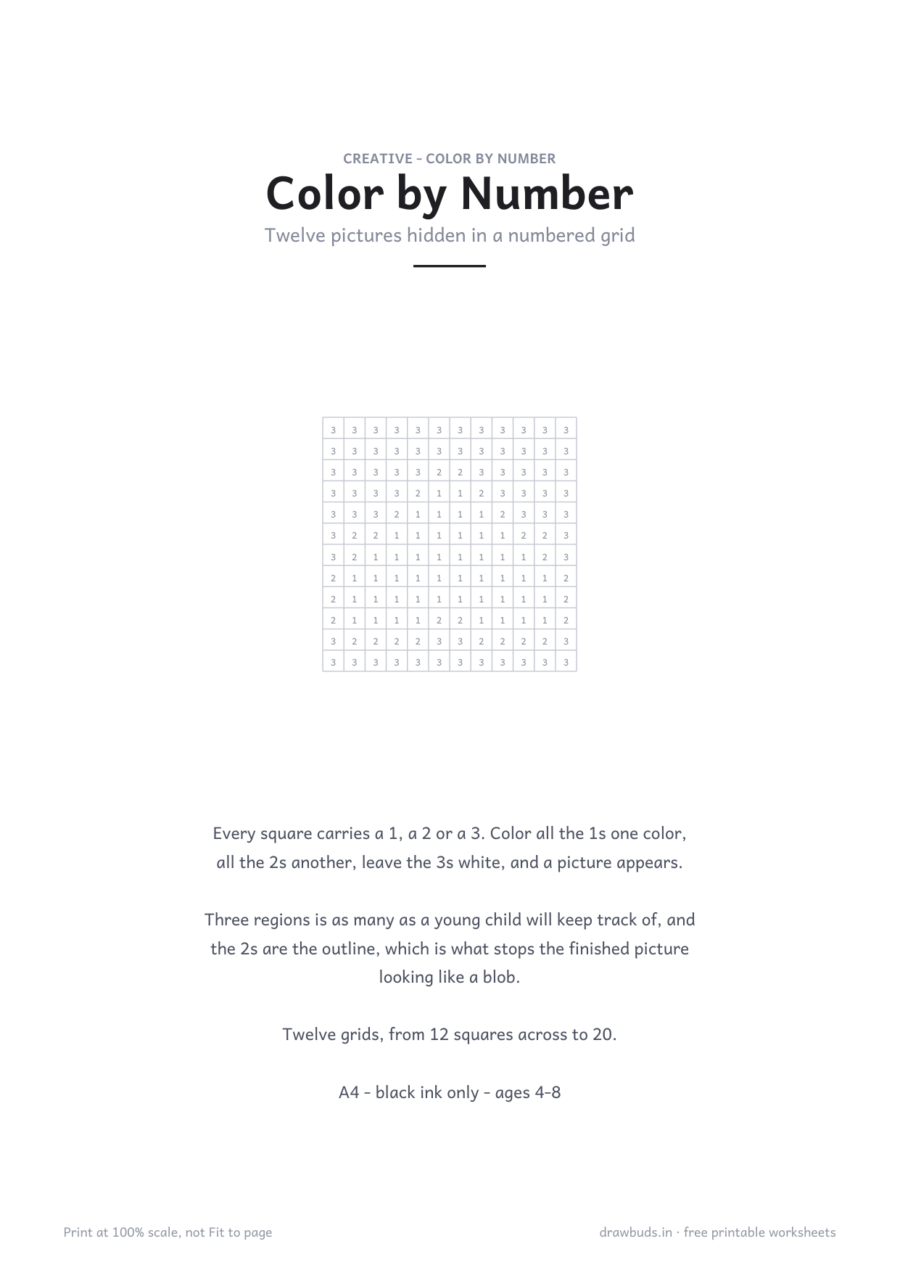
13 printable pages. Every square holds a 1, a 2 or a 3. Color the 1s and 2s, leave the 3s white, and a picture appears. Grids grow from 12 squares across to 20.
- Pages
- 13
- Ages
- 4-8
- Paper size
- A4
- Black ink only
Free to print at home, at school, and in a classroom of thirty.
Three regions per picture, grids from 12 squares across to 20
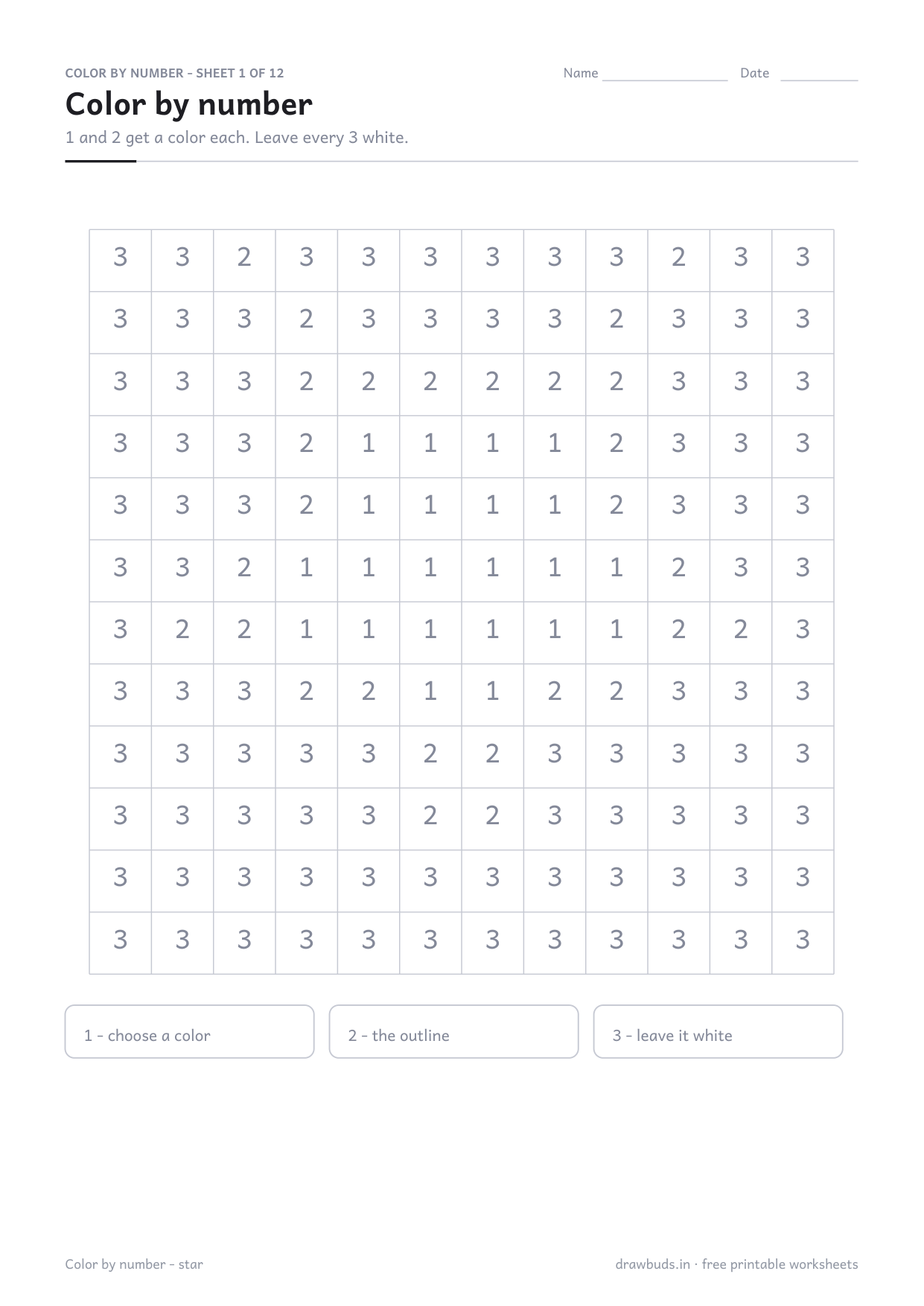
Every square in the grid carries a 1, a 2 or a 3. Color all the 1s one color, all the 2s another, leave every 3 white, and a picture comes out of it.
The picture is a surprise, which is the point — it is the only kind of coloring page where a child has a reason to be accurate.
Why only three numbers
Three regions is about as many as a young child will keep track of without losing the thread and coloring squares at random. Sheets with eight or ten numbers look more impressive and get abandoned halfway.
The 2s are always the outline of the shape and the 1s are its inside. That is what stops the finished picture looking like a solid blob — the edge reads as a border, the way it would in a drawing.
The twelve pictures
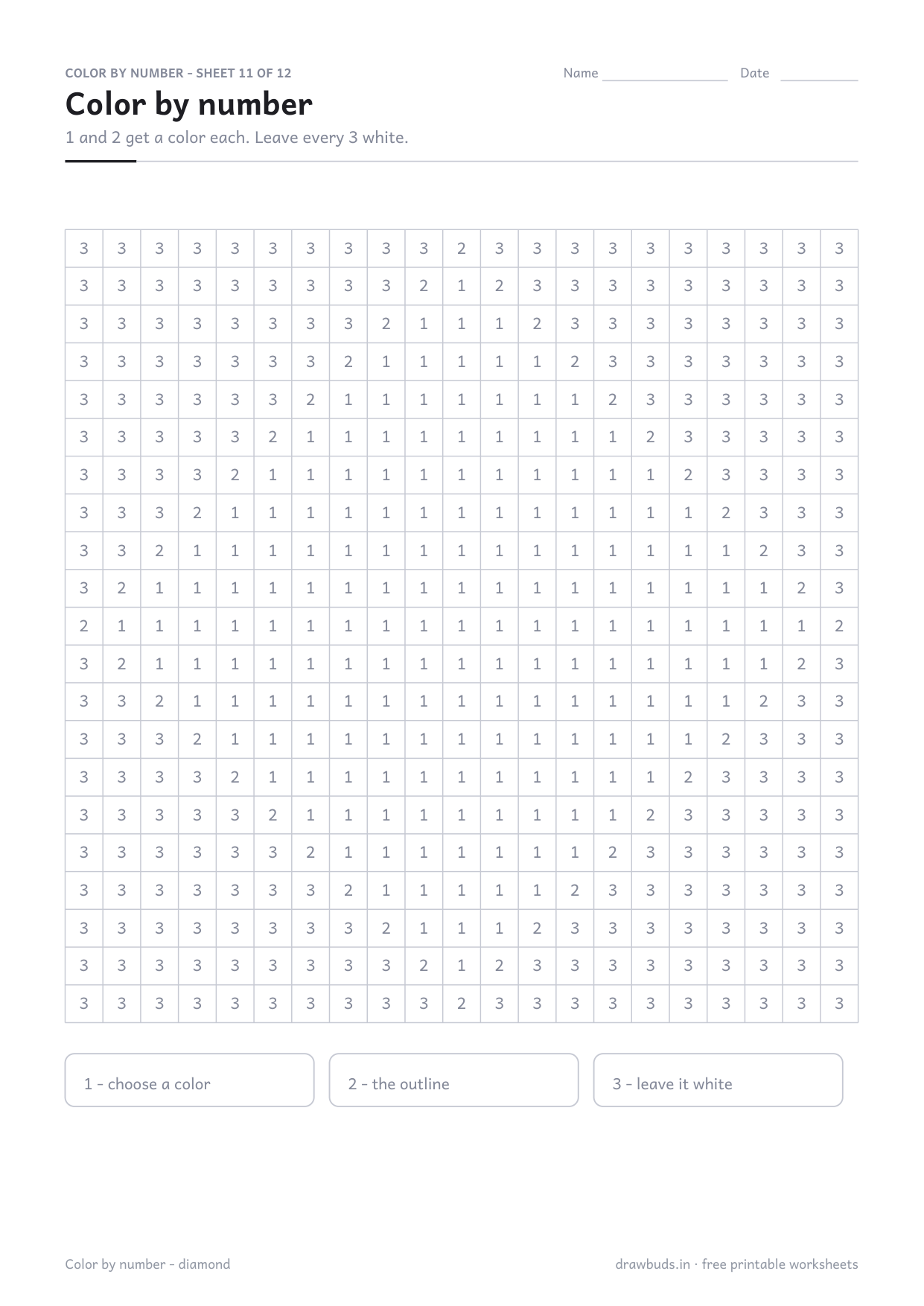
A star, a heart, an apple, a house, a tree, a rocket, a kite, a crown, a moon, an ice cream, a diamond and a flower. The grids get finer as the book goes on, from 12 squares across on the first sheets to 20 on the last, so the same picture is drawn in more detail towards the back.
How the pictures are made
Each grid is generated from the actual outline of the shape rather than drawn square by square, so the edges land where the real shape’s edges are. That is why an 18-square grid of the same picture is genuinely more detailed than a 12-square one, instead of just bigger.
Which colors to use
Anything, but the 2s work best in a darker color than the 1s, because they are the outline. Pencils are better than felt pens here: a felt pen bleeds over the grid lines and the border stops reading as a border.
Counting practice hiding inside it
A child who does not yet recognise numerals reliably has to read several hundred of them to finish one sheet, without it feeling like number practice at all. If numeral recognition is the actual goal, Number Tracing 1-20 is the direct route.
What comes next
Big Shapes to Color for coloring without the counting, and Draw the Other Half for the same grid used a different way.
Printing this one correctly
In your printer dialog set Scale to 100% or Actual size, not Fit to page. Fit to page shrinks the tracing letters and they stop matching the size a child's hand is learning.
Plain paper is fine for crayons and pencils. If your child uses felt pens, 100 gsm paper stops the ink bleeding to the next sheet.