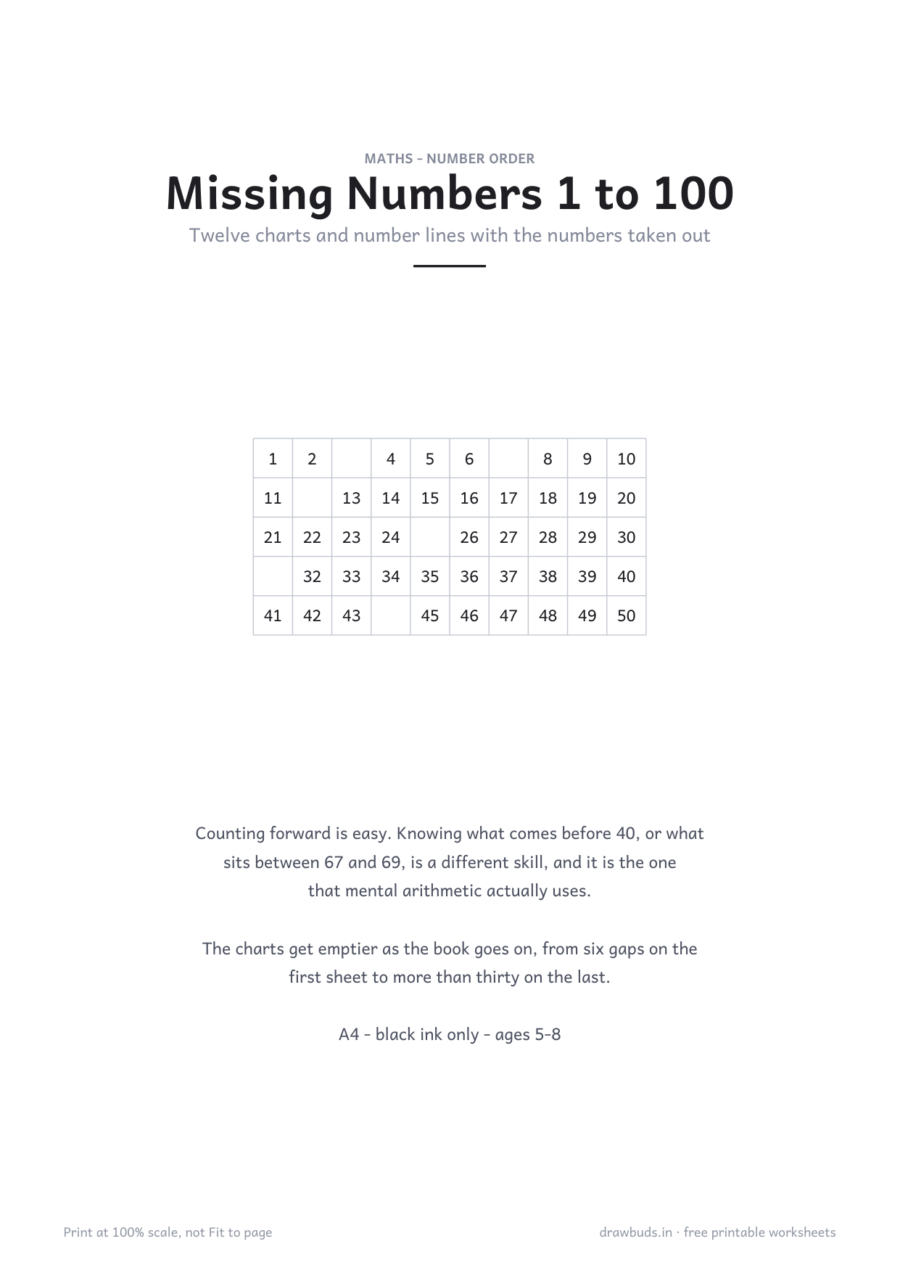
Missing Numbers 1 to 100
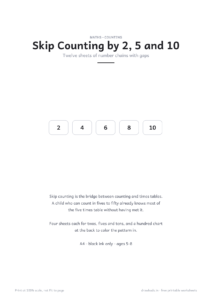
13 printable pages. Number charts that get emptier as the book goes on — six gaps on the first sheet, more than thirty on the last.
- Pages
- 13
- Ages
- 5-8
- Paper size
- A4
- Black ink only
Free to print at home, at school, and in a classroom of thirty.
Charts that get emptier: six gaps on sheet one, more than thirty on sheet twelve
Counting forward from one is a song. Knowing what comes before 40, or what sits between 67 and 69, is a different thing entirely, and it is the one that mental arithmetic actually uses. A chart with holes in it asks that question about forty times a page.
How the difficulty builds
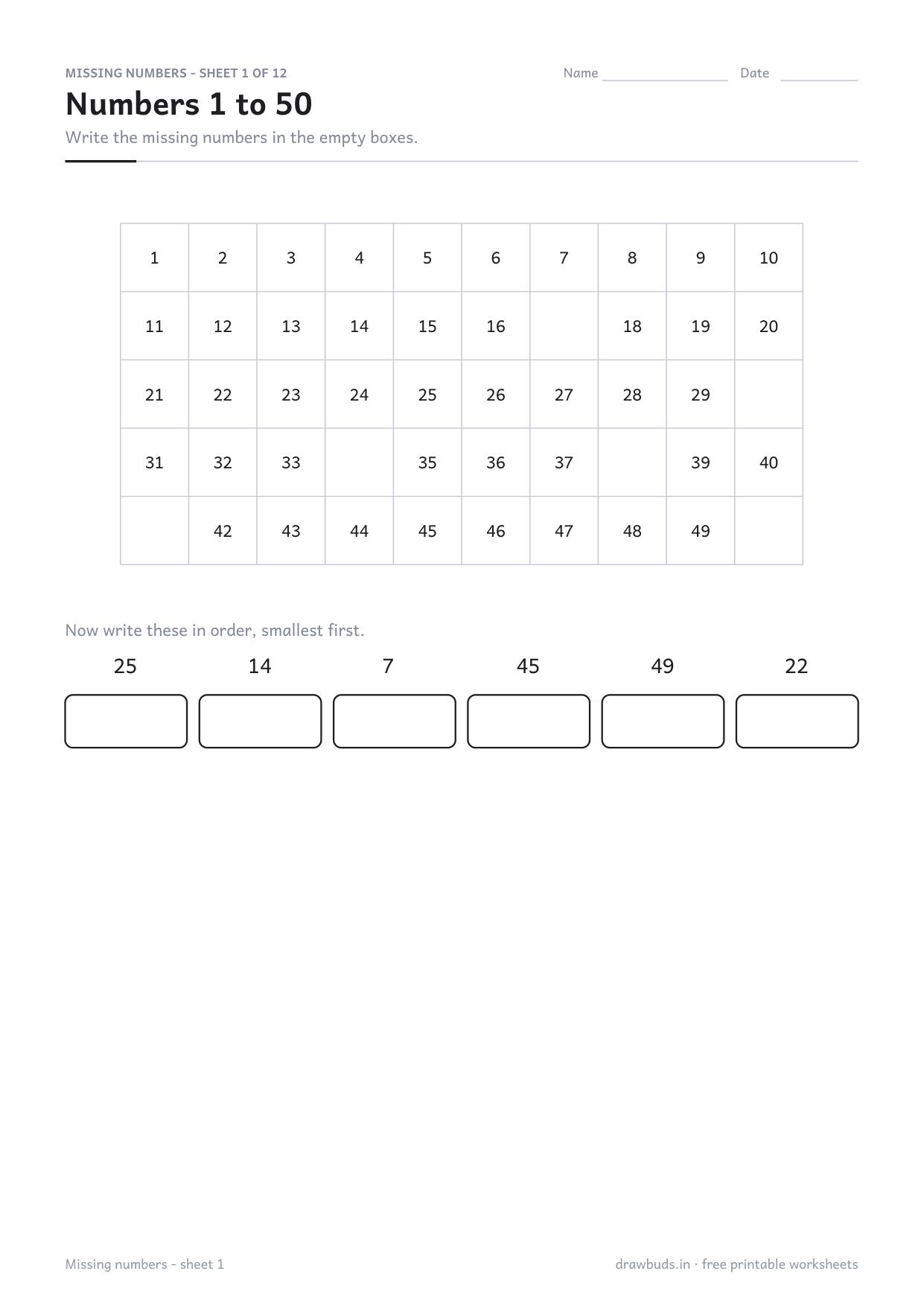
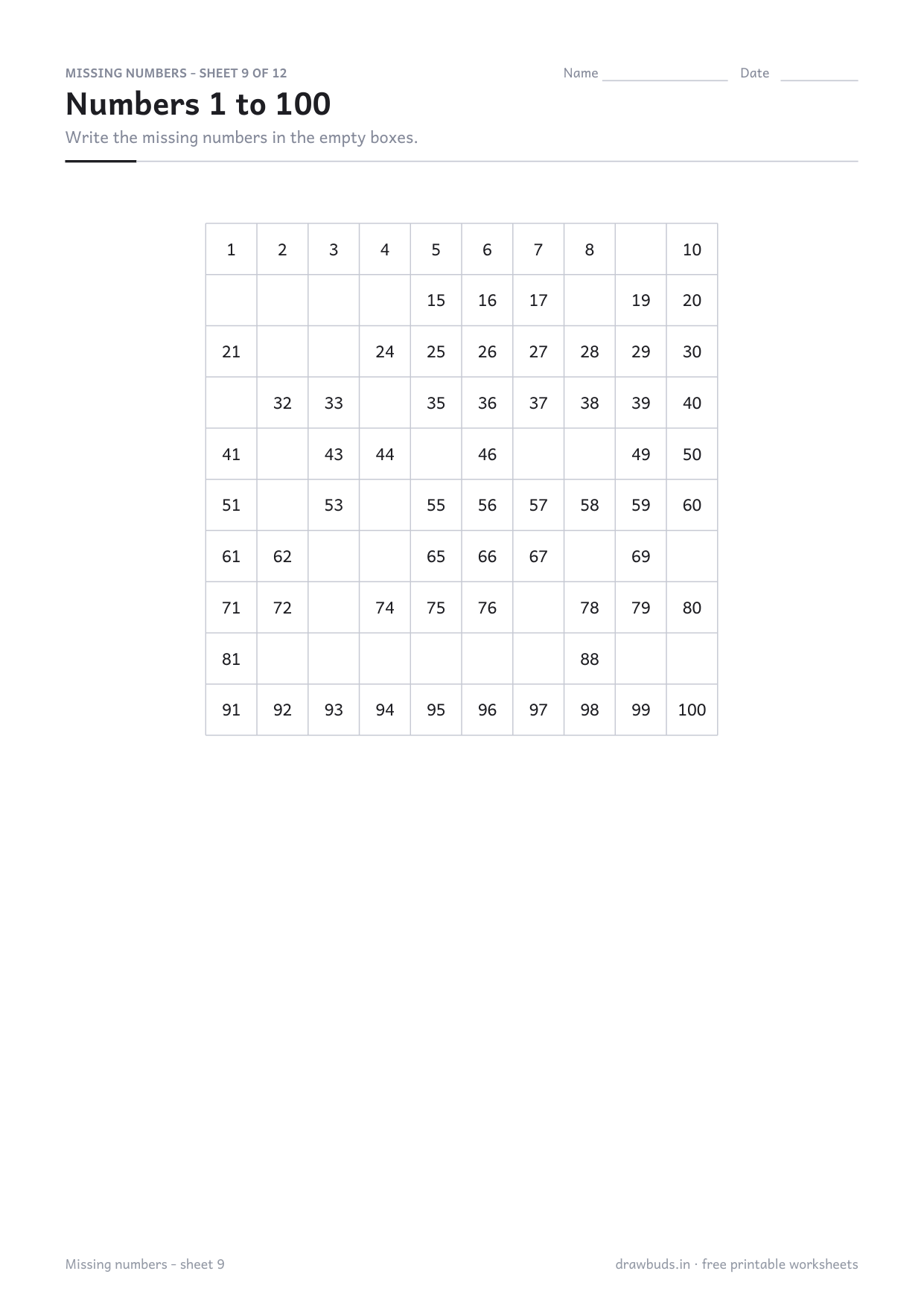
Sheets 1 to 4 are charts of fifty with six to fifteen gaps. Sheets 5 onward are full hundred charts, and the number of gaps keeps climbing — by sheet 12 more than thirty numbers are missing, which is enough that a child has to reconstruct rather than recall.
The first four sheets also carry a second exercise underneath: six numbers scattered out of order, to be written back into order smallest first.
What a hundred chart teaches that a number line does not
The rows and the columns both mean something. Move one square right and you add one. Move one square down and you add ten — the units digit stays put and only the tens change. A child who notices that has understood place value from a picture, before anyone has used the words.
Two things worth pointing at
The tens column. Every number ending in 0 lines up on the right-hand edge. That is the whole ten times table, sitting in a column.
The diagonal. 11, 22, 33, 44 run corner to corner. Children find this on their own and are usually delighted by it, which is a good enough reason to leave them to it.
Where it goes wrong
Almost always at the end of a row — 29 to 30, 59 to 60. The units digit rolls over and the tens digit changes at the same time, which is the one moment in counting where two things happen at once. If that is where the gaps are wrong, do a sheet of counting in tens first.
What comes next
More, Less or Equal, which uses the same number knowledge to compare rather than to order.
Printing this one correctly
In your printer dialog set Scale to 100% or Actual size, not Fit to page. Fit to page shrinks the tracing letters and they stop matching the size a child's hand is learning.
Plain paper is fine for crayons and pencils. If your child uses felt pens, 100 gsm paper stops the ink bleeding to the next sheet.