Number Bonds to 10 Worksheets
11 printable pages. 60 part-part-whole diagrams, with the empty circle moving around so the same fact gets asked three different ways.
- Pages
- 11
- Ages
- 5-7
- Paper size
- A4
- Black ink only
Free to print at home, at school, and in a classroom of thirty.
60 part-part-whole diagrams, the missing circle moves around
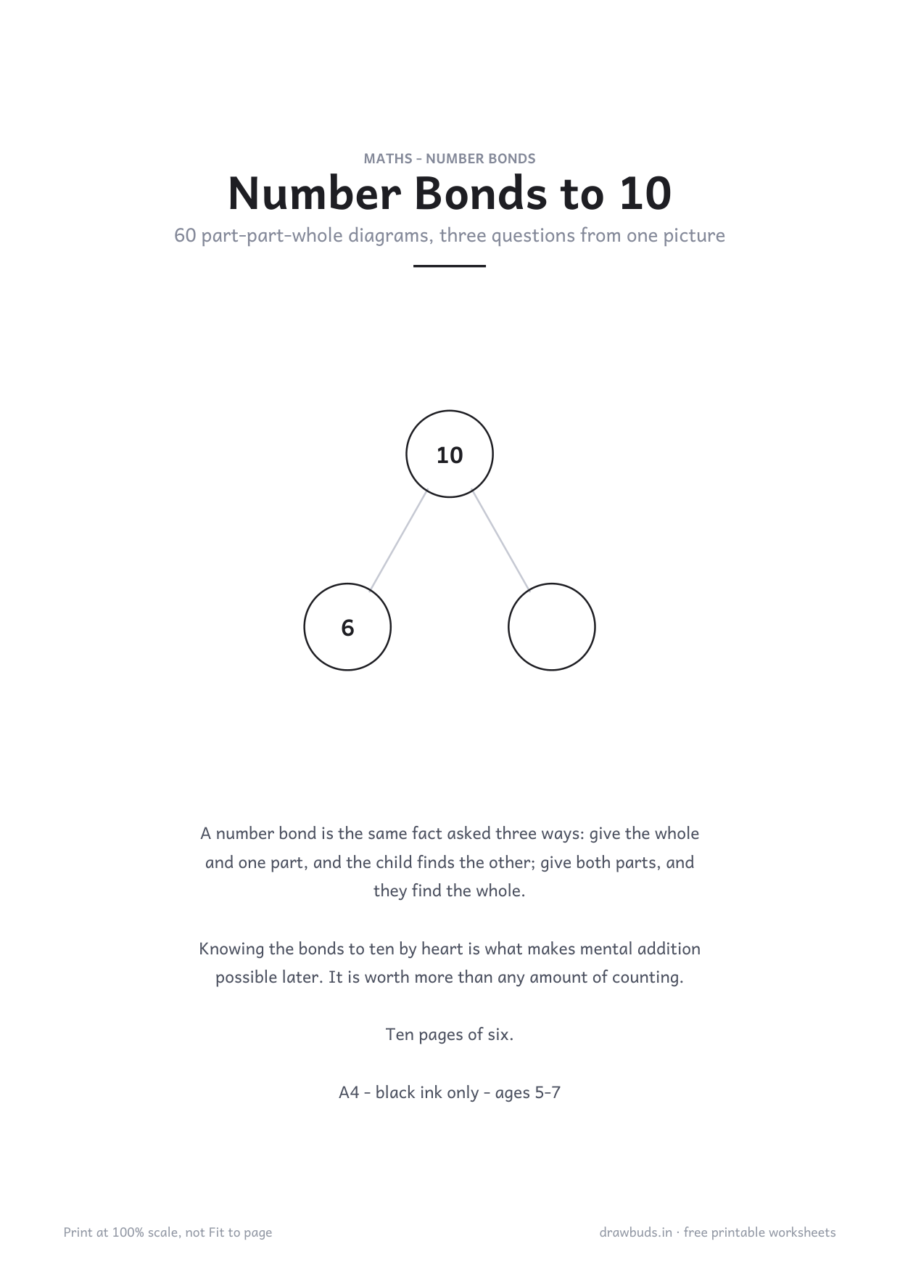
A number bond is three circles: one whole at the top, two parts below, joined by lines. Leave any one of them empty and you have a different question — and that is the whole point of the diagram. 6 and 4 make 10, 10 take away 6 is 4, 10 take away 4 is 6. One picture, three facts.
What is on each page
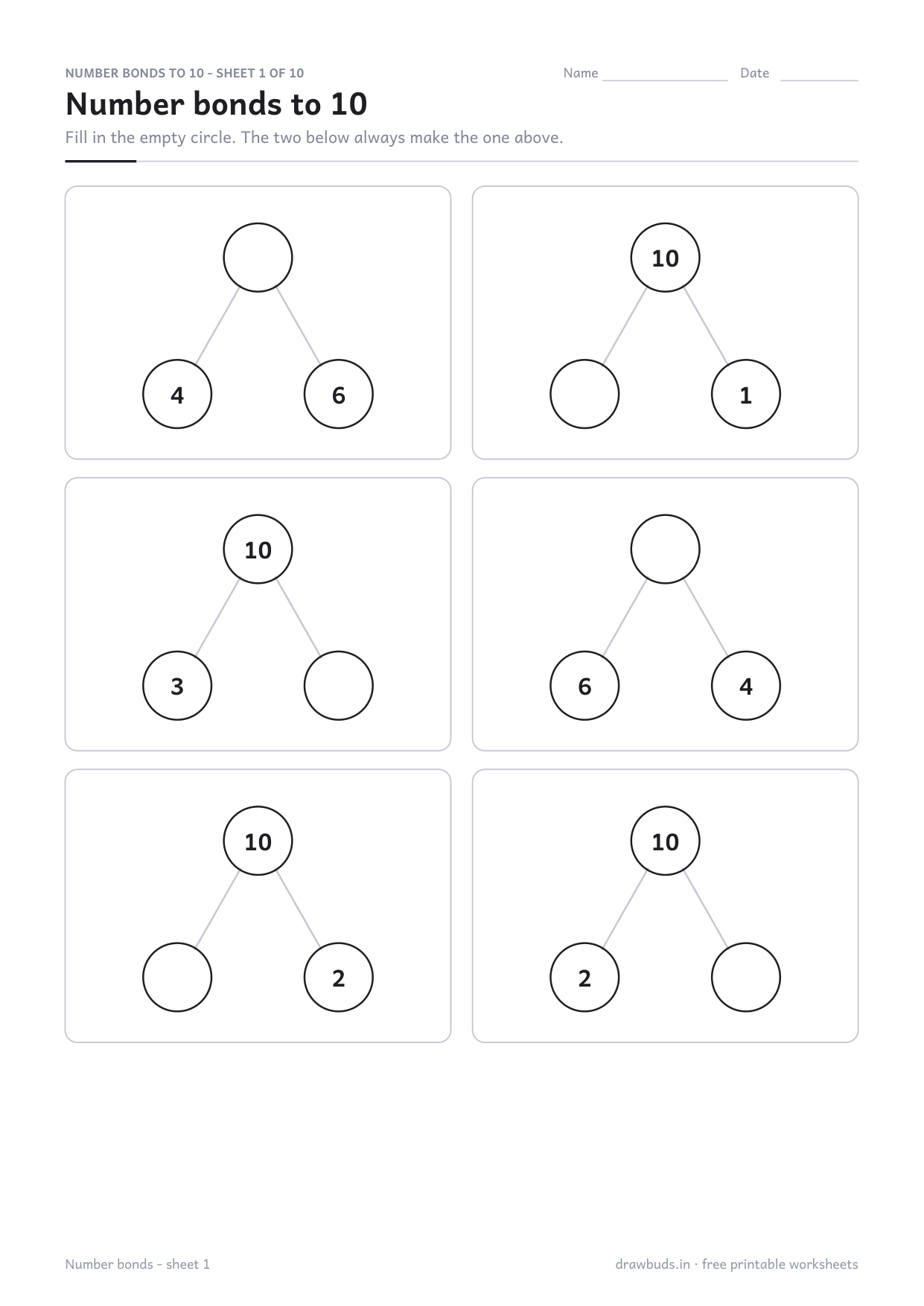
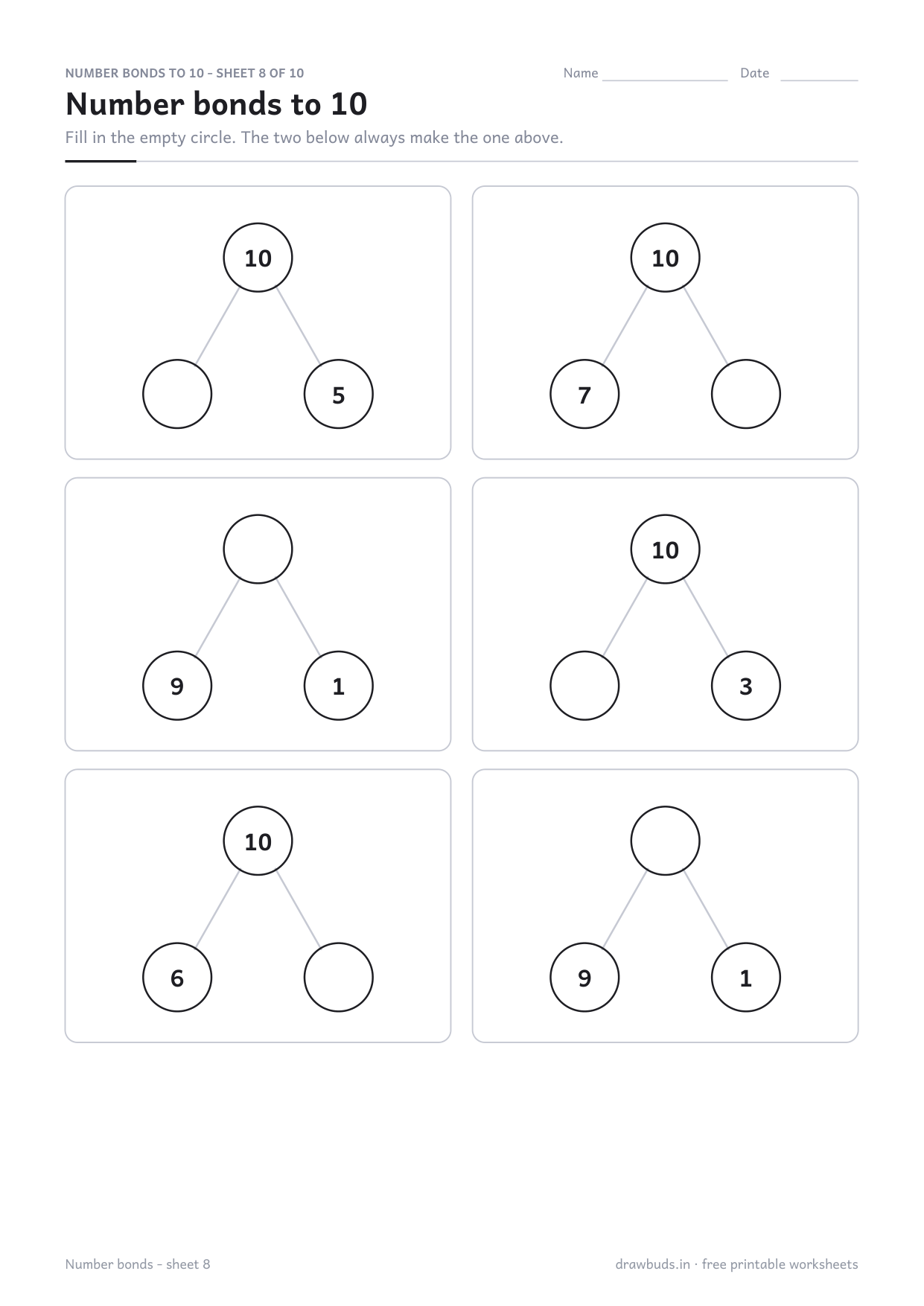
Six bonds in two columns. Which circle is left empty rotates as you work down the page, so a child cannot settle into answering the same kind of question six times.
The first six sheets are all bonds to ten. The last four use totals from five to ten, because a child who has only ever seen bonds to ten will sometimes think the diagram itself means ten.
Why the bonds to ten are worth memorising
They are the smallest set of facts with the biggest return in early maths. A child who knows instantly that 7 and 3 make 10 can do 7 + 5 by splitting the 5 into 3 and 2 — make ten, then add the rest. That method, taught everywhere as “bridging through ten”, does not work at all until the bonds are automatic.
There are only five pairs to learn: 1 and 9, 2 and 8, 3 and 7, 4 and 6, 5 and 5. That is a small enough list to say at bedtime.
Do it with objects first
Ten counters, two hands. Put some in each hand behind your back, show one hand, ask how many are hidden. It is the same question the diagram asks and it is much more interesting. The worksheet is for recording what has already been understood.
Part-part-whole, and why the layout matters
The whole is drawn above and the parts below, joined by lines, because that arrangement carries over into bar models and then into algebra. A child who has seen it this way for two years reads a bar model without being taught one.
What comes next
Addition Within 10 and Subtraction Within 10 both become easy once the bonds are known — which is the fastest way to show a child that the memorising was worth it.
Printing this one correctly
In your printer dialog set Scale to 100% or Actual size, not Fit to page. Fit to page shrinks the tracing letters and they stop matching the size a child's hand is learning.
Plain paper is fine for crayons and pencils. If your child uses felt pens, 100 gsm paper stops the ink bleeding to the next sheet.