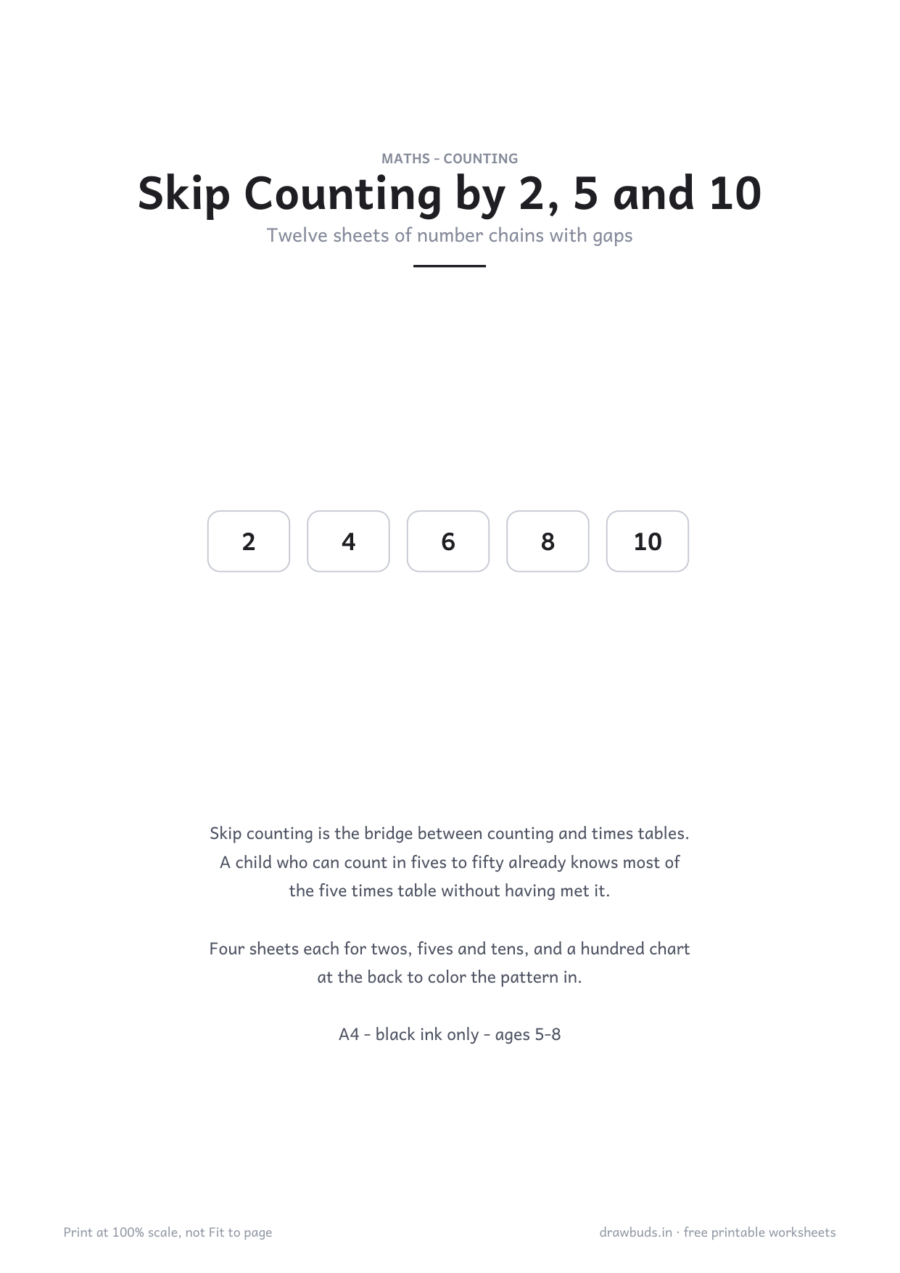
Skip Counting by 2, 5 and 10
13 printable pages. Number chains counting in twos, fives and tens, with three gaps in every row — the bridge between counting and times tables.
- Pages
- 13
- Ages
- 5-8
- Paper size
- A4
- Black ink only
Free to print at home, at school, and in a classroom of thirty.
Twelve sheets of number chains with three gaps in every row
A child who can count in fives to fifty already knows most of the five times table. They do not know that yet, and nobody needs to tell them: skip counting is the version of multiplication that arrives before the word does.
What is in it
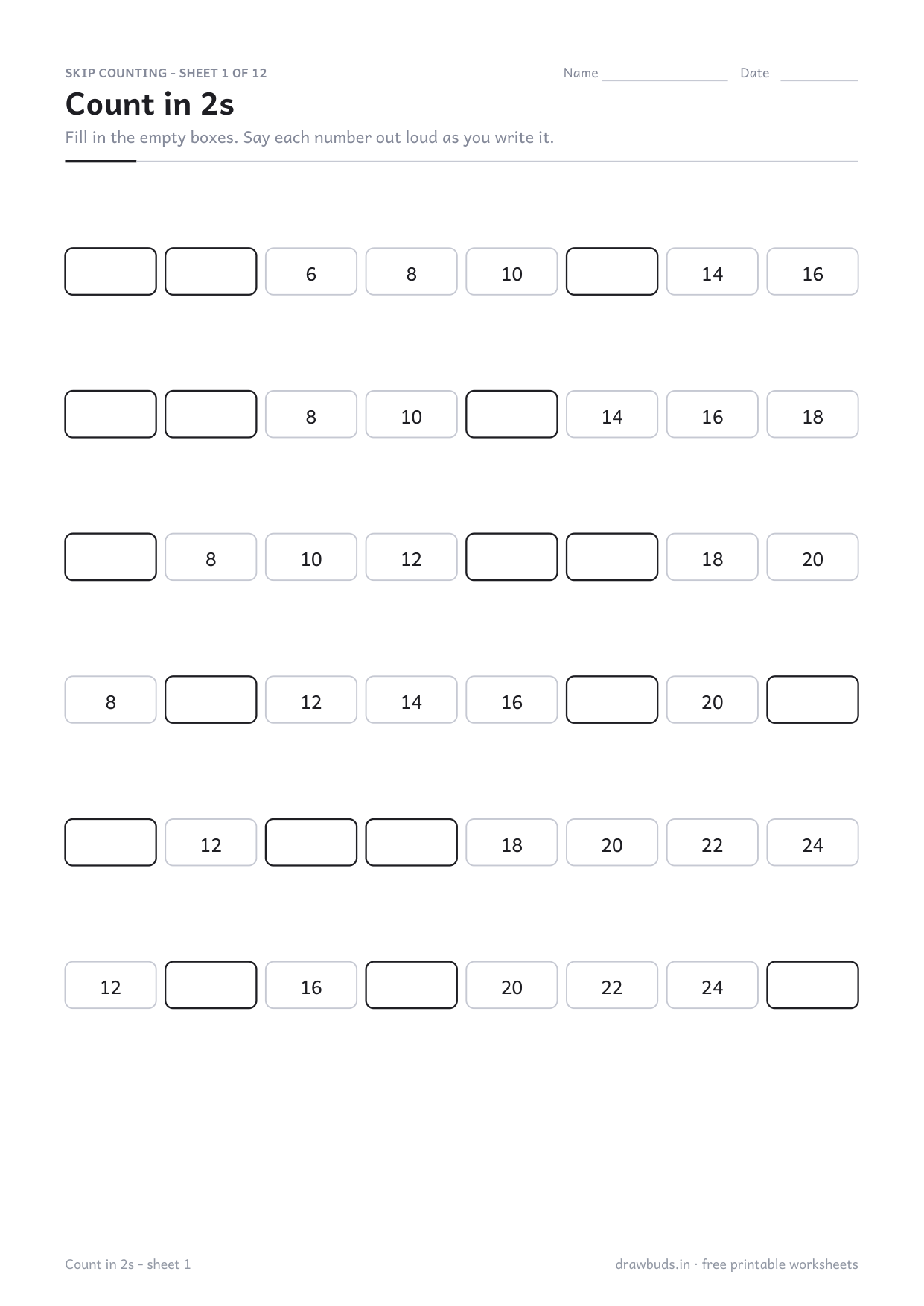
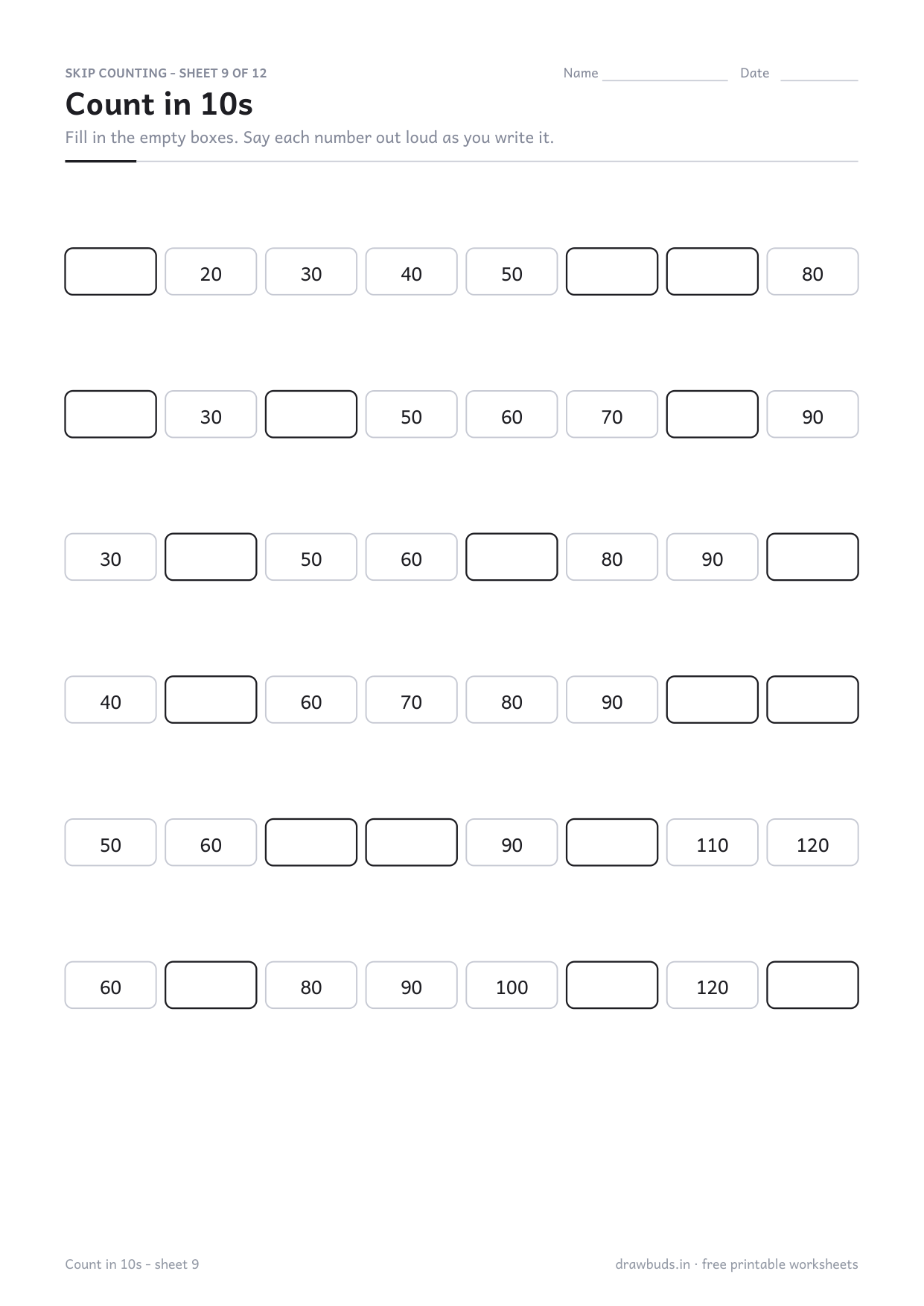
Twelve sheets: four counting in twos, four in fives, four in tens. Each sheet has six chains of eight boxes, with three boxes in every chain left empty. The chains start at different points, so a child cannot answer by remembering where the last row began.
Say it out loud while writing it
Skip counting is a spoken pattern before it is a written one. A child who writes 10, 20, 30 silently is copying; one who says them is learning the chant that will still be there in three years when the times tables arrive. This is the rare worksheet where making noise is the instruction.
Which one to start with
Tens are easiest — only the first digit changes. Fives are next, and the alternating 5 and 0 endings make them almost as easy. Twos are the hardest of the three, despite the smallest step, because every digit changes and there is no visual pattern to lean on.
The book runs twos, fives, tens in that order because it follows the school sequence, but there is no harm at all in doing the tens first if a child is stuck.
Where it connects
Counting in twos is the same thing as odd and even. Counting in tens is the column structure of a hundred chart — every jump lands directly below the last one, which is worth showing on the chart rather than explaining.
What comes next
Missing Numbers 1 to 100, where the same patterns appear as columns and rows rather than as a line.
Printing this one correctly
In your printer dialog set Scale to 100% or Actual size, not Fit to page. Fit to page shrinks the tracing letters and they stop matching the size a child's hand is learning.
Plain paper is fine for crayons and pencils. If your child uses felt pens, 100 gsm paper stops the ink bleeding to the next sheet.