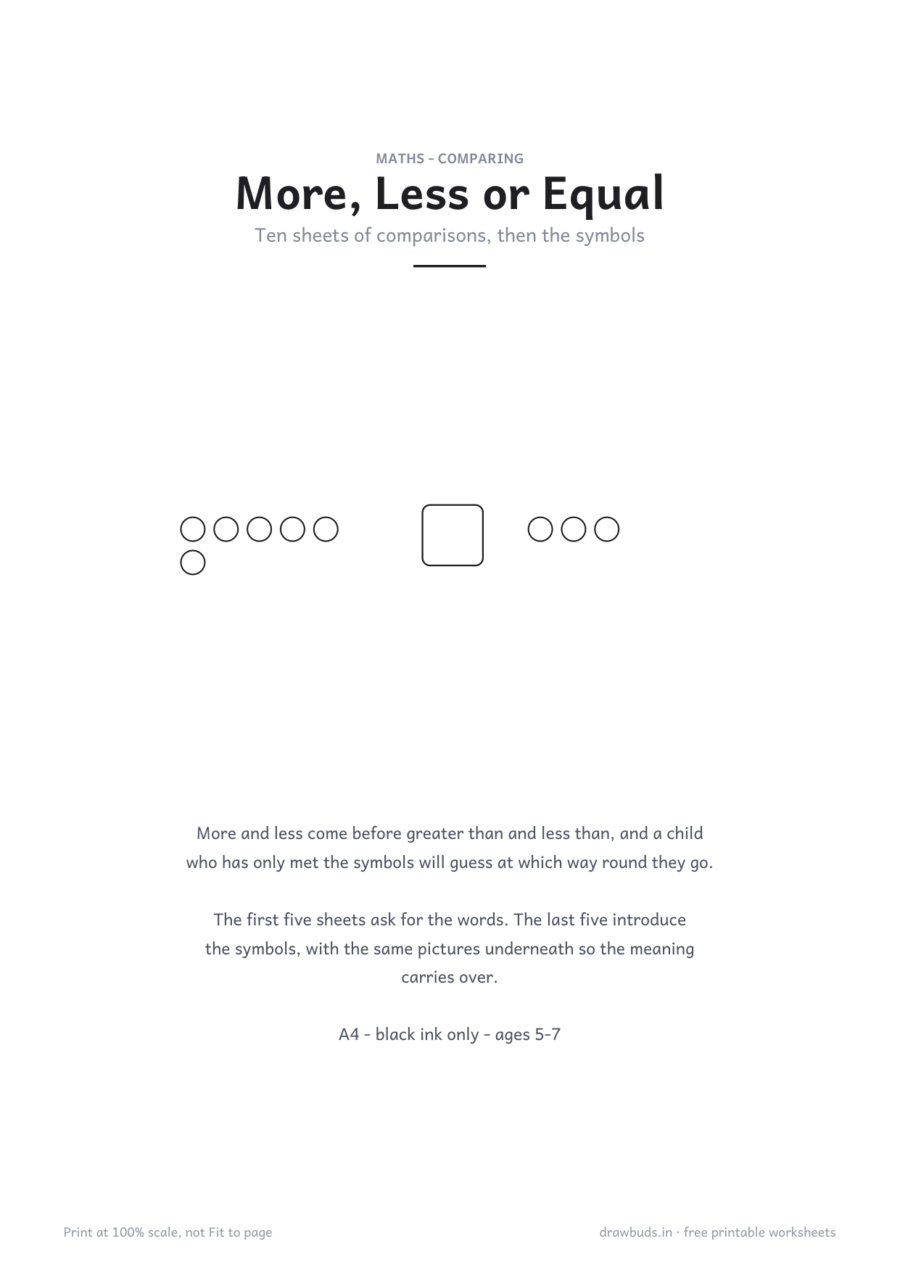
More, Less or Equal
11 printable pages. Five sheets asking for the words more, less and equal, then five introducing the and = symbols with the same pictures underneath.
- Pages
- 11
- Ages
- 5-7
- Paper size
- A4
- Black ink only
Free to print at home, at school, and in a classroom of thirty.
Five sheets in words, five with the < > = symbols
The greater-than symbol is taught as a crocodile mouth, an arrow, a bird’s beak, and half a dozen other things, because children get it backwards constantly. They get it backwards because they meet the symbol before they have done much comparing.
So the first half of this book has no symbols in it at all.
What is on each page
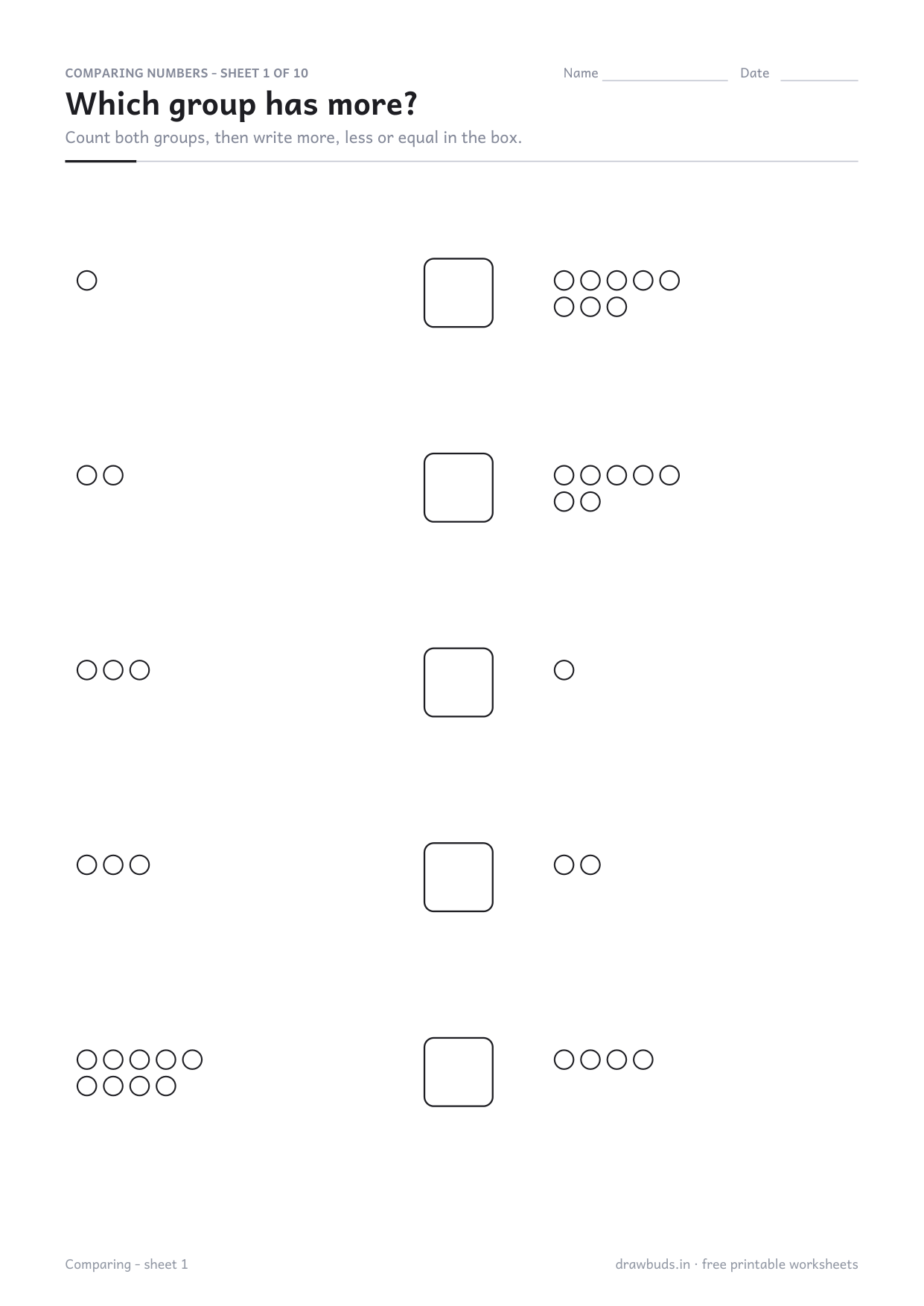
Five rows. Each row has a group of counters on the left, a group on the right, and a box in the middle.
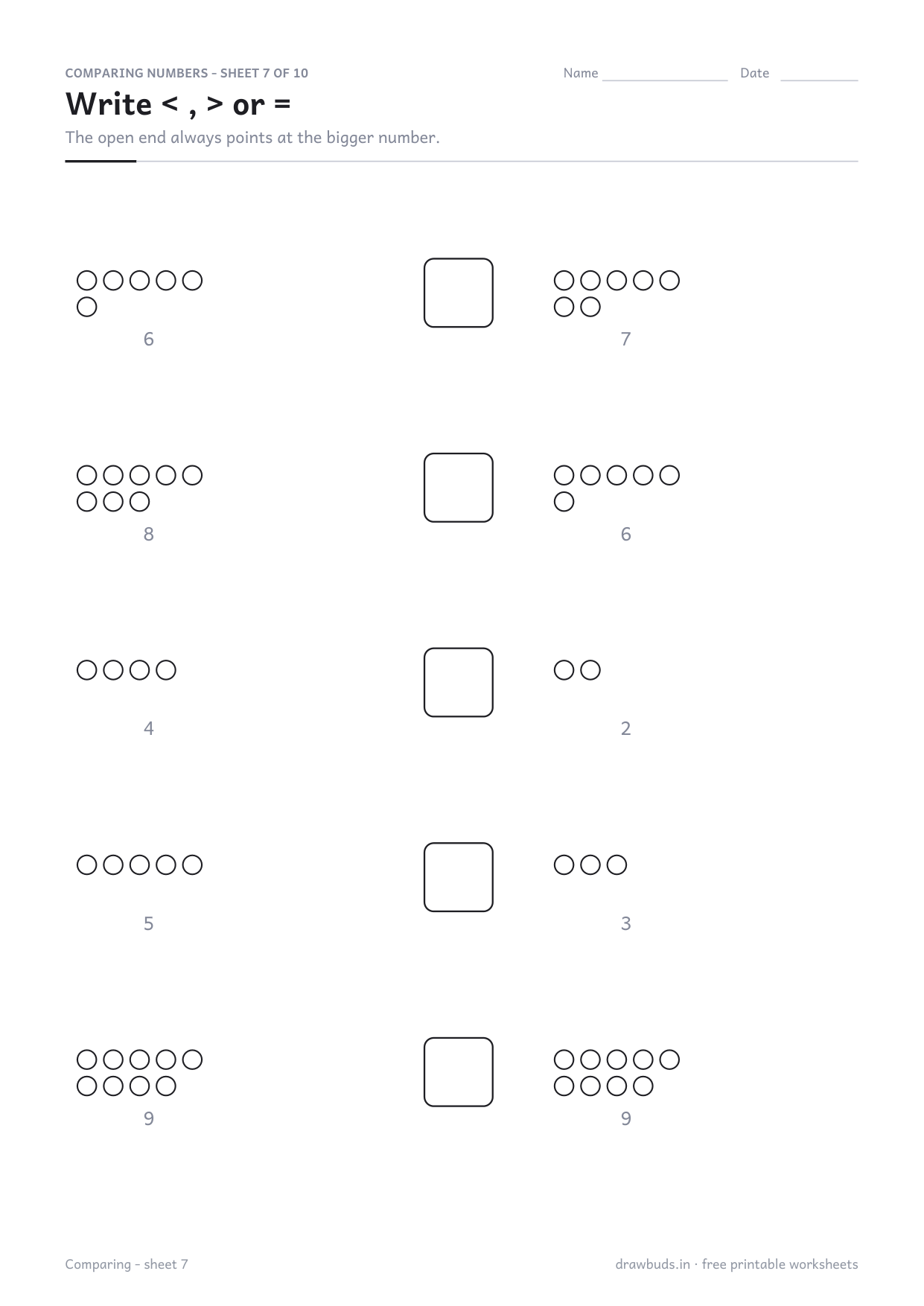
Sheets 1 to 5 ask for the word: more, less or equal. Sheets 6 to 10 ask for <, > or =, with the numerals printed under each group so the picture and the numbers can be checked against each other.
The one thing to say about the symbol
The open end always points at the bigger number. That is it — one rule, no crocodile. The mouth story works for a week and then a child meets 3 < 8 with no picture and has forgotten which animal it was.
Equal is the hard one
Children answer more and less long before they will volunteer equal. Given two groups of five, many will still pick one as bigger, because the question sounds like it wants a winner. Equal rows are scattered through every sheet on purpose, and they are worth stopping on.
Counting is allowed
The counters are there to be counted. Comparing two numbers without counting comes later and comes on its own, once the numbers themselves are familiar. Nothing is gained by covering the pictures up.
What comes next
Missing Numbers 1 to 100 builds the number order this book relies on, and Subtraction Within 10 is where comparing turns into finding the difference.
Printing this one correctly
In your printer dialog set Scale to 100% or Actual size, not Fit to page. Fit to page shrinks the tracing letters and they stop matching the size a child's hand is learning.
Plain paper is fine for crayons and pencils. If your child uses felt pens, 100 gsm paper stops the ink bleeding to the next sheet.