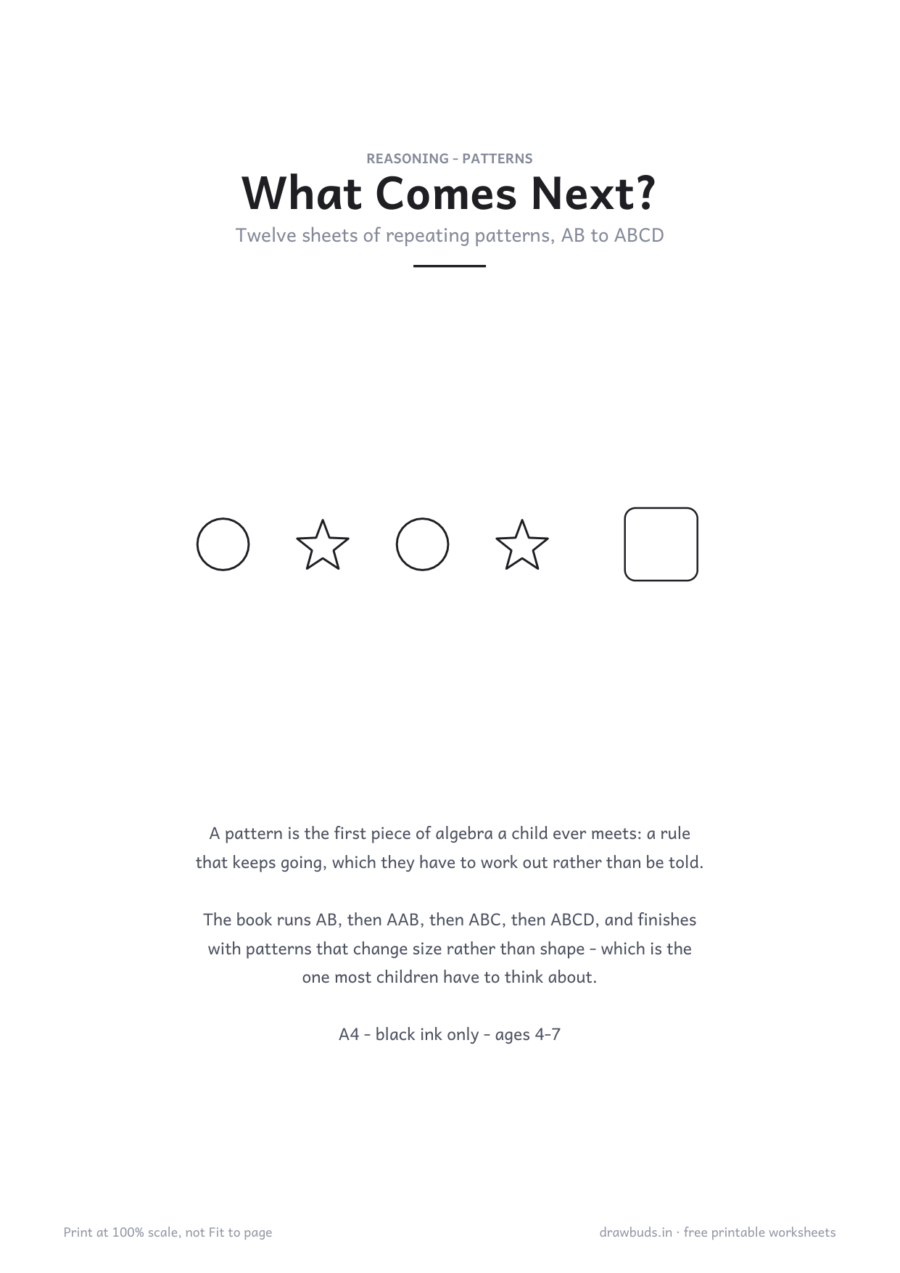
What Comes Next? Pattern Worksheets
13 printable pages. Repeating patterns from AB to ABCD, finishing with two sheets where the shape stays the same and only the size changes.
- Pages
- 13
- Ages
- 4-7
- Paper size
- A4
- Black ink only
Free to print at home, at school, and in a classroom of thirty.
AB, AAB, ABC, ABCD, and two sheets where only the size changes
A pattern is the first piece of algebra a child ever meets: a rule that carries on, which they have to work out rather than be told. Nobody explains the rule on these pages — that is the exercise.
How it builds
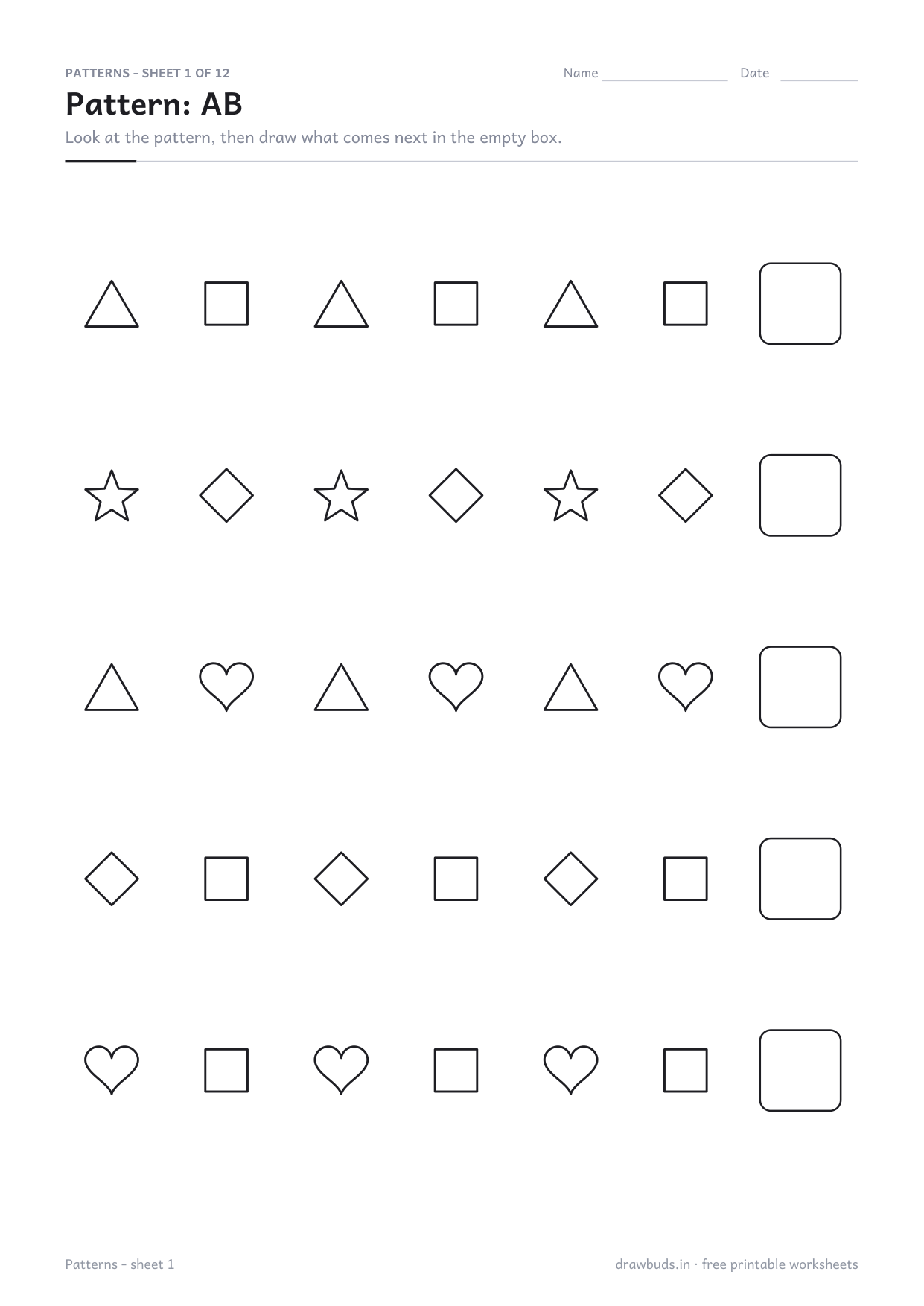
| Sheets | Pattern | Looks like |
|---|---|---|
| 1-2 | AB | circle, star, circle, star… |
| 3-4 | AAB | circle, circle, star… |
| 5 | ABB | circle, star, star… |
| 6-7, 10 | ABC | three shapes in rotation |
| 8 | ABCD | four shapes in rotation |
| 9 | AABB | pairs |
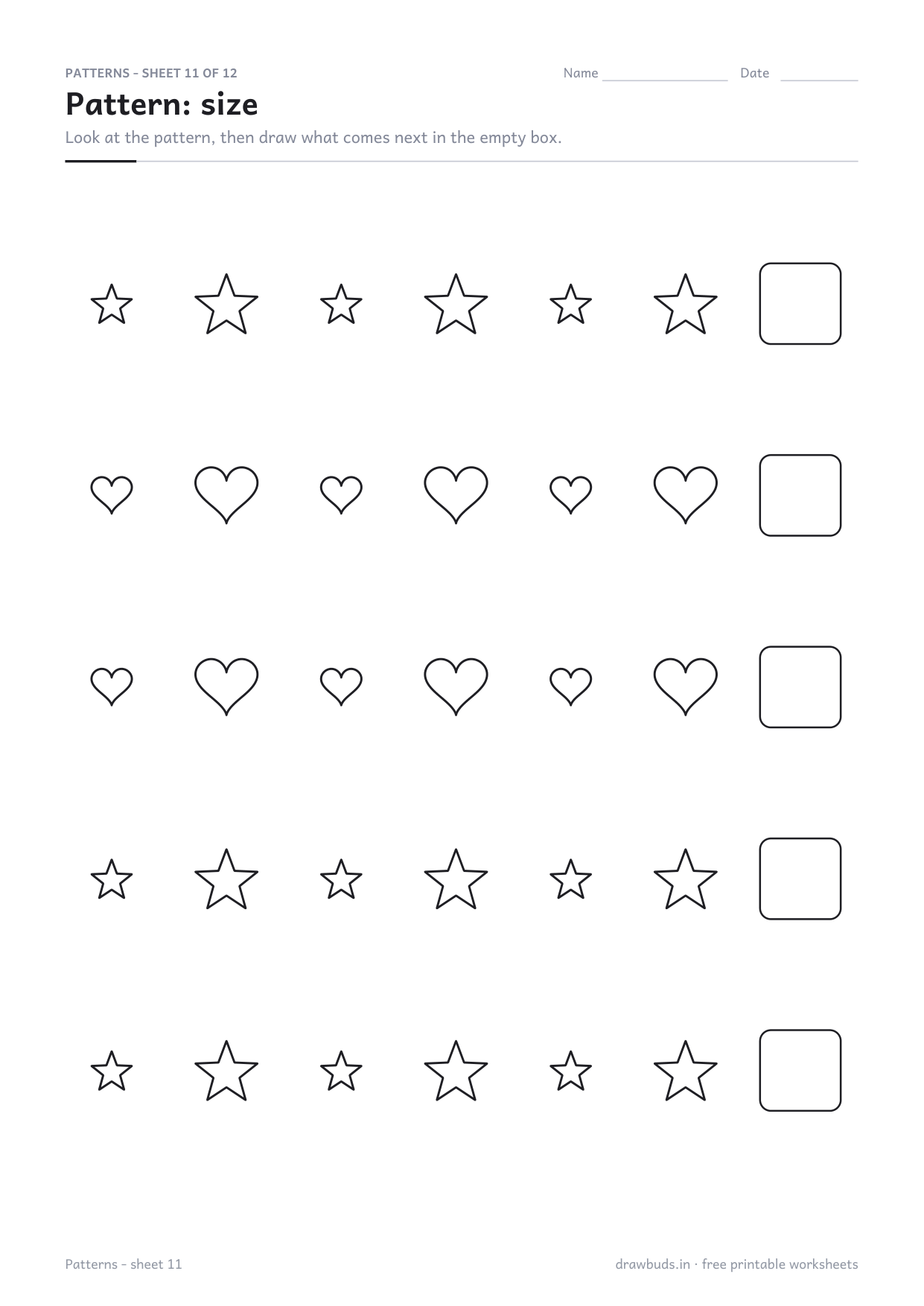
| 11-12 | size | one shape, big and small alternating |
Five rows per sheet, six shapes shown and an empty box at the end of each row.
The size sheets are the hard ones
Children handle AB and ABC quickly because the shapes are different and the difference is obvious. When every shape in the row is a star and only the size changes, many of them stall — they have been looking at what the shapes are rather than at the sequence. Those two sheets are at the back for that reason, and they are worth doing slowly.
Say the pattern out loud
“Circle, star, circle, star…” and keep going past the end of the printed row. Almost every child who cannot see the answer can hear it. Saying it is also how they discover the pattern has a name — AB — which is what lets them recognise the same rule in a different set of shapes.
Beyond the page
Patterns are easy to make with anything: buttons, cutlery, socks, steps. A child who can build one is further on than a child who can only finish one, so once a few sheets are done, ask them to make a pattern for you and get one wrong on purpose.
What comes next
Find the Odd One Out uses the same close looking for a different purpose, and Skip Counting is the same idea in numbers.
Printing this one correctly
In your printer dialog set Scale to 100% or Actual size, not Fit to page. Fit to page shrinks the tracing letters and they stop matching the size a child's hand is learning.
Plain paper is fine for crayons and pencils. If your child uses felt pens, 100 gsm paper stops the ink bleeding to the next sheet.