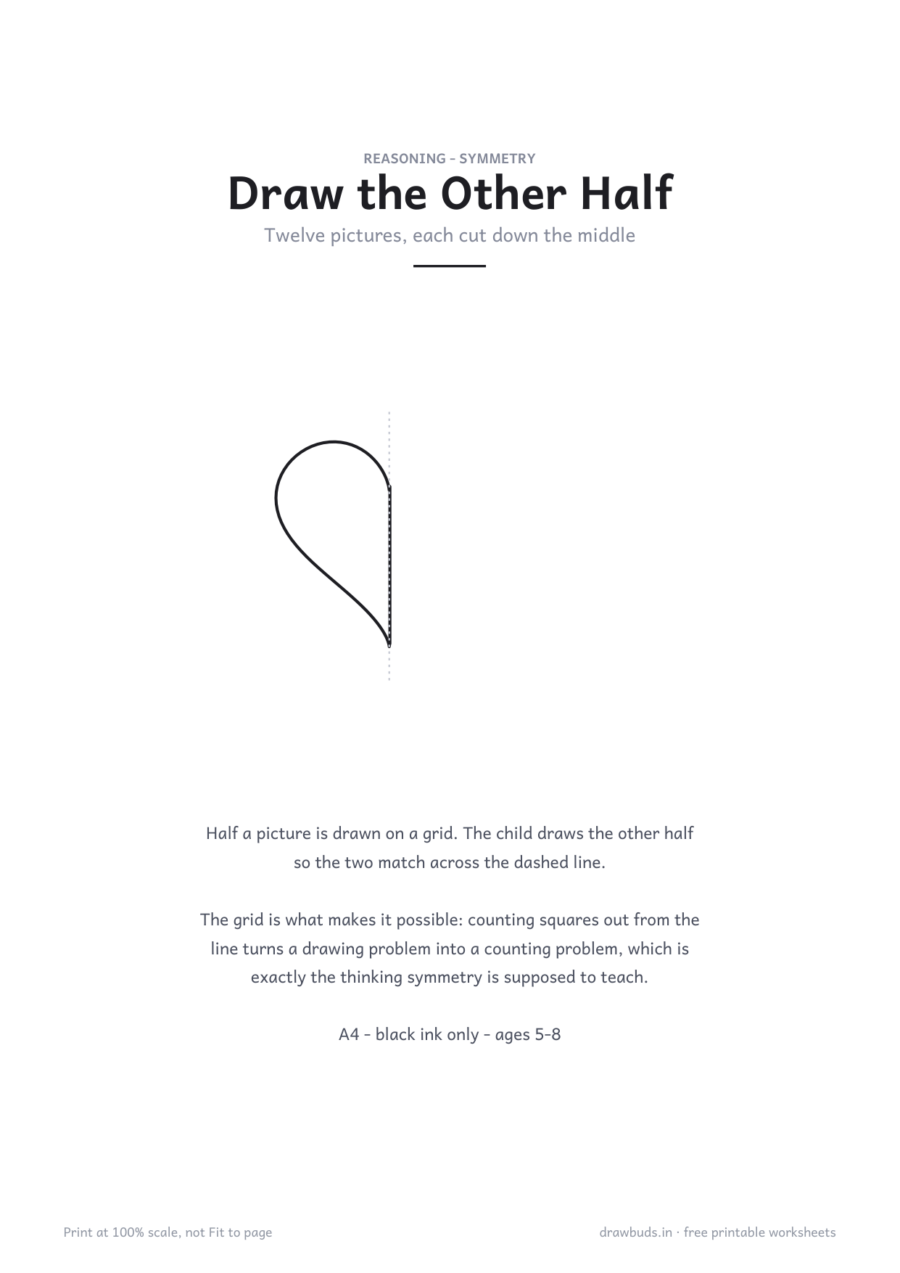
Symmetry: Draw the Other Half
13 printable pages. Half a picture on a 16 by 16 grid, and a dashed line to mirror it across. The grid turns a drawing problem into a counting problem.
- Pages
- 13
- Ages
- 5-8
- Paper size
- A4
- Black ink only
Free to print at home, at school, and in a classroom of thirty.
Twelve pictures on a 16 by 16 grid, cut down the middle
Half a picture is drawn on a grid, with a dashed line down the middle. The child draws the other half so the two match. That is the whole book, twelve times, and it is harder and more absorbing than it sounds.
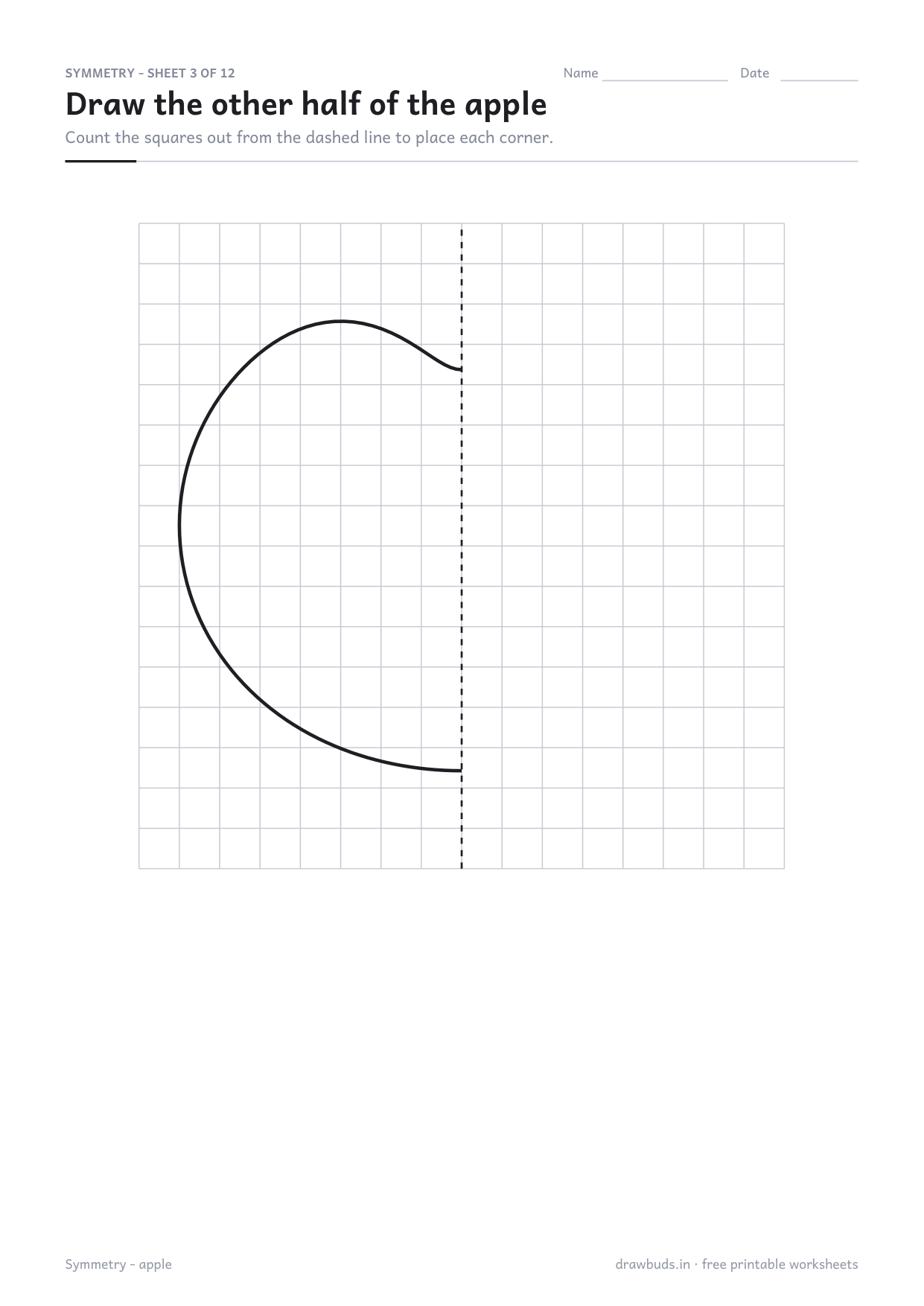
The grid is the teaching
Without it, completing a symmetrical picture is a freehand drawing task and a child either has the eye for it or does not. With a 16 by 16 grid, it becomes counting: this corner is four squares left of the line and two squares up, so the matching corner is four squares right and two up.
That is exactly the reasoning symmetry is supposed to teach, and the grid is what makes it available to a five-year-old.
The twelve pictures
A star, a heart, an apple, a house, a tree, a rocket, a kite, a crown, a moon, an ice cream, a diamond and a flower. All are symmetrical about a vertical line, and they run roughly easiest first — the diamond and the kite are four straight lines, the flower and the apple are curves.
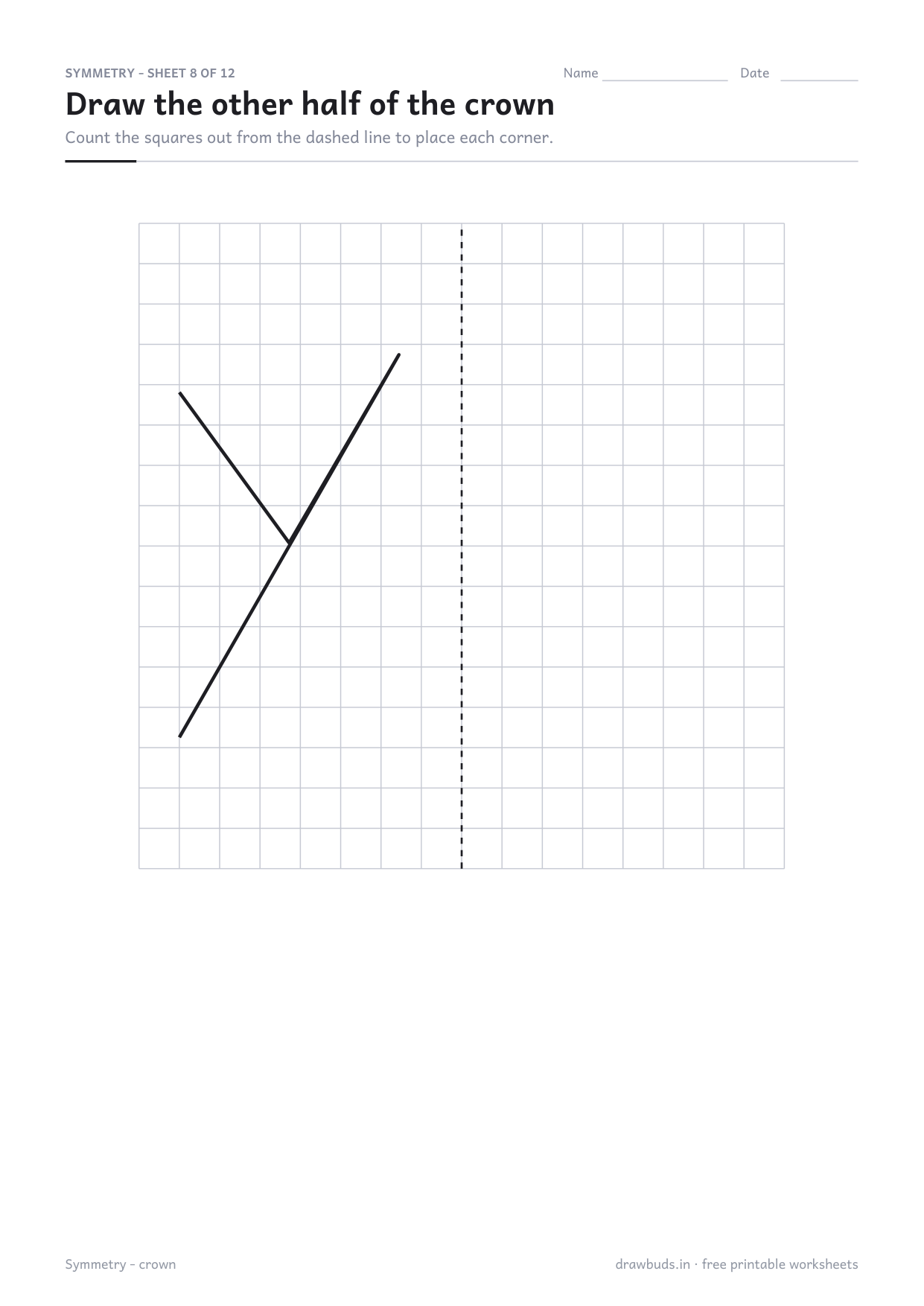
Corners first, curves after
The method worth teaching: mark the mirrored position of every corner as a dot, check the dots look right, and only then join them. A child who starts drawing the outline immediately will drift, discover it near the bottom, and have to start again.
On the curved pictures, mark the point where the outline crosses each grid line instead.
Checking it
Fold the page along the dashed line and hold it up to a window. If the halves sit on top of each other, it is right. This is far better than being told, and it is why the dashed line is exactly on a grid line rather than between two.
What comes next
Draw It in Four Steps for a child who enjoys the drawing more than the counting, and 2D and 3D Shapes for the geometry vocabulary this sits inside.
Printing this one correctly
In your printer dialog set Scale to 100% or Actual size, not Fit to page. Fit to page shrinks the tracing letters and they stop matching the size a child's hand is learning.
Plain paper is fine for crayons and pencils. If your child uses felt pens, 100 gsm paper stops the ink bleeding to the next sheet.