Addition and Subtraction Word Problems
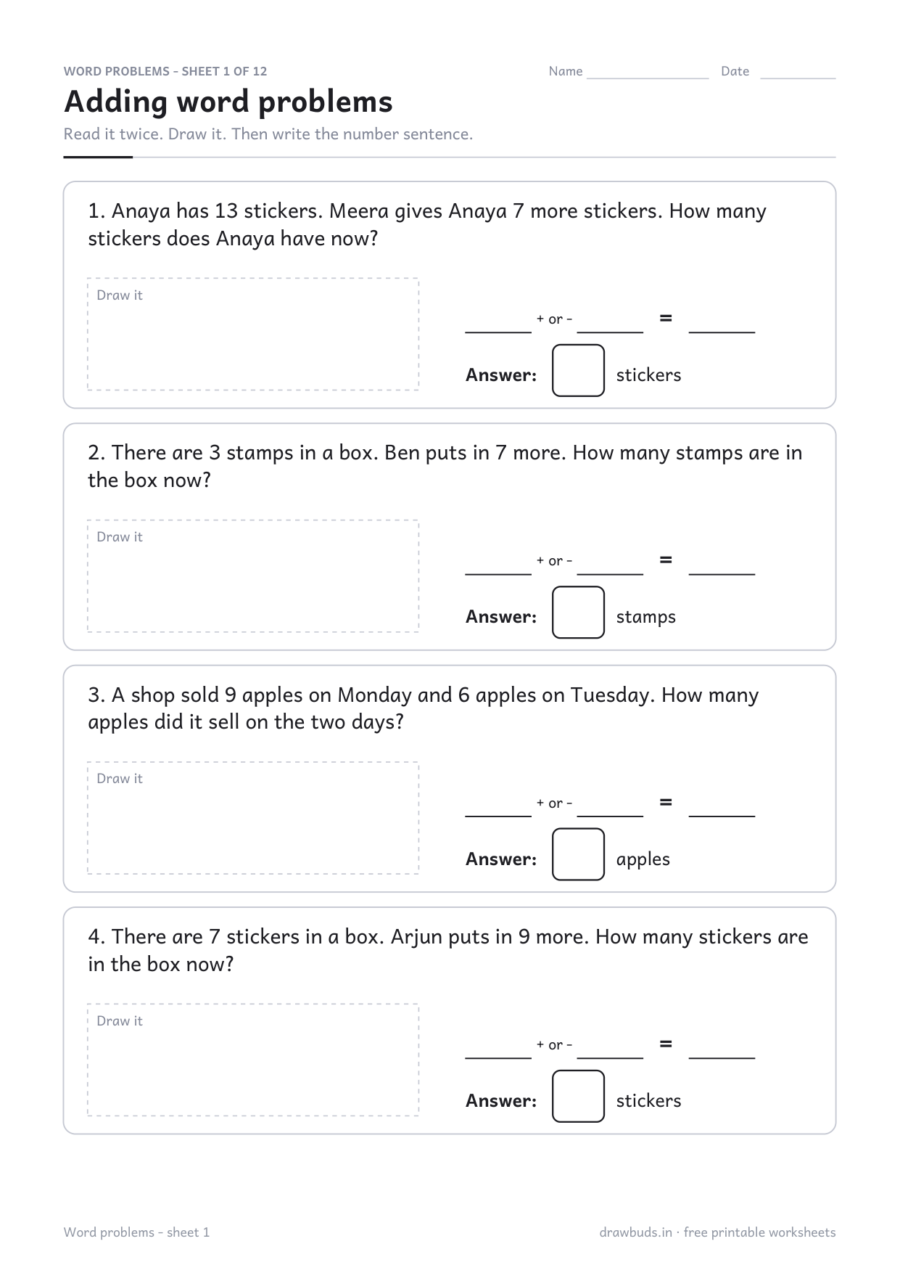
Addition and subtraction word problems for class 1 and 2: 48 short stories with room to draw, a number sentence and an answer box. Free PDF.
- Pages
- 14
- Ages
- 6-8
- Paper size
- A4 and US Letter
- Black ink only
Same worksheets, two paper sizes. Free to print at home, at school, and in a classroom of thirty.
48 story problems with a drawing space, number sentence and answer box
These addition and subtraction word problems are for the child who can do 12 + 5 on a page of sums but freezes when the same thing is written as a story. The arithmetic is not the problem. The missing step is turning the story into a sum, and that step is what every page here practices.
How each problem is laid out
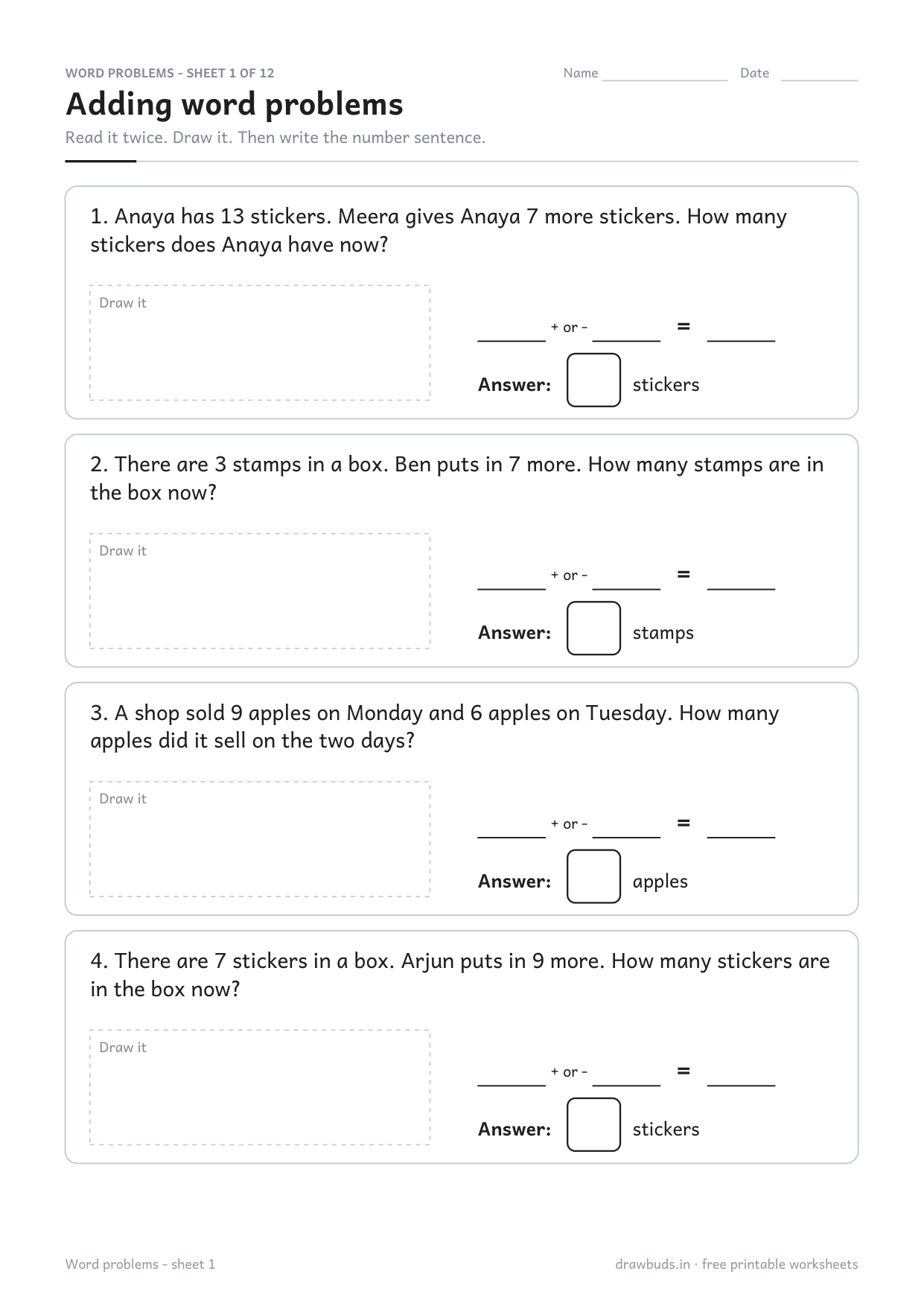
Four problems per sheet, each in its own box with three parts:
- The story, one or two sentences with a question at the end.
- A “draw it” space for circles, sticks or a quick sketch of the marbles.
- A number sentence to fill in (a blank, then + or −, then a blank, then =), and an answer box with the unit printed beside it: stickers, children, pages.
The unit is there on purpose. “Answer: 17” is a sum. “Answer: 17 stickers” means the child has gone back to the story.
The order of the 12 sheets
- Sheets 1-4: addition word problems within 20. Joining, putting together, “how many altogether”.
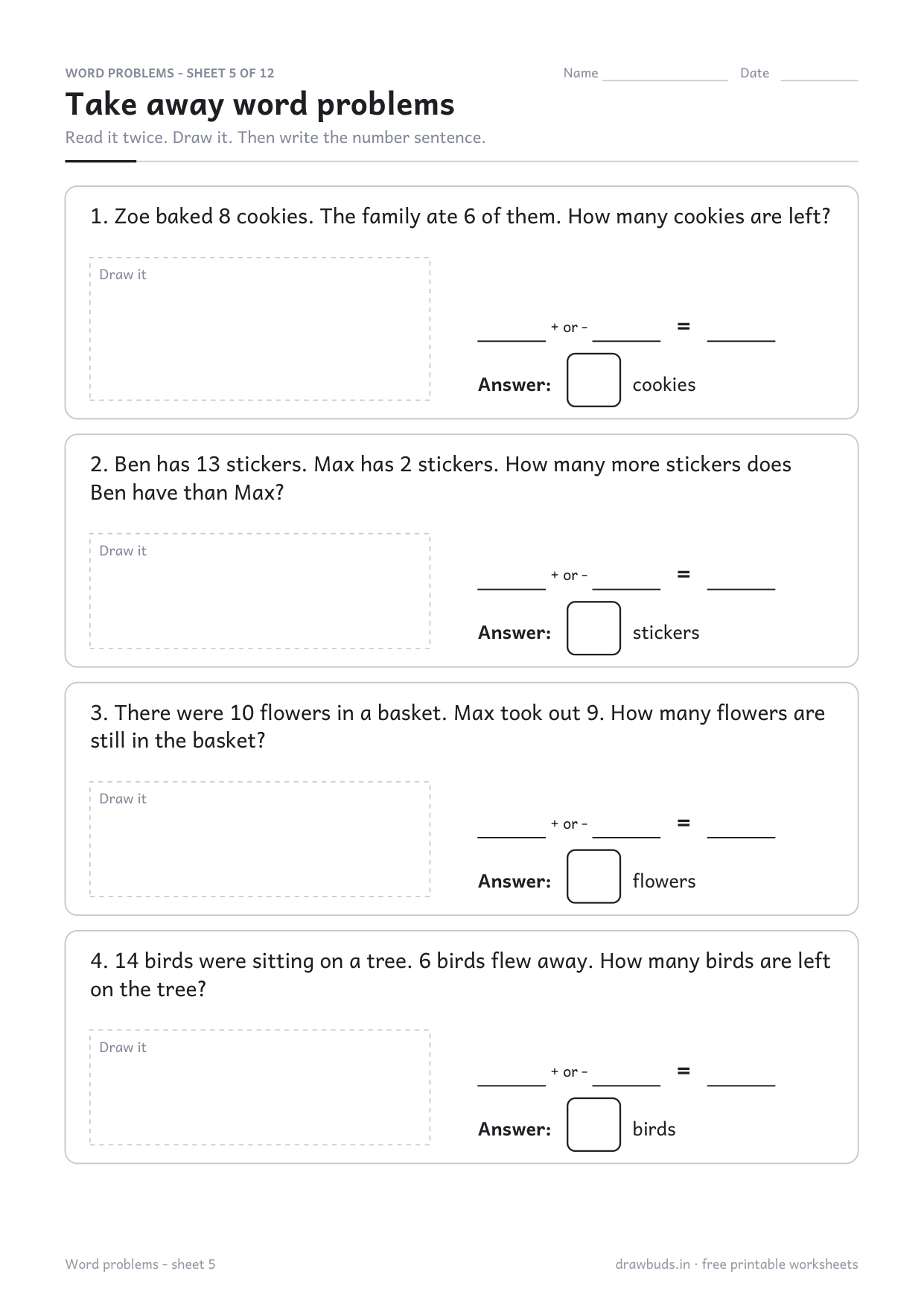
- Sheets 5-8: subtraction word problems within 20, including “how many more” comparisons.
- Sheets 9-10: mixed addition and subtraction with 2 digit numbers, no regrouping.
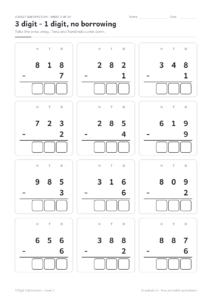
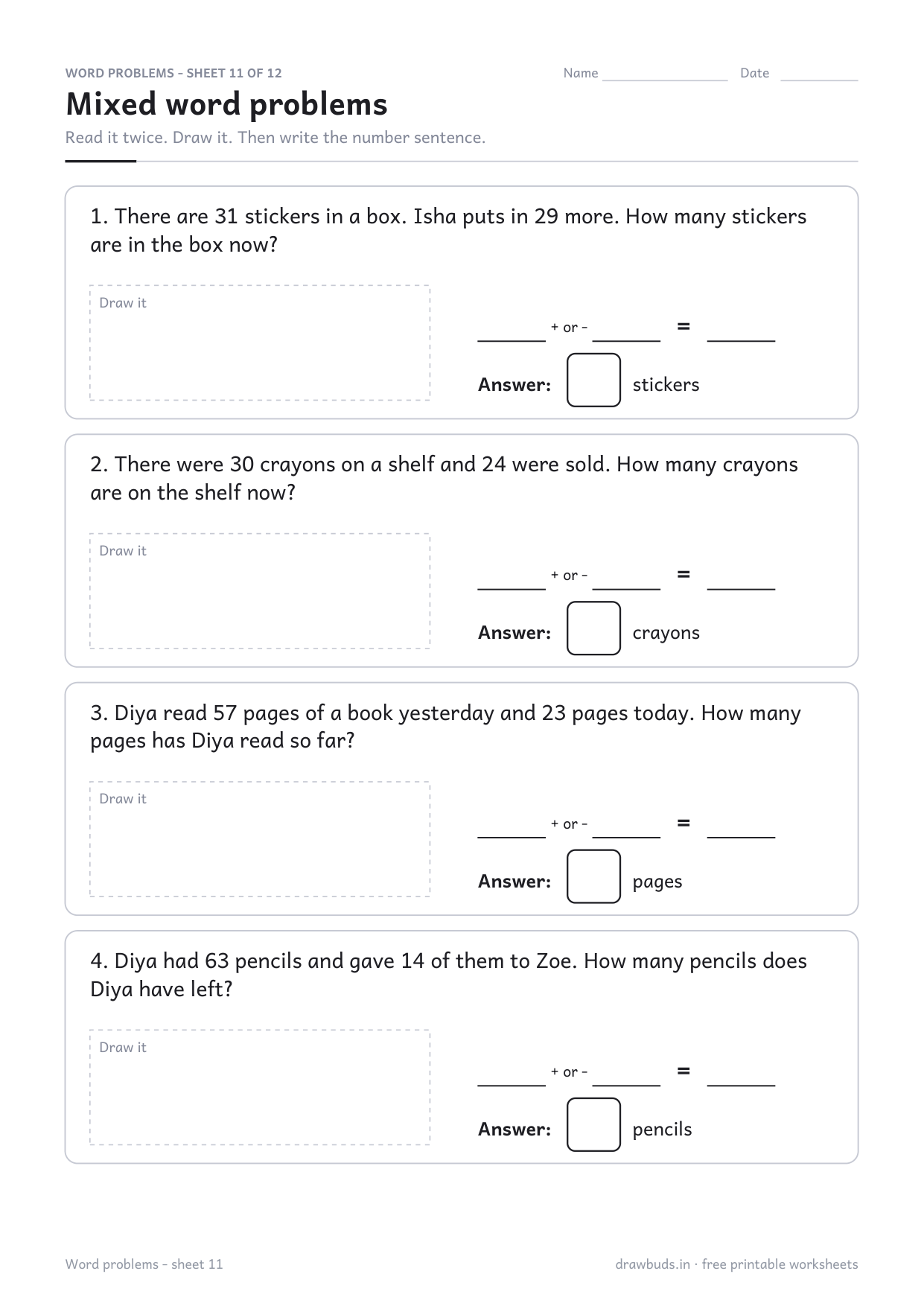
- Sheets 11-12: mixed, 2 digit numbers with carrying or borrowing.
The last page lists the number sentence for all 48 problems.
“How many more” is subtraction
“Ben has 13 stickers and Max has 2. How many more does Ben have?” This question catches more class 1 children than any other. The word “more” makes them add, and they write 15. It is subtraction: find the difference. If it keeps happening, draw both groups in the space, one above the other, and match them up. The stickers left without a partner are the answer.
Read it twice, draw it, then write the sum
Every sheet repeats that instruction because it works in that order. The first reading is for the story and the second is for the numbers. The drawing slows the child down enough to notice whether things are joining or leaving. Let the drawing be rough. Circles for marbles are fine.
Class 1, class 2, grade 1 and grade 2
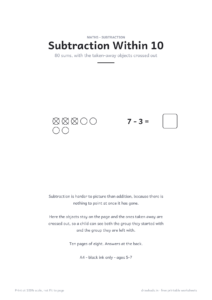
Sheets 1-8 fit class 1 (grade 1). Sheets 9-12 need 2 digit sums, so they fit the second half of class 1 or class 2 (grade 2). A child meeting sheet 11 should have done the carrying sheets in 2 digit addition worksheets and the borrowing sheets in 2 digit subtraction worksheets first. For the within-20 sheets, addition within 10 and subtraction within 10 are the warm-up.
Printing this one correctly
In your printer dialog set Scale to 100% or Actual size, not Fit to page. Fit to page shrinks the tracing letters and they stop matching the size a child's hand is learning.
Plain paper is fine for crayons and pencils. If your child uses felt pens, 100 gsm paper stops the ink bleeding to the next sheet.