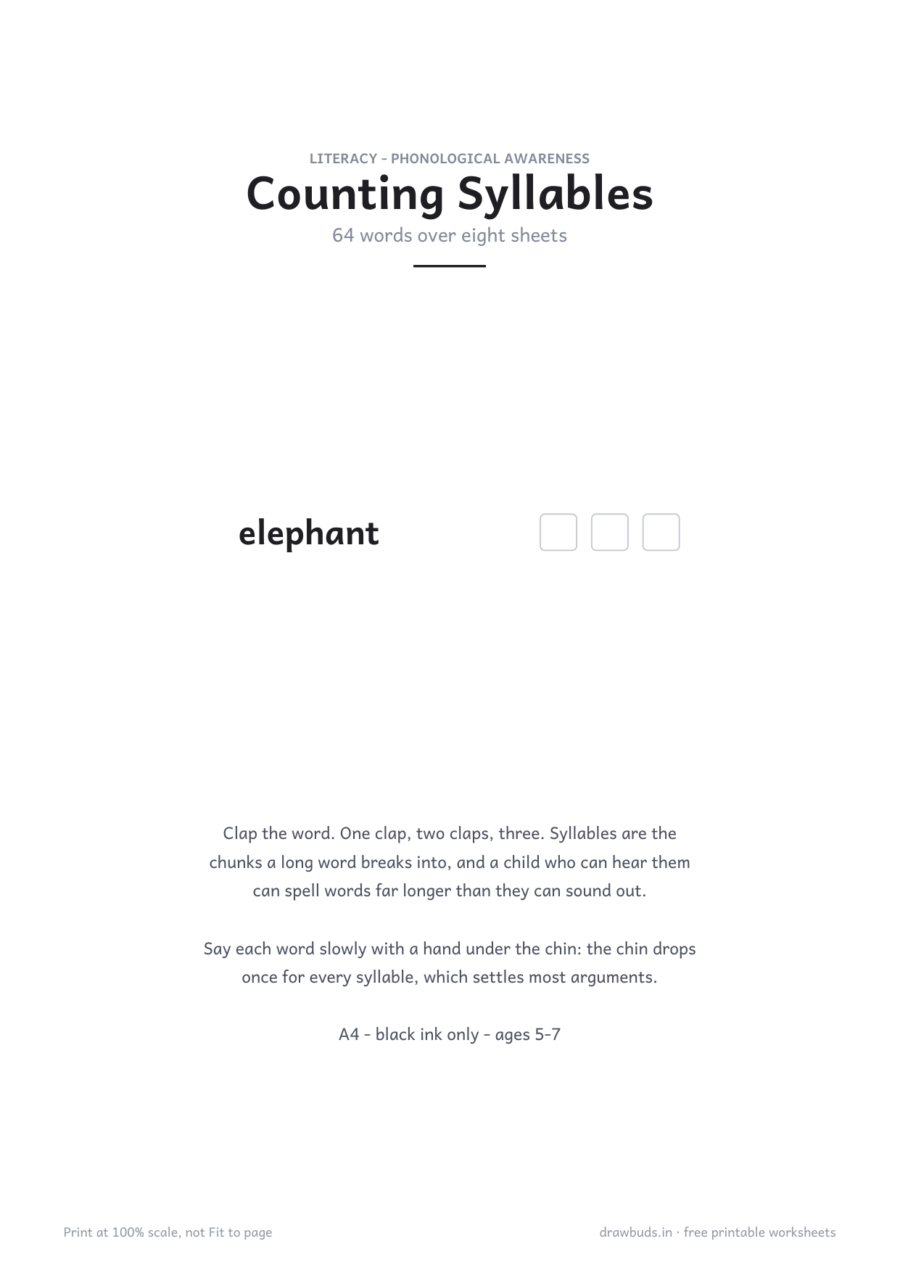
Counting Syllables Worksheets
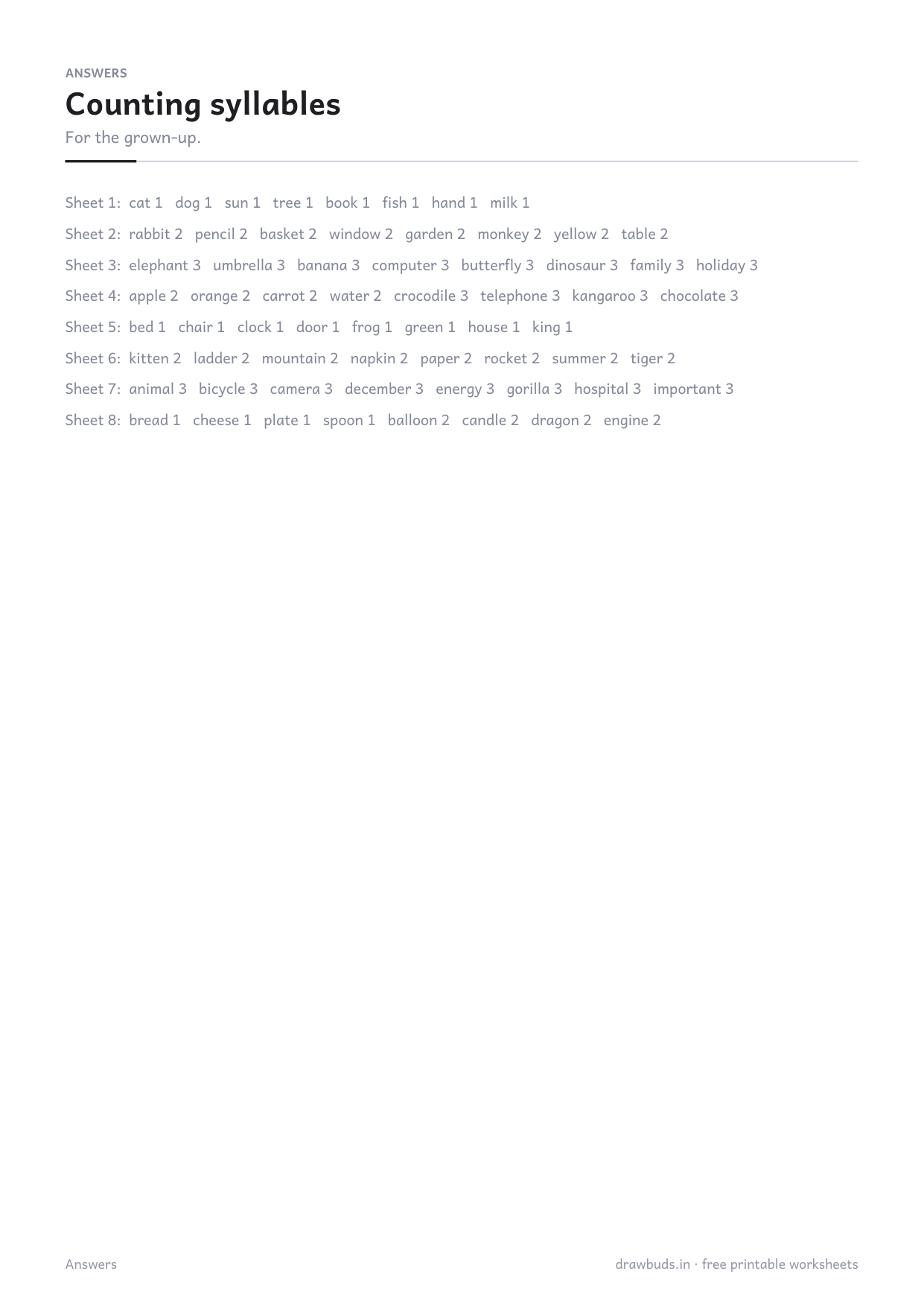
10 printable pages. 64 words with tick boxes for one, two or three claps, and every answer at the back.
- Pages
- 10
- Ages
- 5-7
- Paper size
- A4
- Black ink only
Free to print at home, at school, and in a classroom of thirty.
64 words with tick boxes for one, two or three claps, answers at the back
Clap the word. Cat is one clap. Rabbit is two. Elephant is three. Syllables are the chunks a word breaks into when you say it slowly, and a child who can hear them can spell words far longer than they can sound out letter by letter.
What is on each page
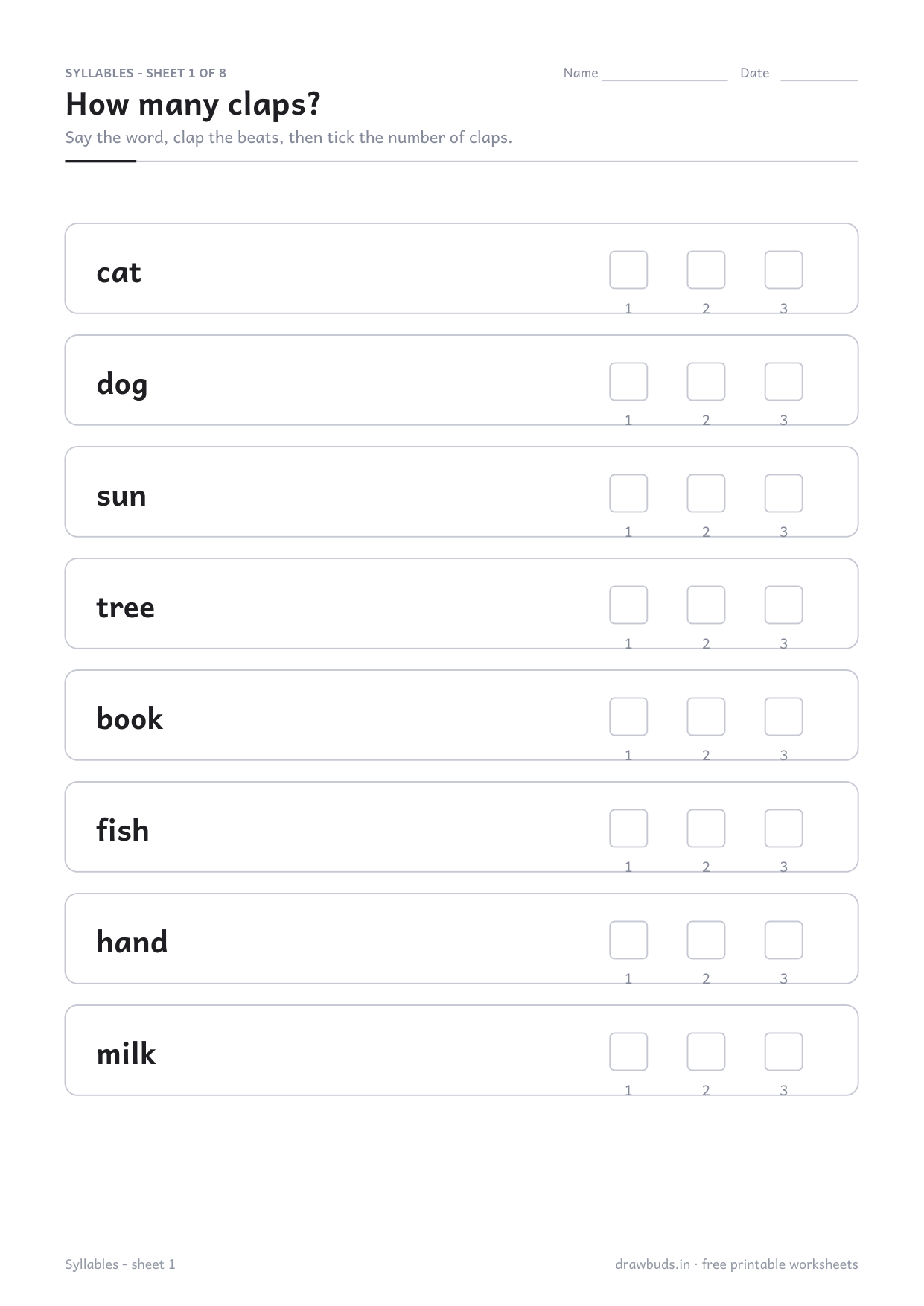
Eight words, each on its own card with three tick boxes numbered 1, 2 and 3. Eight sheets, 64 words, and an answer page at the back.
The words are mixed rather than grouped — a page of eight three-syllable words can be answered without listening to any of them.
The hand-under-the-chin trick
Put a hand flat under the chin and say the word slowly. The jaw drops once for every syllable, because every syllable needs a vowel and every vowel opens the mouth. It settles almost every argument, and it works for the child who claps enthusiastically on every consonant.
Why syllables matter for spelling
A child who can break butterfly into but-ter-fly has three short spelling problems instead of one long one. That is how longer words are actually written, and it is the reason syllable work continues in school long after phonics has moved on.
The words that cause arguments
A few words genuinely vary by accent. Family is three syllables said slowly and two said quickly. Chocolate is the same. The answer page gives the careful, slowly-spoken count, and if a child says two for family they have heard their own speech correctly rather than made a mistake — which is worth telling them.
What comes next
Rhyming Words is the companion skill, and both feed straight into reading longer words. For handwriting practice using the same kind of words, see Animal Names Tracing A-Z.
Printing this one correctly
In your printer dialog set Scale to 100% or Actual size, not Fit to page. Fit to page shrinks the tracing letters and they stop matching the size a child's hand is learning.
Plain paper is fine for crayons and pencils. If your child uses felt pens, 100 gsm paper stops the ink bleeding to the next sheet.