4 Digit Subtraction Worksheets with Borrowing
4 digit subtraction worksheets: 192 column sums in six stages, ending with borrowing across two zeros. Exchange boxes and answers. Free PDF.
- Pages
- 27
- Ages
- 8-10
- Paper size
- A4 and US Letter
- Black ink only
Same worksheets, two paper sizes. Free to print at home, at school, and in a classroom of thirty.
192 column sums under Th, H, T and O in six stages, exchange boxes, answers
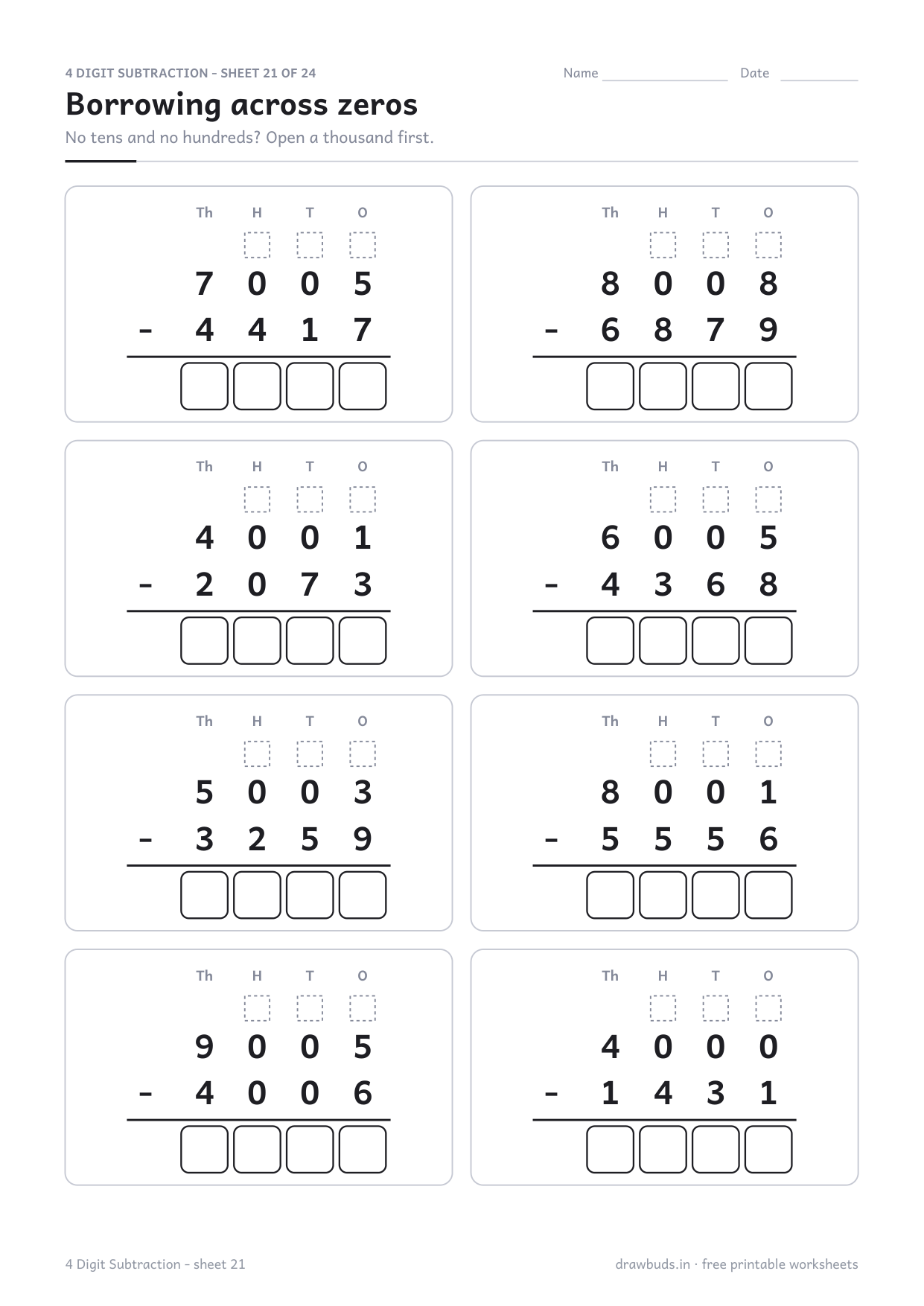
These 4 digit subtraction worksheets finish on the sum most sets never reach: 7005 – 4417, where there are no tens and no hundreds to borrow from. A child has to open a thousand into ten hundreds, then one of those hundreds into ten tens, and only then take anything away. The last four sheets are nothing but that.
What is in the 27 pages
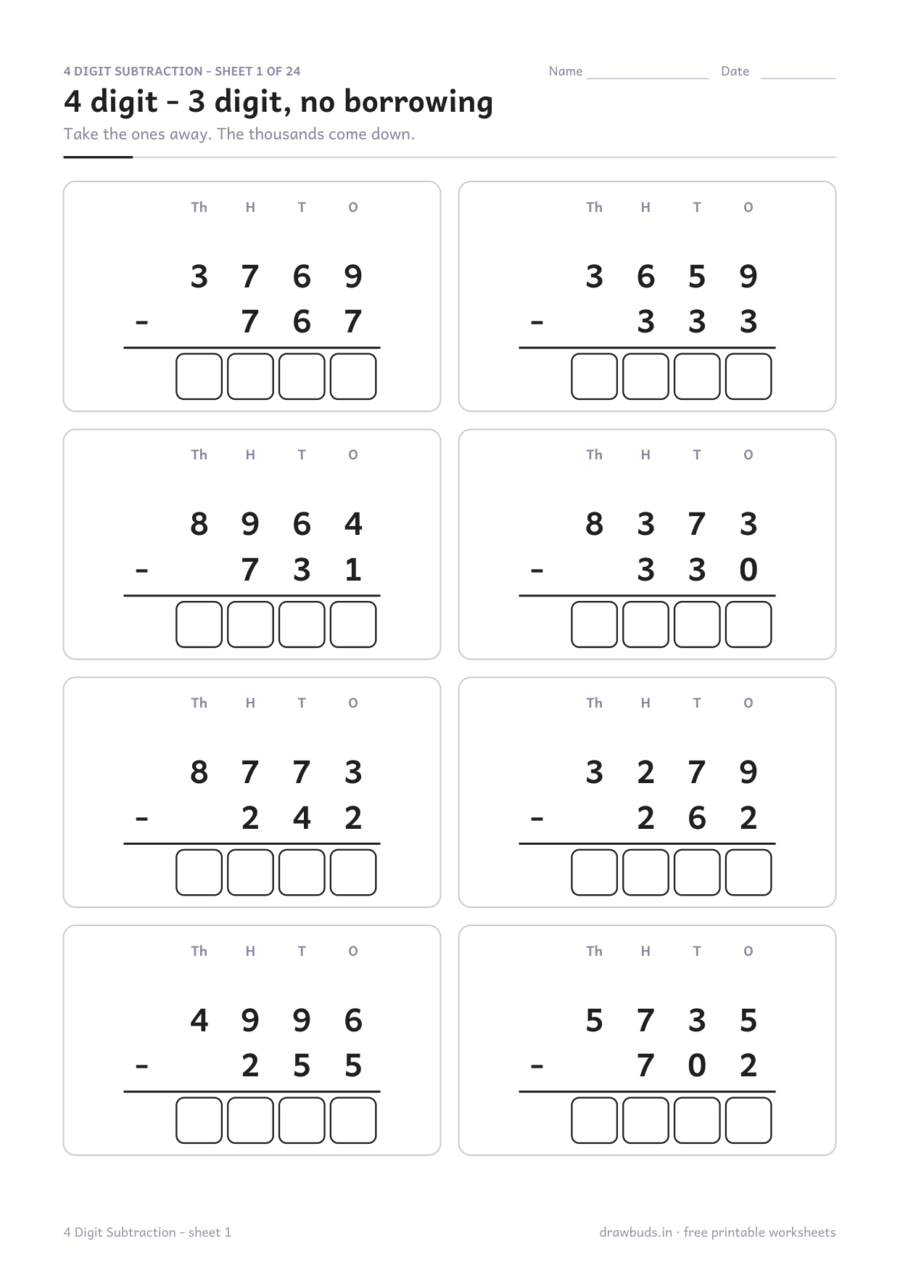
- Sheets 1-4: 4 digit – 3 digit, nothing to exchange (3769 – 767).
- Sheets 5-8: 4 digit – 4 digit, nothing to exchange.
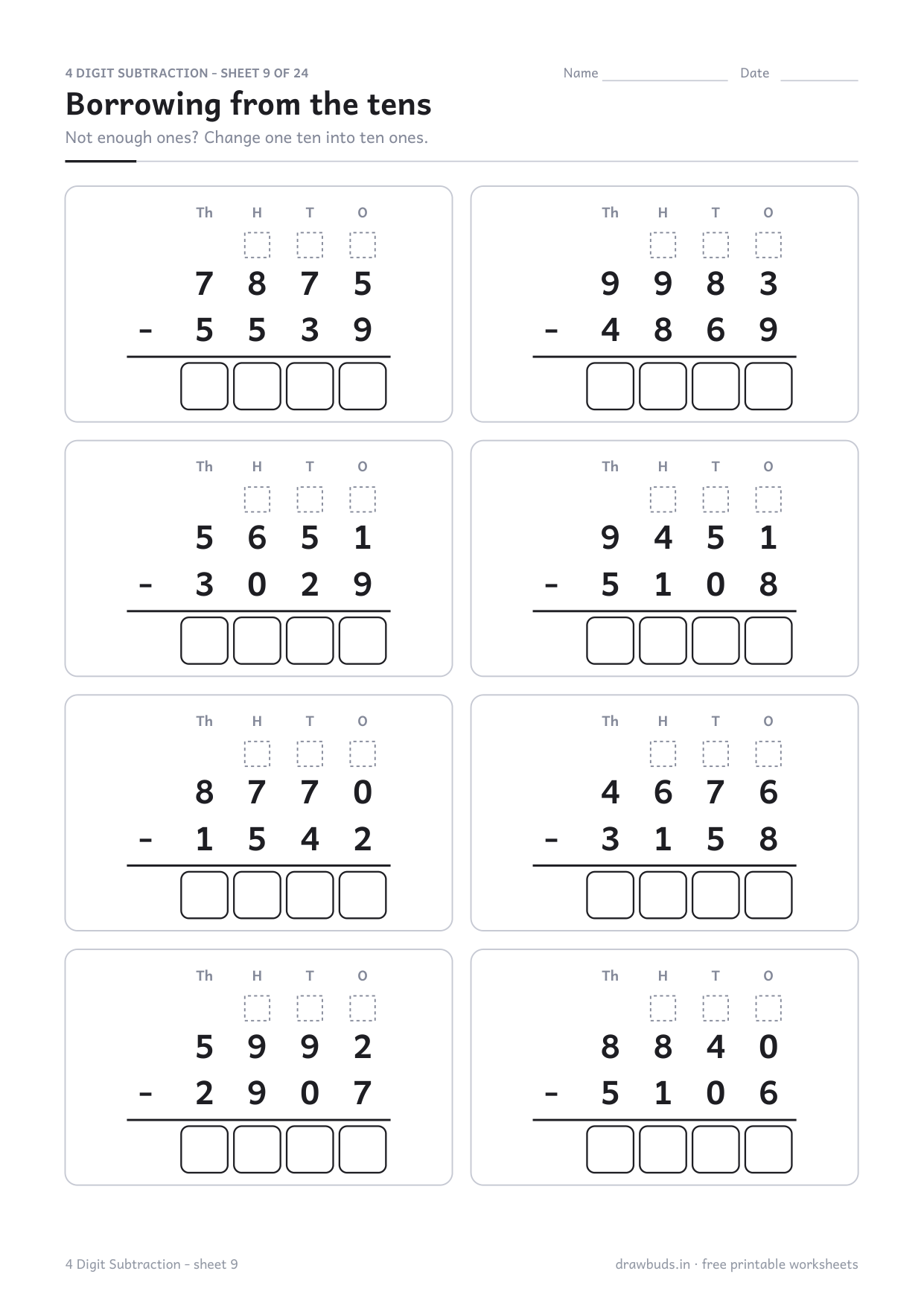
- Sheets 9-12: borrowing from the tens only (7875 – 5539).
- Sheets 13-16: borrowing twice, from the tens and then the hundreds.
- Sheets 17-20: borrowing three times, each column from the one on its left.
- Sheets 21-24: borrowing across zeros (7005 – 4417).
- Last two pages: every answer, sheet by sheet.
Eight sums a sheet, 192 in all, under printed Th, H, T and O headings. Every answer is positive and no sum repeats.
Why the zeros get four whole sheets
Borrowing across a zero is the hardest thing in primary subtraction, and it fails for a reason that has nothing to do with subtraction. The child looks left for a ten, finds a 0, and stops. Nothing in the four sheets before it has taught them that a zero is not an empty column but a column waiting to be opened from further left. Sheets 21-24 give that one move enough repetitions to become automatic instead of remembered.
Exchange boxes, and the crossing out
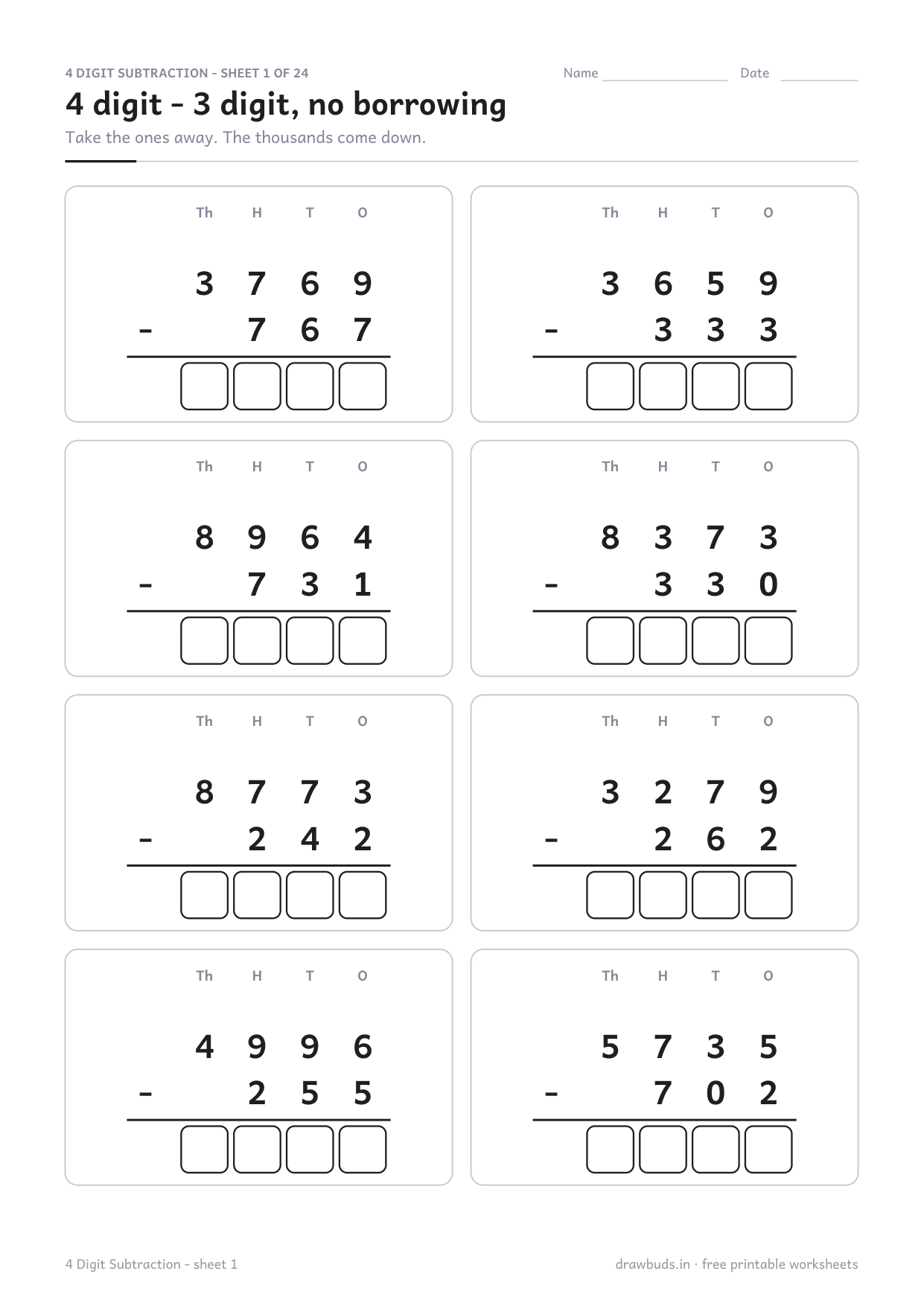
From sheet 9 the top number carries a small dashed box above each digit that can be exchanged. The usual method is to cross out the digit and write one less above it, and the box is where that goes. On sheet 21 the same digit gets crossed out twice in one sum, first when it gives to its right and again when it takes from its left. Children who are fine until sheet 21 and then stall have usually forgotten the second crossing out, not the method.
Borrowing from the tens, before anything else
Sheets 9-12 exchange in one column and leave the rest alone, so the child sees the whole move once, slowly, in a sum where everything else is easy. It is the same reason the addition book spends four sheets carrying out of the ones only.
Class 3, class 4, or grade 3
Indian schools meet four-digit subtraction in class 3 and finish it in class 4. US schools do it in grade 3, England in year 4. If borrowing is new rather than shaky, 3 digit subtraction worksheets run the same stages one column smaller. If the trouble is reading the columns rather than exchanging between them, place value hundreds and thousands comes first.
The adding version of these six stages is 4 digit addition worksheets.
Printing this one correctly
In your printer dialog set Scale to 100% or Actual size, not Fit to page. Fit to page shrinks the tracing letters and they stop matching the size a child's hand is learning.
Plain paper is fine for crayons and pencils. If your child uses felt pens, 100 gsm paper stops the ink bleeding to the next sheet.