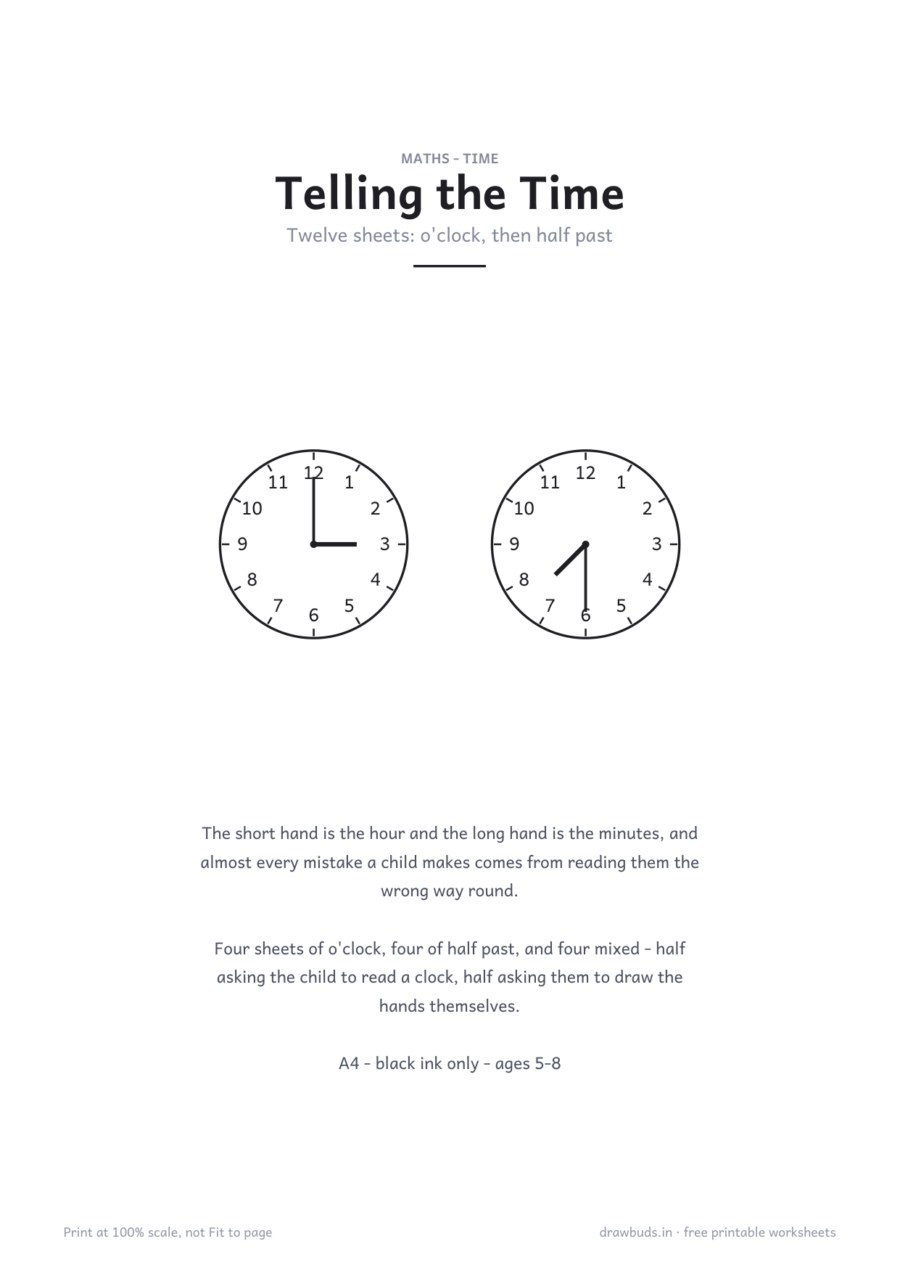
Telling the Time: O’clock and Half Past
13 printable pages. Four sheets of o'clock, four of half past, four mixed — and half of every stage asks the child to draw the hands rather than read them.
- Pages
- 13
- Ages
- 5-8
- Paper size
- A4
- Black ink only
Free to print at home, at school, and in a classroom of thirty.
Four sheets o'clock, four half past, four mixed - half read, half draw
The short hand is the hour and the long hand is the minutes. Almost every mistake a child makes when telling the time comes from reading those two the wrong way round, and it survives a surprising amount of practice.
What is in it
| Sheets | Times |
|---|---|
| 1-4 | o’clock only |
| 5-8 | half past only |
| 9-12 | both, mixed |
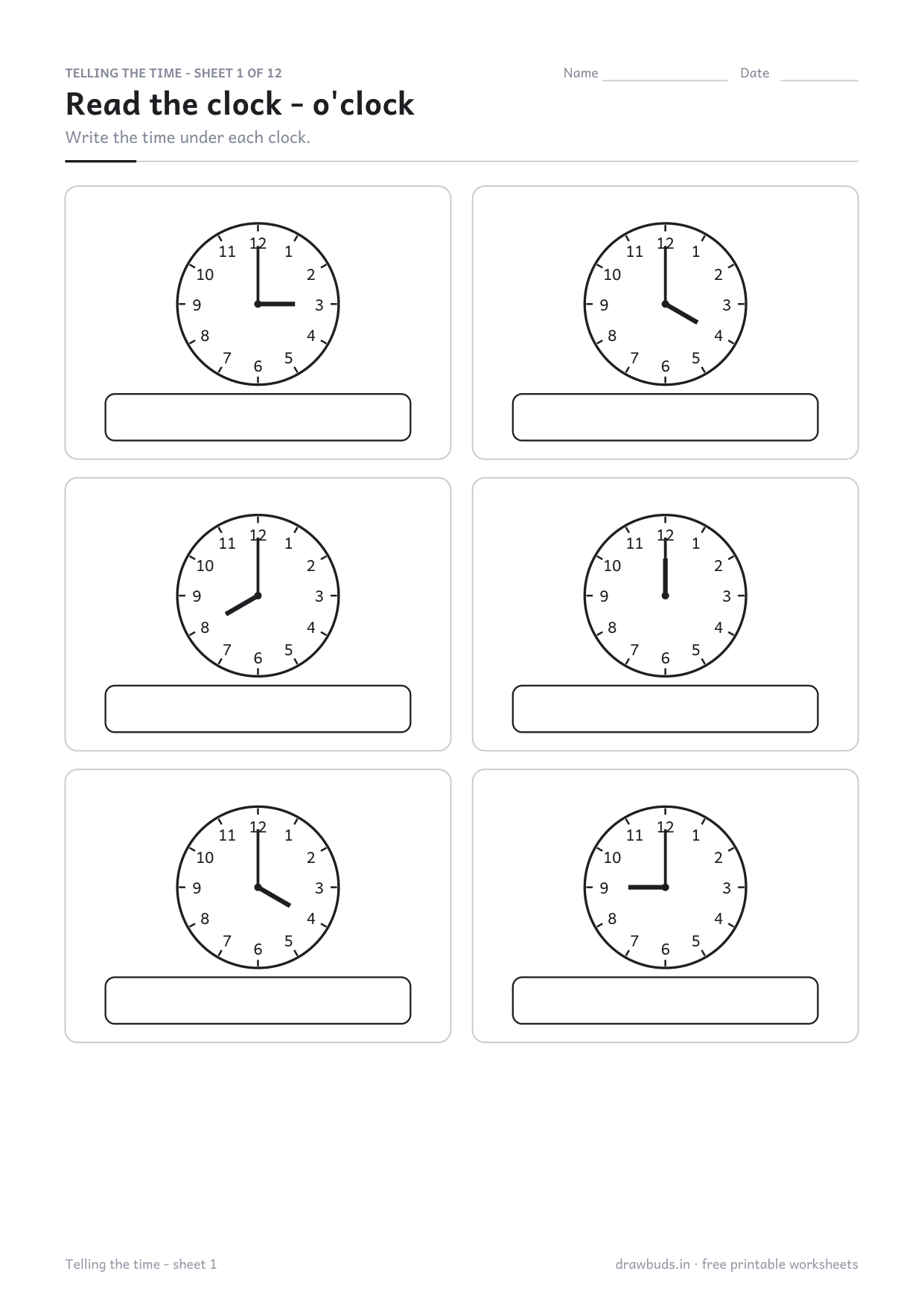
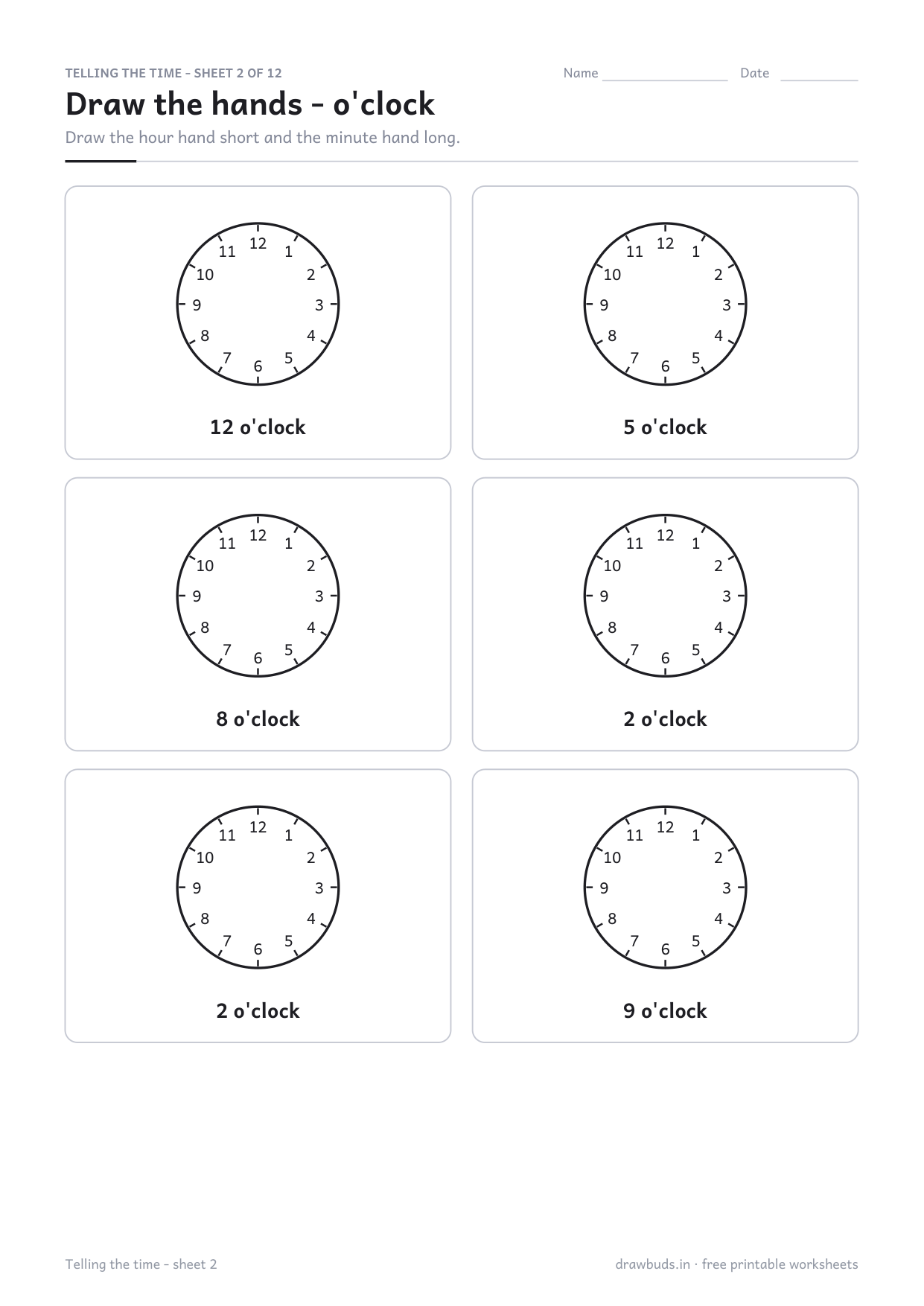
Within each stage, the odd-numbered sheets show a clock and ask for the time in writing. The even-numbered ones give the time in words and leave the clock face empty, for the child to draw the hands.
Drawing is harder than reading, and more useful
A child can read “3 o’clock” from a clock by looking only at the short hand. Drawing it means placing both hands, which is the first time the long hand has to be thought about at all. Half the book is drawing for that reason.
Half past is where it breaks
At half past three, the hour hand is not on the 3. It is halfway between the 3 and the 4, because half an hour has gone. Almost every child draws it pointing straight at the 3, and almost no worksheet mentions it.
The printed clocks in this book put the hour hand in the correct in-between position, so a child reading them sees it done properly from the start. When they draw their own, it is worth pointing at once and then leaving alone.
The other thing worth saying once
The numbers on a clock face mean two different things depending on which hand is pointing at them. The 3 means three o’clock for the short hand and fifteen minutes for the long one. Nothing else a child learns to read works like that, and it is worth naming rather than hoping they absorb it.
What comes next
Quarter past and quarter to, once these twelve sheets are comfortable. Before that, Counting Worksheets 1-20 is worth having done — a child who is unsure of the numbers to twelve cannot read a clock face reliably however well they understand the hands.
Printing this one correctly
In your printer dialog set Scale to 100% or Actual size, not Fit to page. Fit to page shrinks the tracing letters and they stop matching the size a child's hand is learning.
Plain paper is fine for crayons and pencils. If your child uses felt pens, 100 gsm paper stops the ink bleeding to the next sheet.