Capital and Small Letter Matching Worksheets
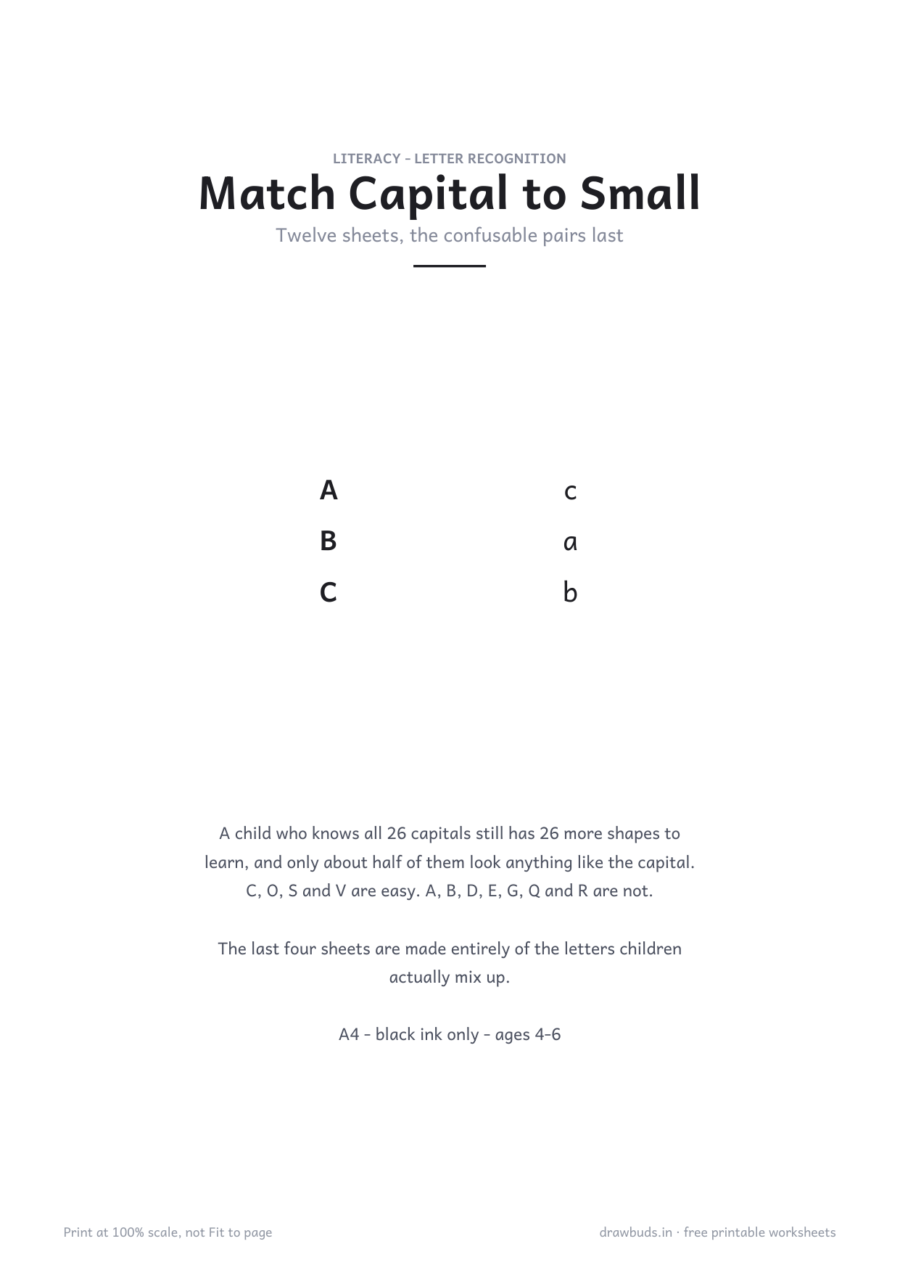
Capital and small letter matching: draw a line from each capital to its small letter, easy pairs first, look-alikes last. 13 pages, free PDF.
- Pages
- 13
- Ages
- 4-6
- Paper size
- A4 and US Letter
- Black ink only
Same worksheets, two paper sizes. Free to print at home, at school, and in a classroom of thirty.
Easy pairs first, the genuinely confusable ones on the last four sheets
A child who knows all twenty-six capitals still has twenty-six more shapes to learn, and only about half of them look anything like the capital they belong to.
C, O, S, V, W, X, Z are the same shape in two sizes. A, B, D, E, G, Q, R are not related at all — a and A share a name and nothing else. This book sorts the alphabet by that difference and works through it in order.
What is on each page
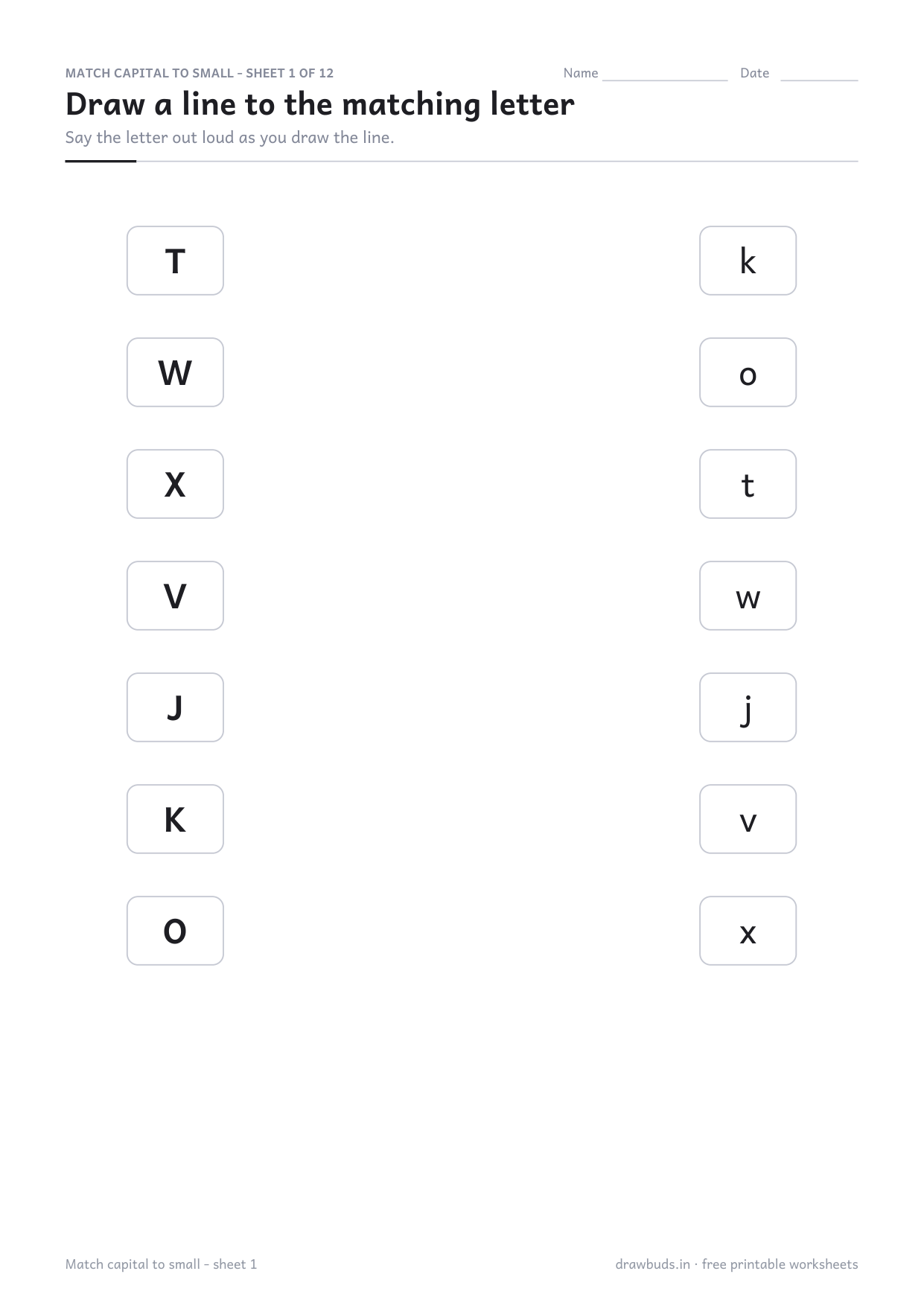
Seven capitals down the left, seven small letters shuffled down the right, and a line to draw between each pair.
- Sheets 1 to 4: only the letters whose two forms look alike.
- Sheets 5 to 8: a mix.
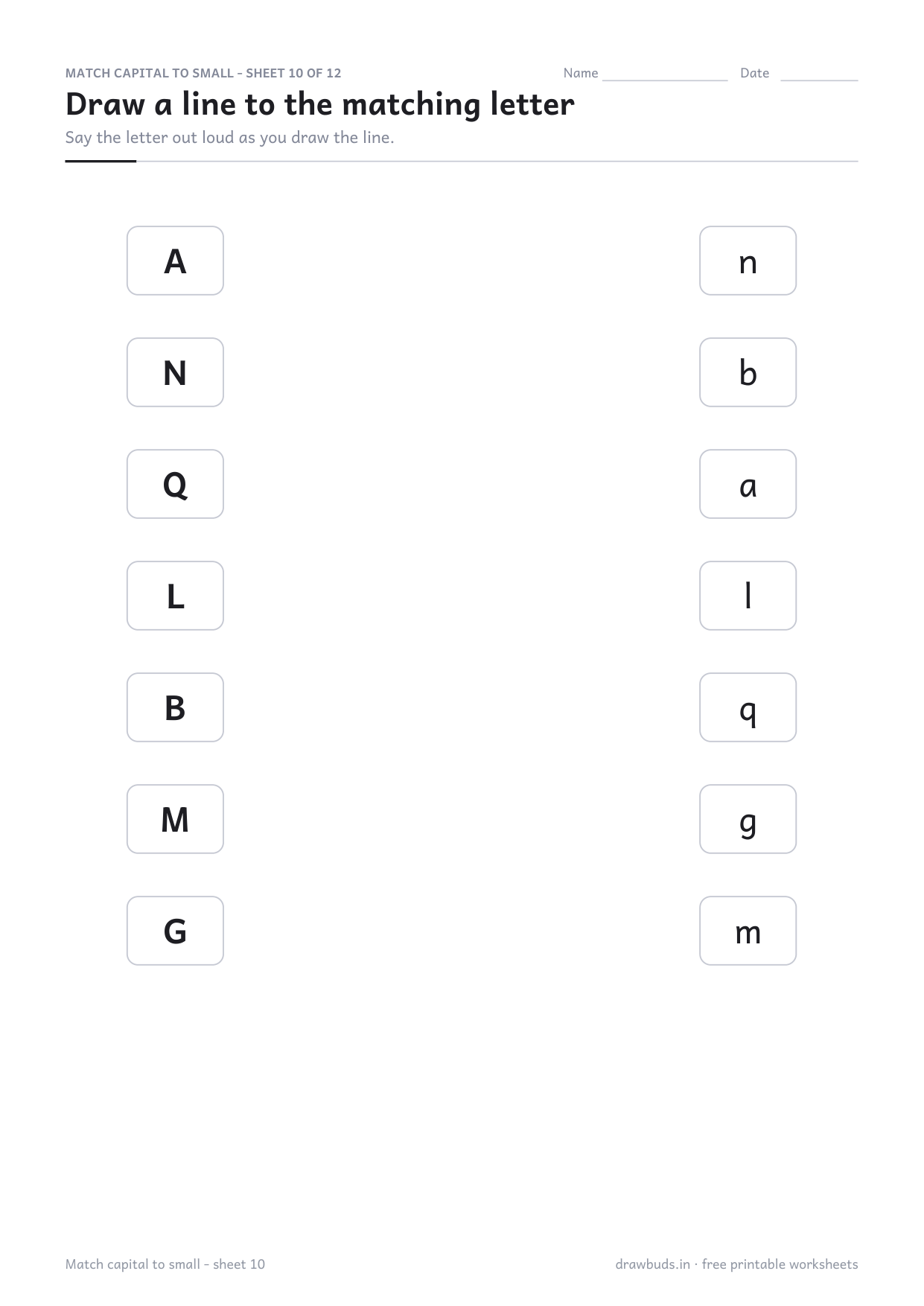
- Sheets 9 to 12: only the difficult ones — A, B, D, E, G, Q, R, H, N, M, I, L.
Say it while you draw the line
The matching is visual, but the letter should be spoken. A child who draws seven lines in silence has done a puzzle; one who says “A, a” each time has practised the pairing they will need when reading.
The five that cause most of the trouble
a and A, e and E, g and G, r and R, q and Q. In each case the small letter is a different shape rather than a smaller one, and there is no trick — they are simply learned. Those five are on every one of the last four sheets.
Why lowercase matters more
Open any children’s book: roughly 95% of the letters in it are lowercase. A child taught capitals first, as most are, has learned the form they will see least. This book is one way of catching up quickly.
What comes next
Find and Color the Letter practises spotting a letter among lookalikes, and Lowercase Tracing a-z is the writing half.
Printing this one correctly
In your printer dialog set Scale to 100% or Actual size, not Fit to page. Fit to page shrinks the tracing letters and they stop matching the size a child's hand is learning.
Plain paper is fine for crayons and pencils. If your child uses felt pens, 100 gsm paper stops the ink bleeding to the next sheet.