Hindi Ginti 1 to 100: Chart and Worksheets
Hindi ginti 1 to 100 chart and worksheets: each number with its Hindi numeral and word, plus tracing, matching and writing. Answers included. Free PDF.
- Pages
- 14
- Ages
- 5-8
- Paper size
- A4 and US Letter
- Black ink only
Same worksheets, two paper sizes. Free to print at home, at school, and in a classroom of thirty.
12 sheets: chart 1 to 100 with Hindi numerals and words, tracing, numeral grid, matching, writing, answers
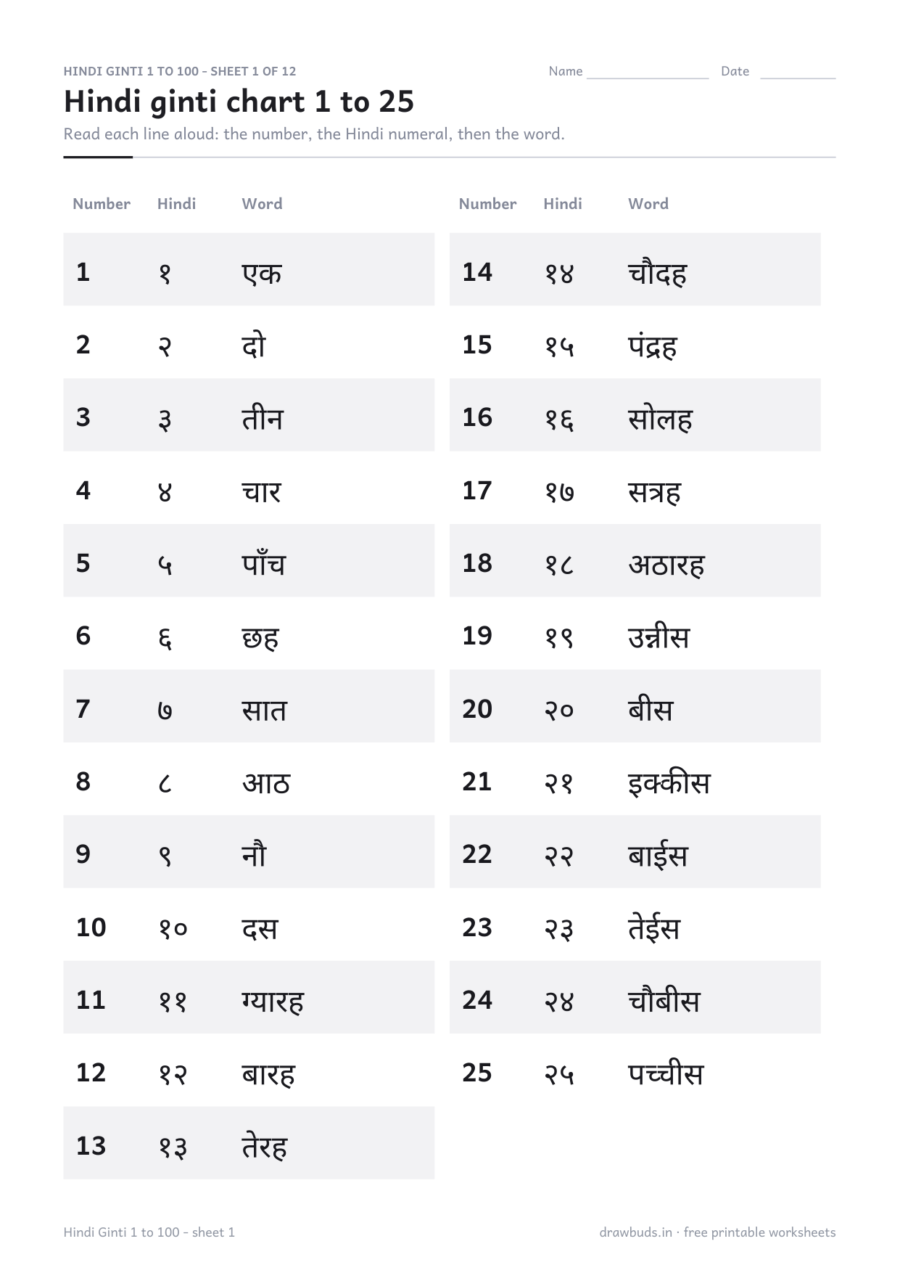
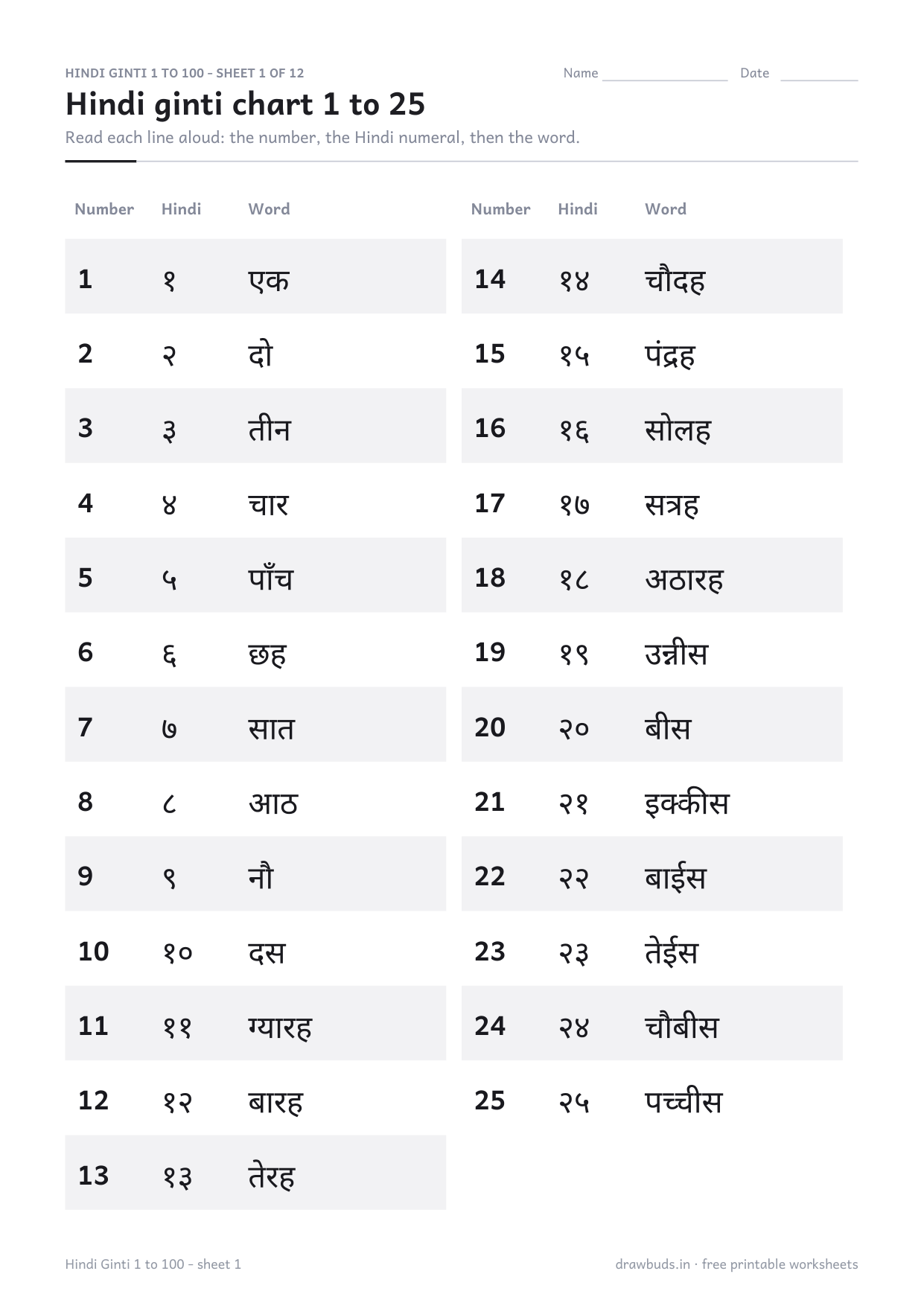
This Hindi ginti 1 to 100 book puts three things on one line for every number: the number as children write it in school (25), the Hindi numeral (२५) and the Hindi word (पच्चीस). Ek se sau tak, on four chart pages, followed by eight practice sheets.
What is in the 14 pages
- Sheets 1-4: the chart, 25 numbers a sheet, from एक to सौ.
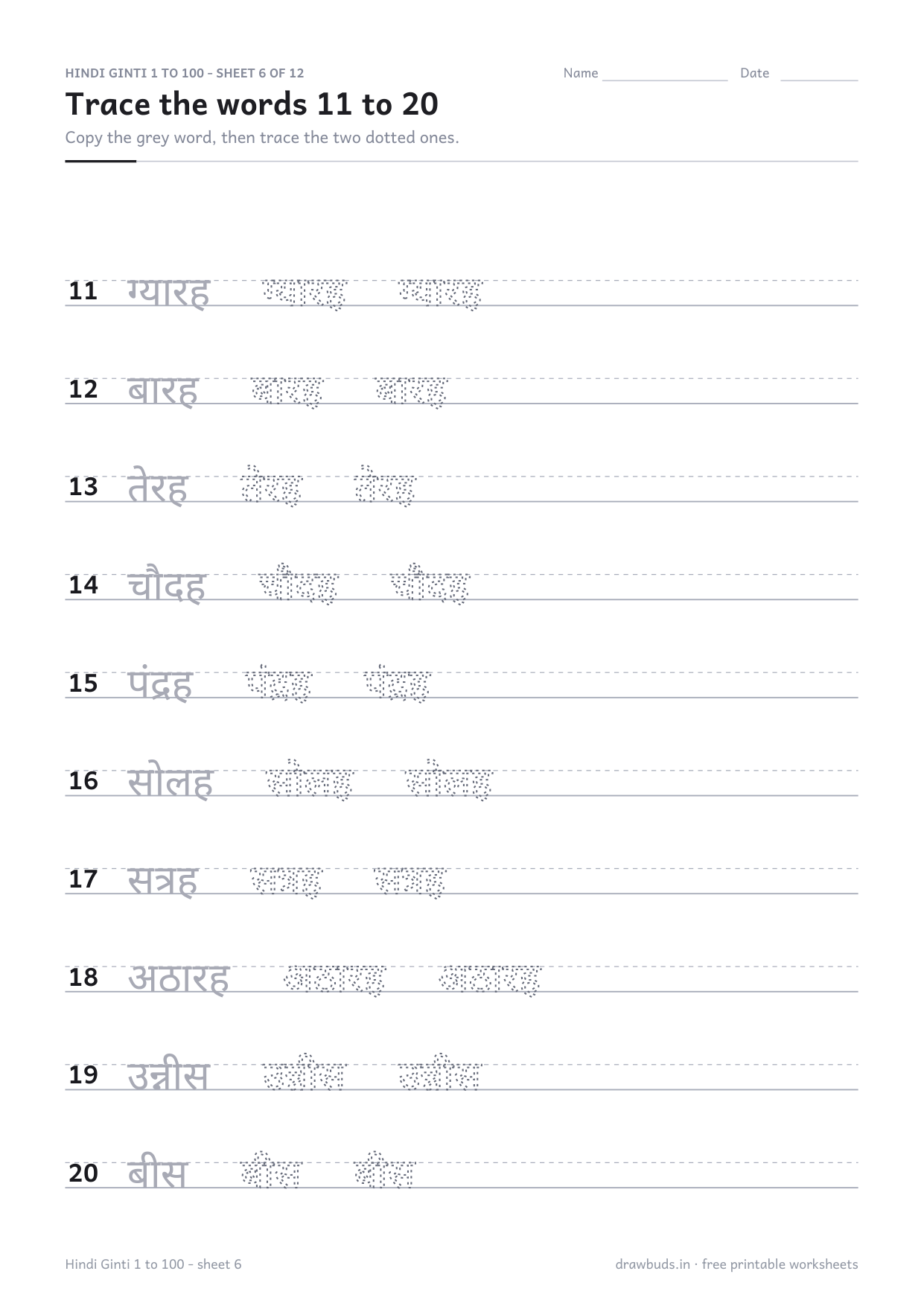
- Sheets 5-6: trace the words for 1 to 20, one grey copy and two dotted copies on each line.
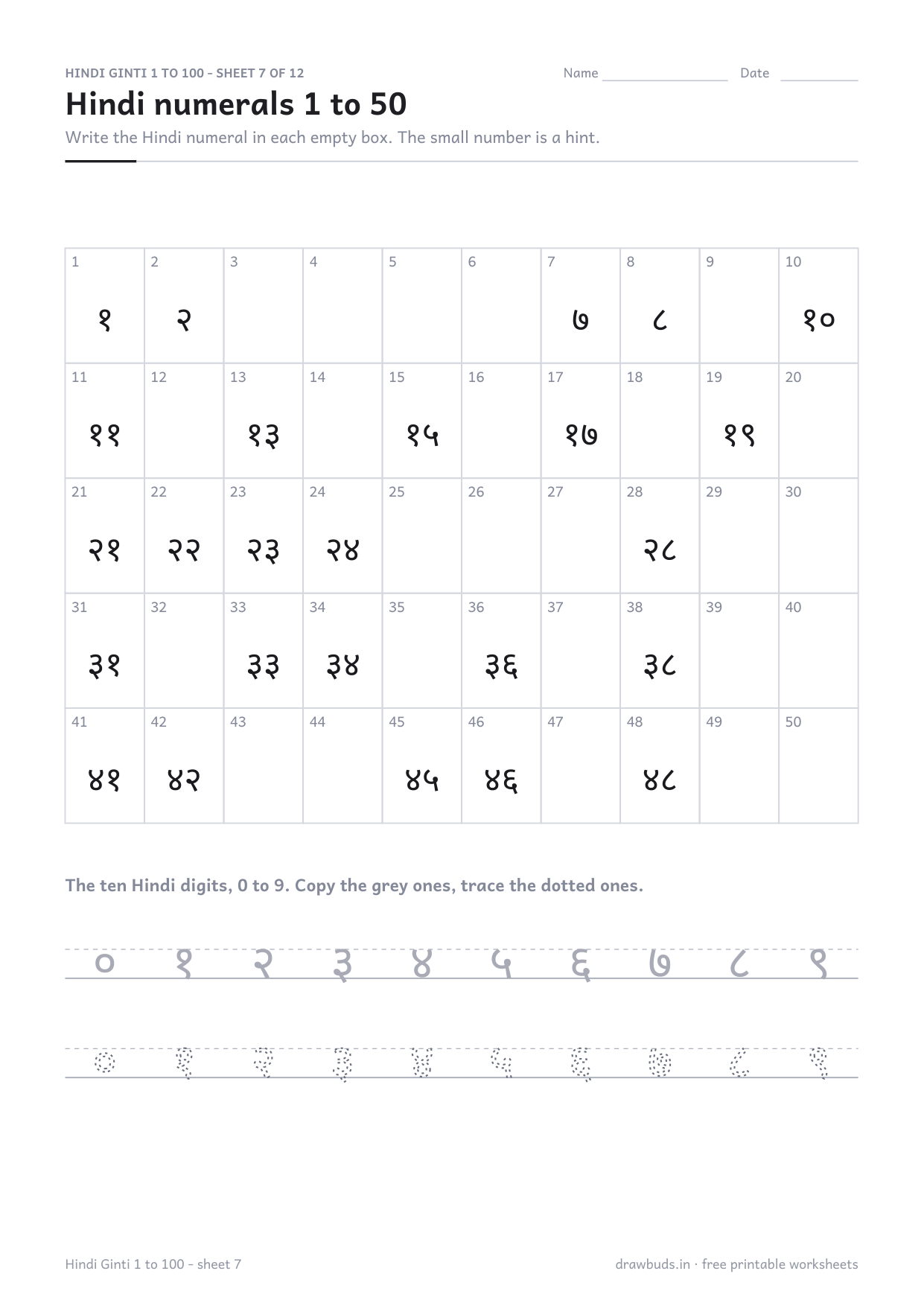
- Sheets 7-8: a grid of Hindi numerals up to 100 with about half the boxes empty, plus a row of the ten Hindi digits, ० to ९, to copy and trace.
- Sheets 9-10: match ten numbers to their words. Sheet 9 uses 1 to 50, sheet 10 uses 51 to 100.
- Sheet 11: write the word for every ten, दस to सौ.
- Sheet 12: write the word for ten mixed numbers between 21 and 99.
- Last page: every answer.
Why 1 to 20 gets the tracing
Hindi number words do not follow a pattern the way English ones mostly do. In English, once a child knows “twenty” and “one”, “twenty-one” is easy. In Hindi, 21 is इक्कीस, 31 is इकतीस and 41 is इकतालीस, and each one has to be learned. The words for 1 to 20 are the ones children use most and the ones every later word grows from, so those are the ones to trace. After that, reading the chart aloud every day works better than copying all hundred words.
The Hindi numerals
Many class 1 Hindi books print numbers as १, २, ३, and children meet them in their Hindi lessons long before they need them anywhere else. The grid on sheets 7 and 8 has a small English number in the corner of every box as a hint, so a child can work it out without turning back to the chart. Every Hindi numeral is built from the same ten digits, and 1 (१) and 9 (९) look alike to a beginner, so those two are worth pointing out.
A note on spelling
Some numbers have more than one accepted spelling. This book uses छह for 6, सड़सठ for 67, उन्यासी for 79 and the -नबे ending for 91 to 98 (बानबे, पंचानबे). Your child’s school book may print छः, सरसठ, उनासी or बानवे instead. Both are correct, so go with whatever the teacher uses.
Who it is for
The sheets suit children of about 5 to 8, usually in class 1 or class 2, who can already read the Hindi letters. If the letters are still new, start with the Hindi varnamala tracing book, then the matra and barakhadi worksheets. For writing the numbers themselves, try the number tracing worksheets 1 to 100.
Printing
Print at 100% scale, not Fit to page. The book comes as an A4 PDF and a US Letter PDF with the same sheets. Black ink only.
Printing this one correctly
In your printer dialog set Scale to 100% or Actual size, not Fit to page. Fit to page shrinks the tracing letters and they stop matching the size a child's hand is learning.
Plain paper is fine for crayons and pencils. If your child uses felt pens, 100 gsm paper stops the ink bleeding to the next sheet.