Letter Formation A-Z: Where to Start and Which Way to Go
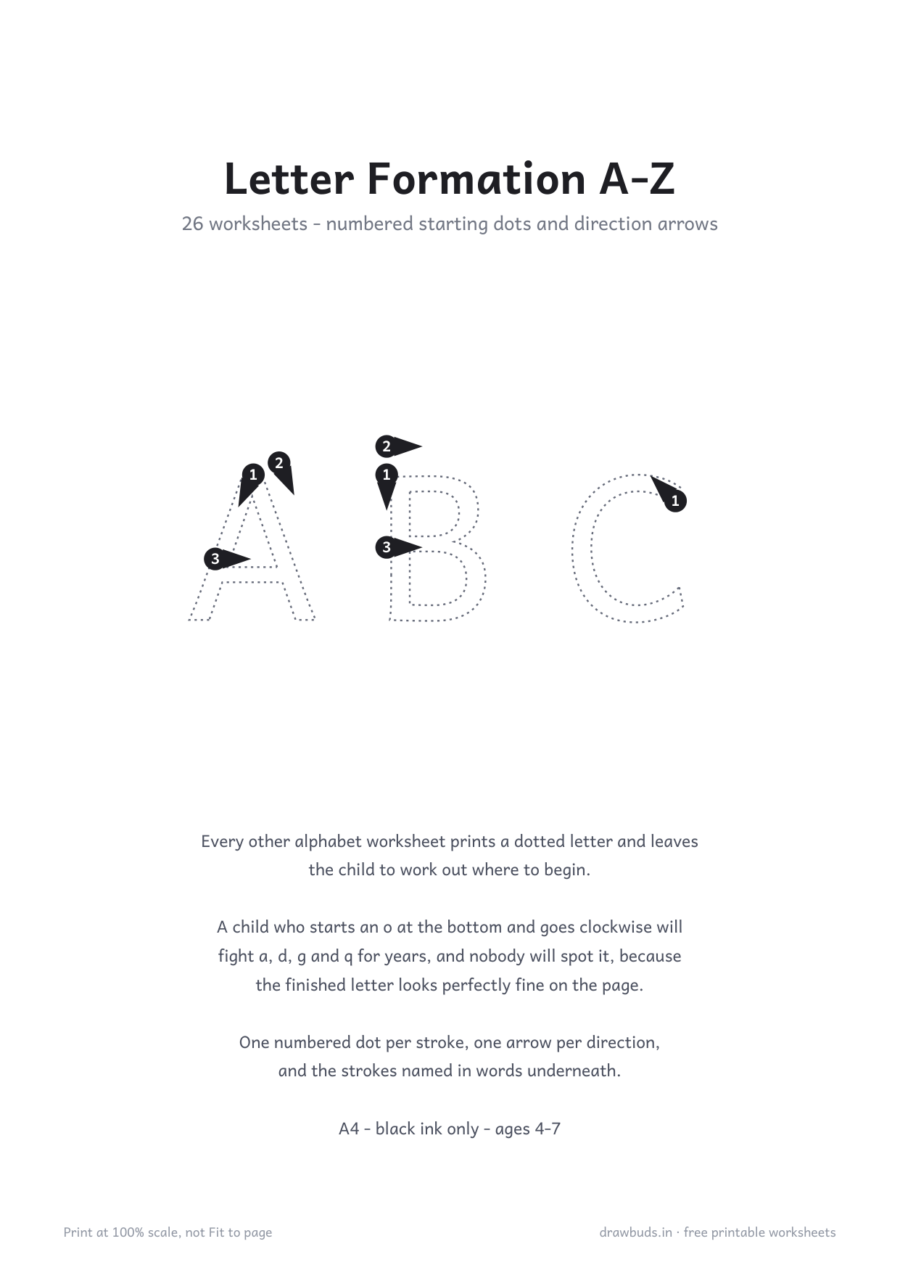
28 printable pages. Every letter with a numbered dot on each stroke and an arrow showing which way the pencil goes — the one thing ordinary tracing sheets never tell a child.
- Pages
- 28
- Ages
- 4-7
- Paper size
- A4
- Black ink only
Free to print at home, at school, and in a classroom of thirty.
Numbered starting dot and a direction arrow on every stroke
Print a dotted letter and a child will trace it. They will not necessarily trace it the way it is written. An o started at the bottom and taken clockwise ends up looking exactly like an o started at the top and taken anticlockwise, and nobody notices for two years — by which time a, d, g and q are all slow, because all four are built from that circle.
This book is the missing half of every other alphabet worksheet: a numbered dot on each stroke, an arrow showing the direction, and the strokes named in words underneath.
What is on each page
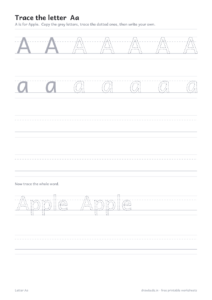
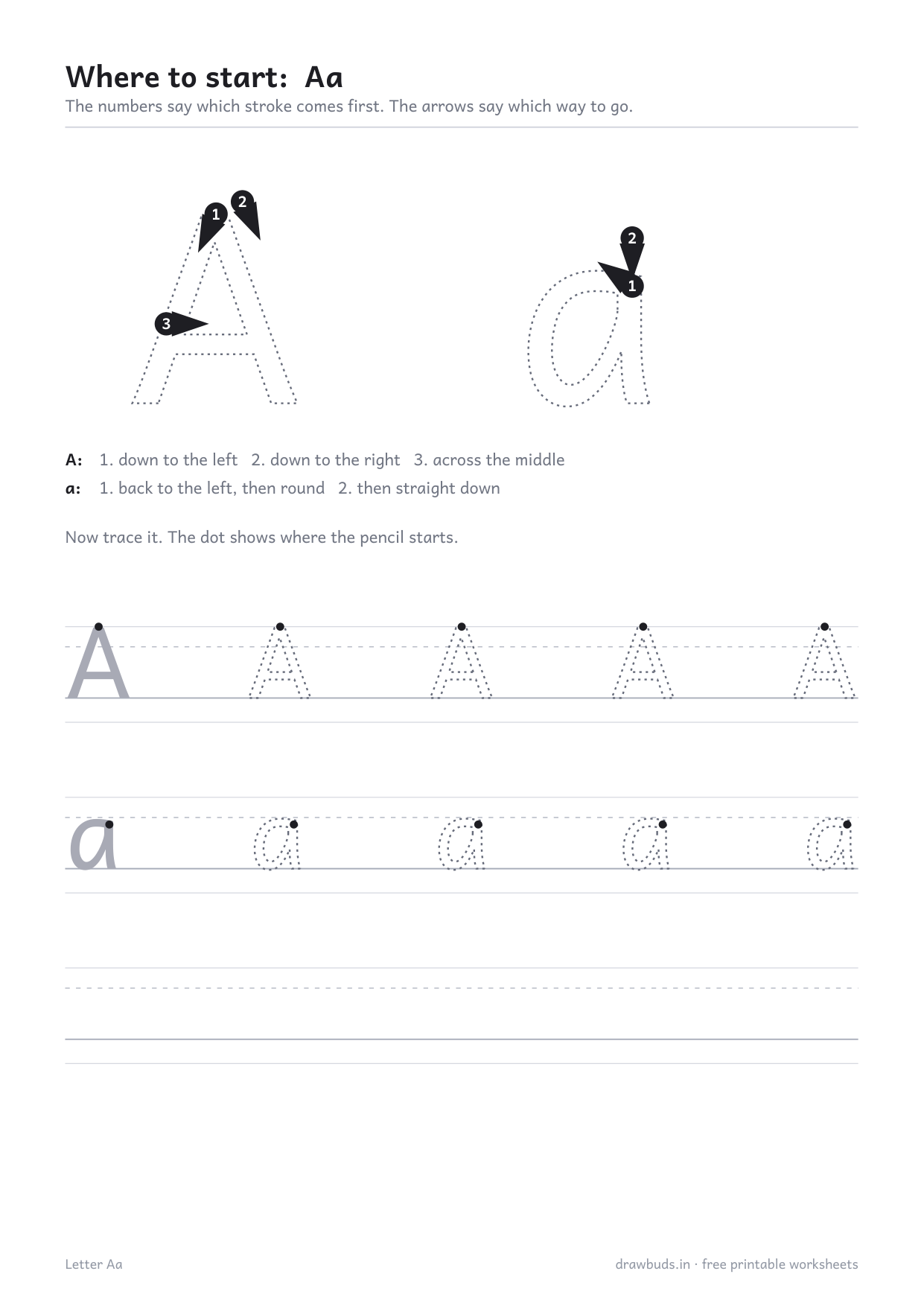
- The capital and the small letter, drawn large, with a numbered dot at the start of every stroke and an arrow out of each dot.
- The strokes in words — “1. down to the left 2. down to the right 3. across the middle” — so an adult can say them aloud without having to work them out.
- Two practice rows where each letter keeps just its first start dot, and a blank row.
The three rules the whole book runs on
- Capitals all start at the top. Every one of them, no exceptions.
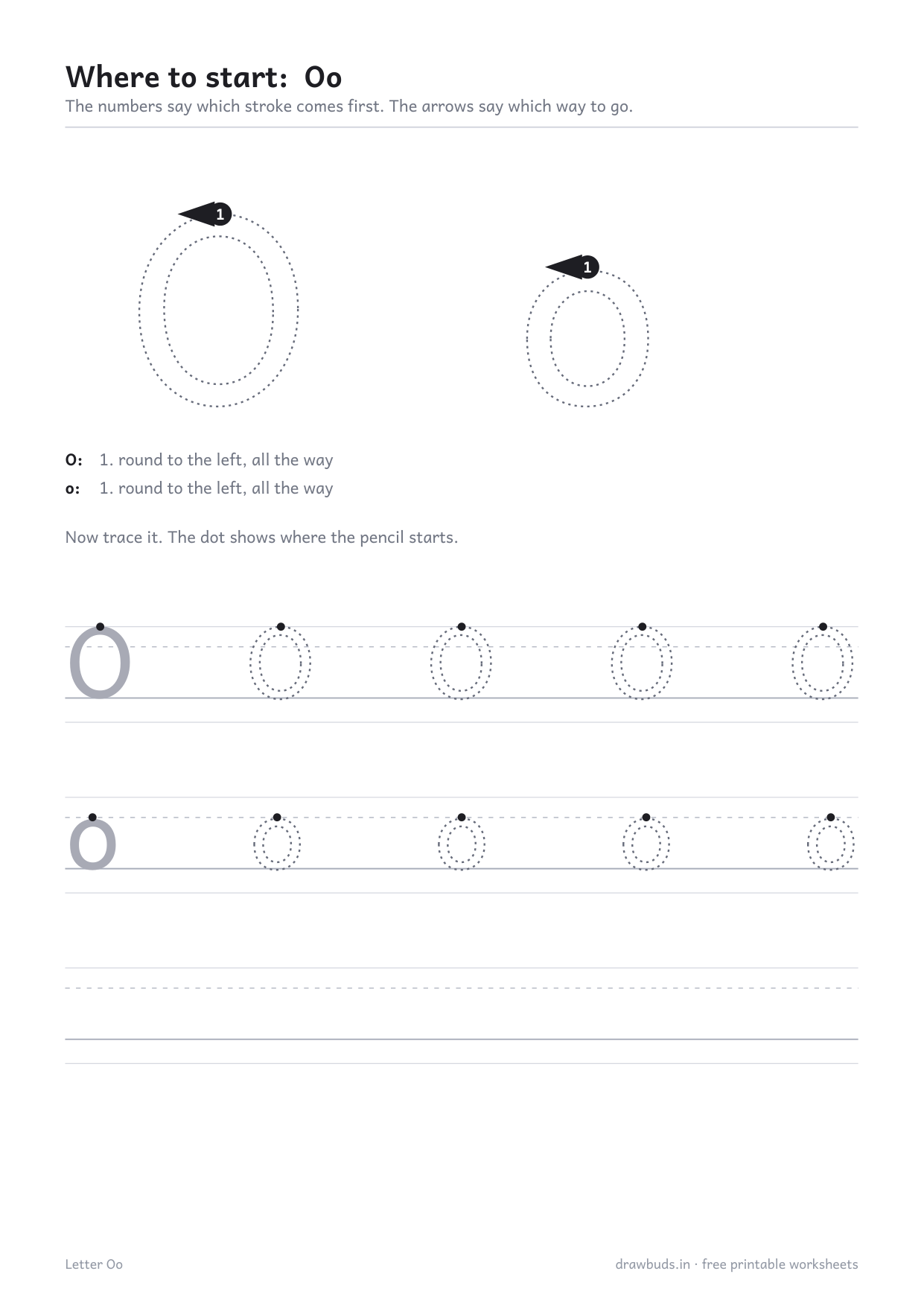
- Round letters go anticlockwise — o, a, c, d, g, q, e, s.
- Top to bottom, left to right, in that order.
Why the anticlockwise o matters more than the rest
It is the shape inside a, d, g and q. Get it right once and five letters come out right. Get it wrong and all five stay slow and effortful, and the page never shows you why — which is the reason this book exists at all.
Watch the pencil, not the page
A letter formed in the wrong order can be indistinguishable from one formed correctly. The only way to catch it is to watch the hand while it moves, which takes about ten seconds per letter. Do it once a week rather than checking finished work.
Schools differ, and that is fine
Joined-up schemes start several letters with a lead-in flick from the baseline, which moves the start dot. If a school teaches that, follow the school — the order of the strokes is the part that rarely changes between schemes, and that is the part most worth having on paper.
Where this sits
Use it alongside Alphabet Tracing A-Z rather than instead of it: this book teaches the movement, that one gives the repetition. A left-handed child should use the left-handed edition for the repetition, since the start dots here sit on the letter itself and are not hidden by the hand.
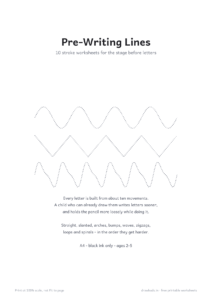
If the strokes themselves are still shaky, Pre-Writing Lines comes first.
Printing this one correctly
In your printer dialog set Scale to 100% or Actual size, not Fit to page. Fit to page shrinks the tracing letters and they stop matching the size a child's hand is learning.
Plain paper is fine for crayons and pencils. If your child uses felt pens, 100 gsm paper stops the ink bleeding to the next sheet.