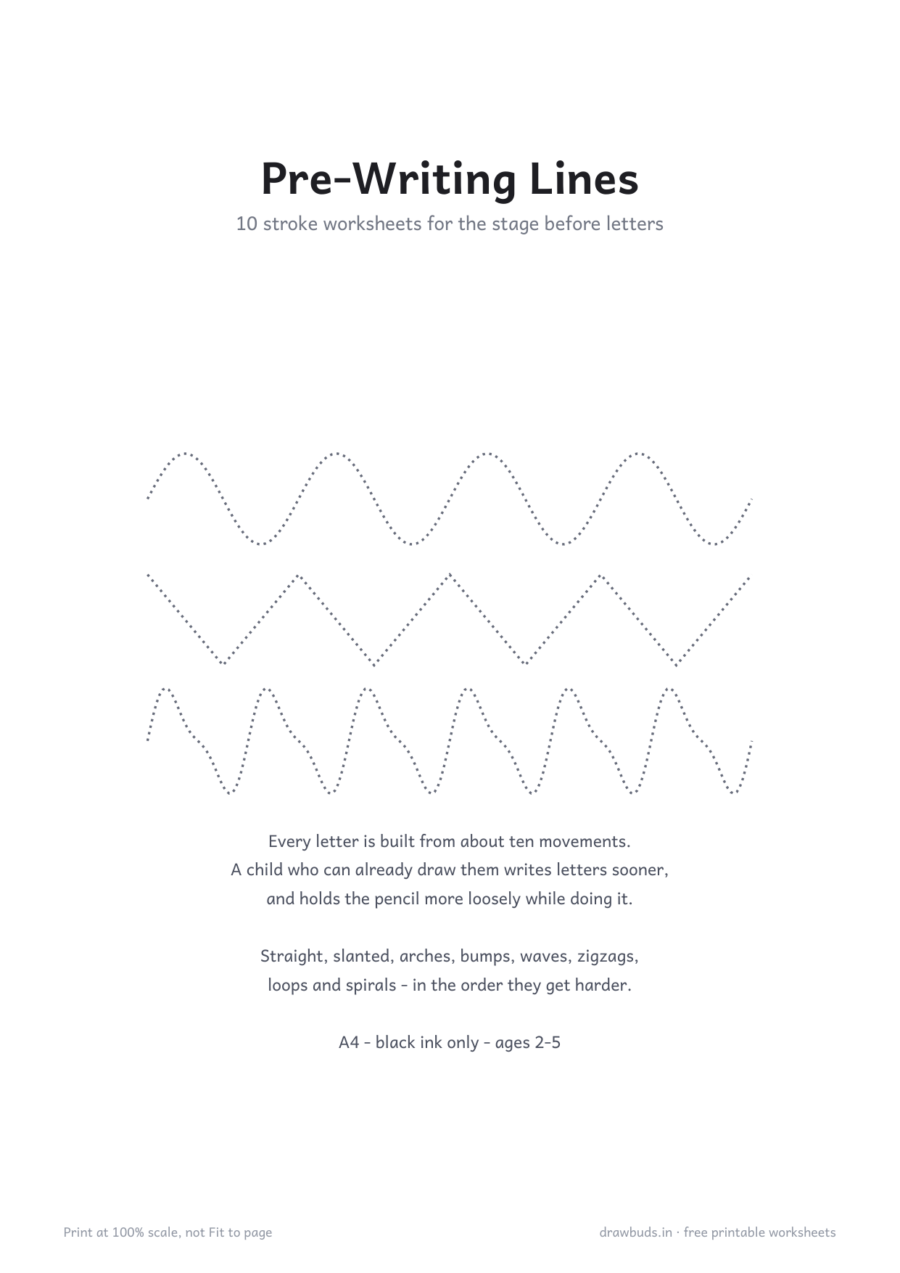
Pre-Writing Line Tracing Worksheets
11 printable pages of the ten strokes every letter is built from — straight, slanted, arches, bumps, waves, zigzags, loops and spirals — in the order they get harder.
- Pages
- 11
- Ages
- 2-5
- Paper size
- A4
- Black ink only
Free to print at home, at school, and in a classroom of thirty.
Ten strokes, hardest last, four rows per page
A child who cannot yet draw an arch cannot write an n, an m, an h or an r, and no amount of letter practice will fix that. About ten movements make up the whole alphabet. This book practises those movements, with no letters anywhere in it.
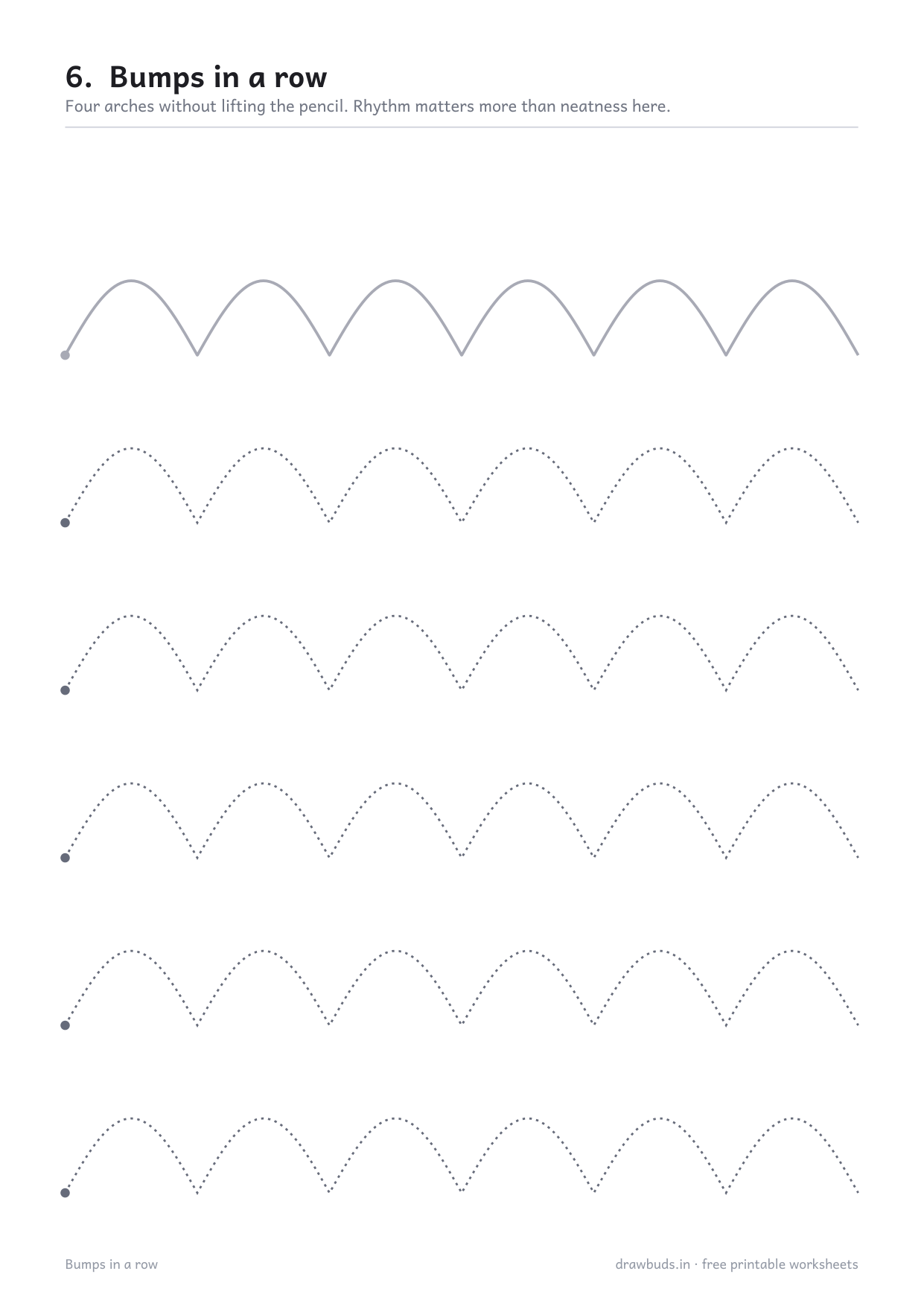
The ten strokes, and what each one becomes
- Straight down — l, i, t, and every capital that stands up.
- Straight across — always left to right, the habit that makes writing agree with reading.
- Slanted lines — A, V, W, X, Y, Z.
- Over the hill — the shoulder of n, m, h and r.
- Under the bridge — the bowl of u, y and j.
- Bumps in a row — the same arch repeated without lifting the pencil.
- Waves — one continuous rise and fall, drawn from the wrist.
- Zigzags — sharp corners, which need a full stop before each change of direction.
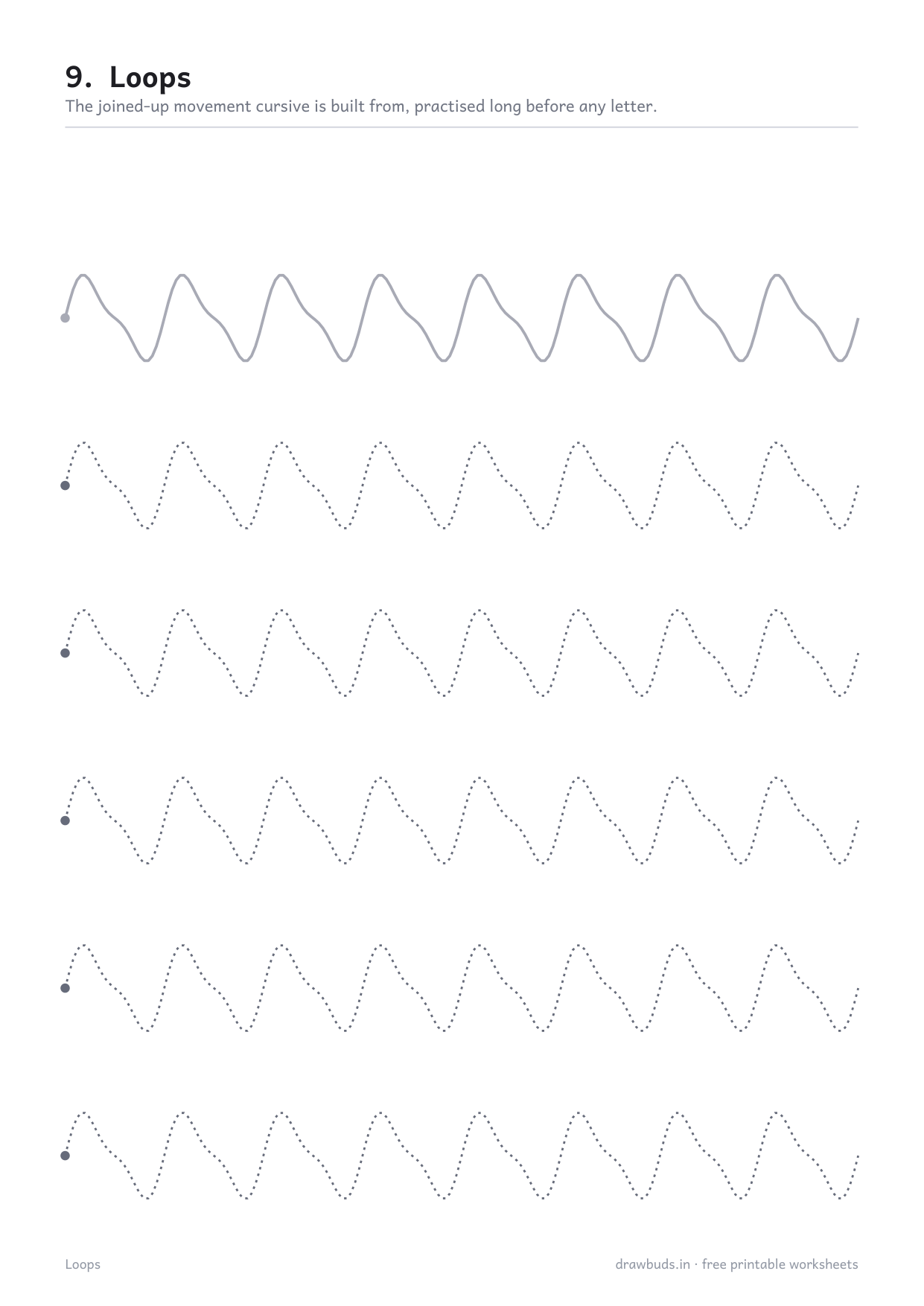
- Loops — the joined-up movement cursive is built from.
- Spirals — the hardest, so it is last.
The dot at the start of every stroke
Each stroke on every row begins with a printed dot. Left to right and top to bottom are not obvious to a three-year-old — plenty of them draw a vertical line upwards, which later makes letter formation slow and shaky. The dot removes the guess.
How long to stay here
Two or three pages a week, for as long as the strokes are wobbly. There is no benefit to rushing on to letters: a child who can draw six even bumps across a page will learn m in an afternoon, and one who cannot will spend a term on it.
What comes next
Shape Tracing uses the same movements on closed outlines, and Cutting Practice builds the same hand muscles without a pencil at all.
Printing this one correctly
In your printer dialog set Scale to 100% or Actual size, not Fit to page. Fit to page shrinks the tracing letters and they stop matching the size a child's hand is learning.
Plain paper is fine for crayons and pencils. If your child uses felt pens, 100 gsm paper stops the ink bleeding to the next sheet.