Maths Worksheets for Class 1: Chapter-wise PDF
Maths worksheets for class 1, one sheet for each chapter of the NCERT Joyful Mathematics book in order, plus a number puzzle and answers. Free PDF.
- Pages
- 16
- Ages
- 5-7
- Paper size
- A4 and US Letter
- Black ink only
Same worksheets, two paper sizes. Free to print at home, at school, and in a classroom of thirty.
14 sheets: one for each of the 13 chapters of the Class 1 textbook, in order, plus a puzzle sheet, answers at the back
These maths worksheets for class 1 follow the class 1 textbook chapter by chapter. NCERT’s book for this class, Joyful Mathematics, has 13 chapters, and this PDF has one sheet for each of them in the same order, then a puzzle sheet and an answer page. If your child’s class is on chapter 6, sheet 6 is the one to print.
What is in the 16 pages
- Sheets 1 to 3: where things are (above, below, inside, outside), long and round things with four solid shapes to match, and counting groups to 9 with one more.
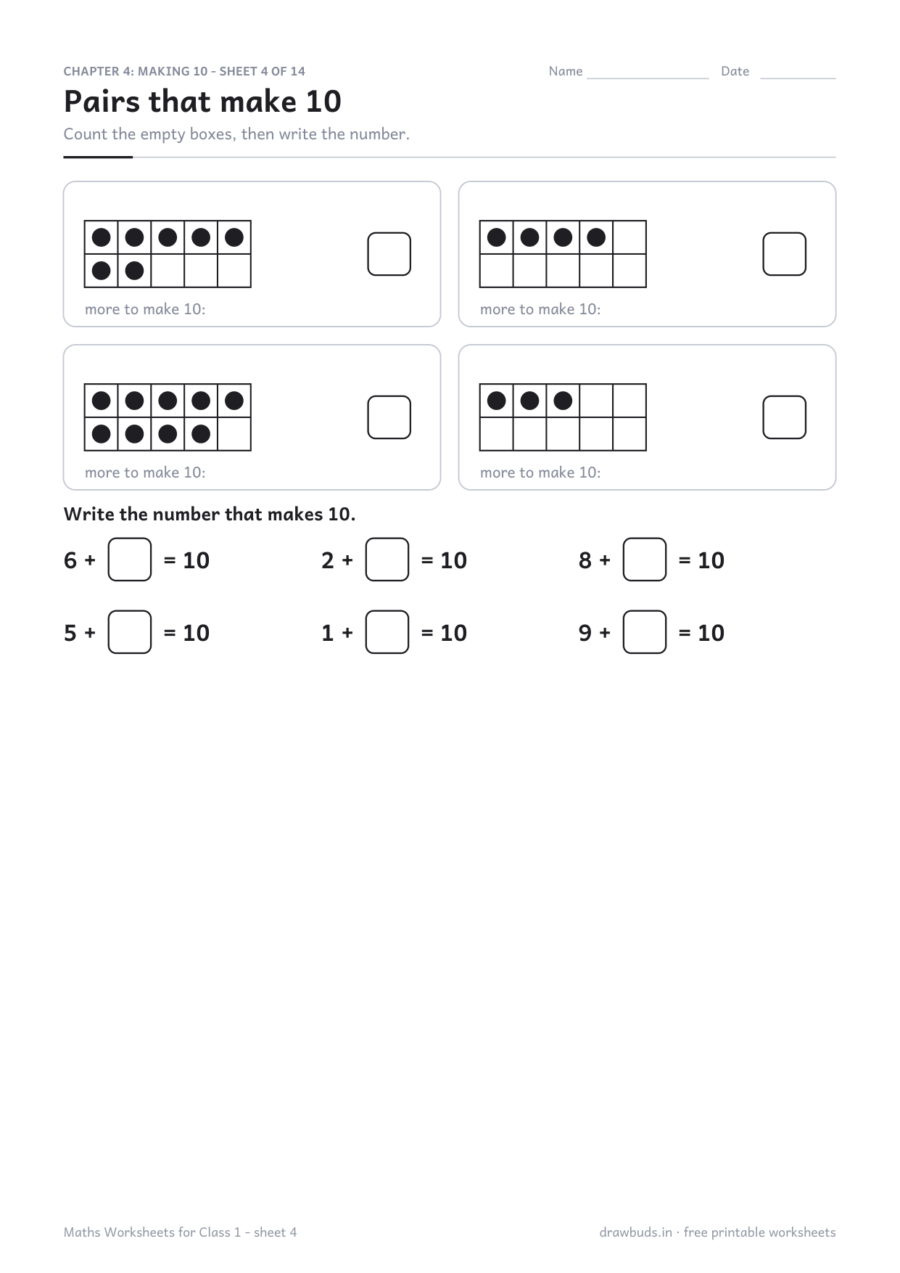
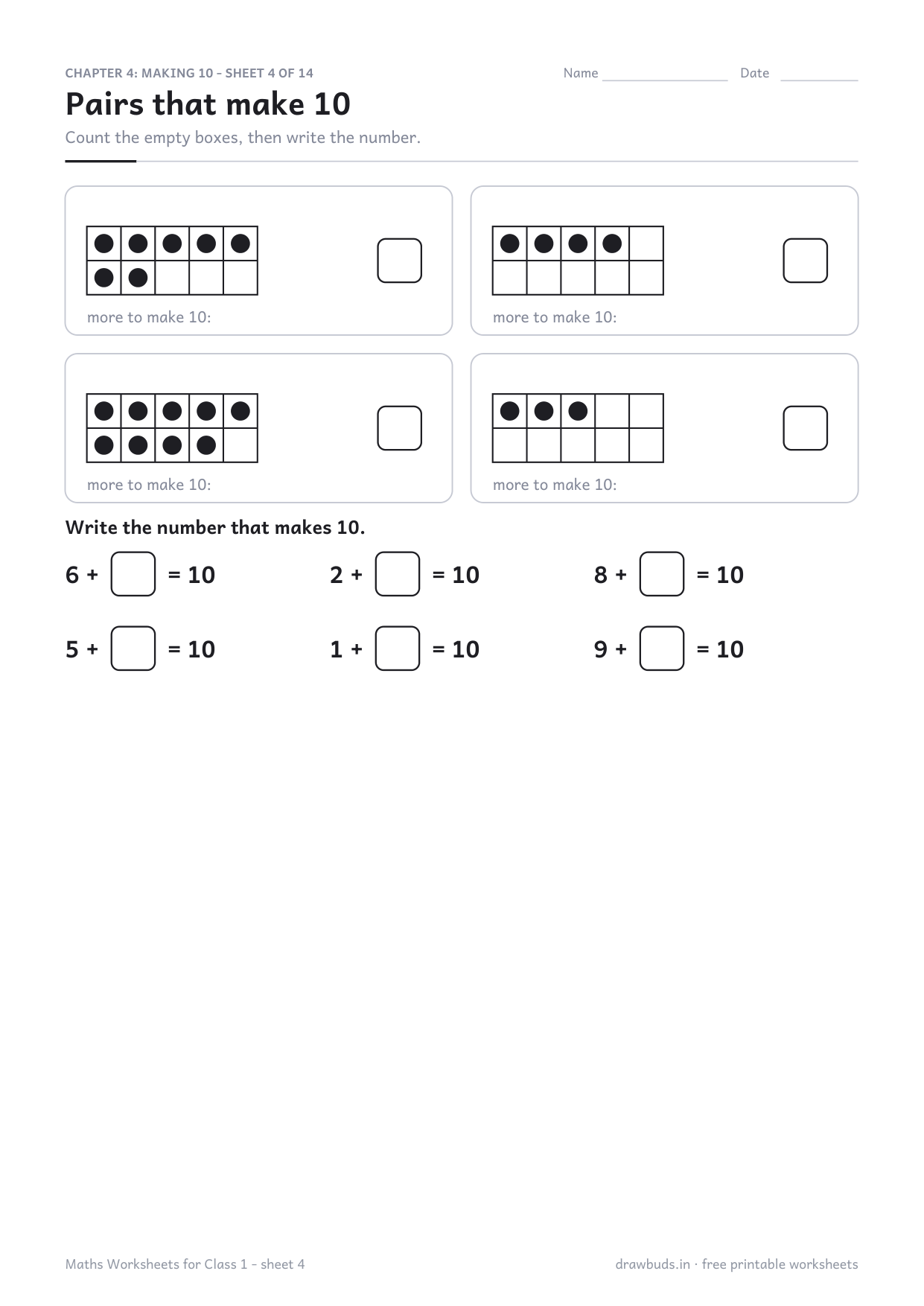
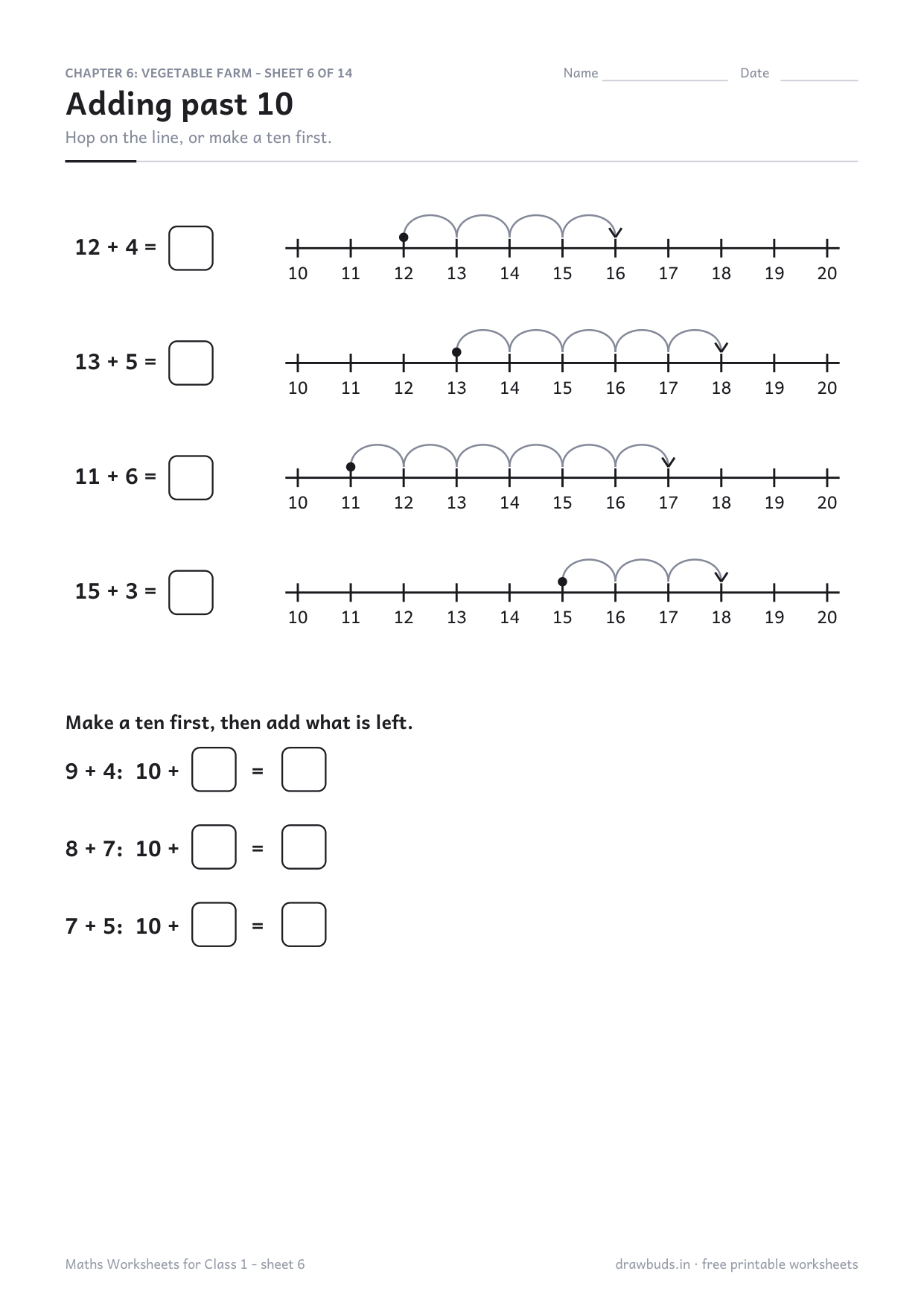
- Sheets 4 to 6: pairs that make 10 on ten frames, putting two groups together, and adding past 10 on a number line or by making a ten first.
- Sheets 7 to 9: tallest and nearest, tens and ones up to 100, and shape and number patterns to carry on.
- Sheets 10 to 13: parts of the day, equal groups, rupee coins and notes, and more than, less than or equal to.
- Sheet 14 and the answers: a 4 by 4 number square to fill with 1 to 4, then every answer on the last page for the grown-up.
The chapter names on each sheet are the textbook’s own, so a child can match the sheet to the lesson. The questions themselves are written fresh and are not copied from the book.
Making 10 is the chapter to slow down on
Sheet 4 shows four ten frames with some boxes filled and asks how many more make 10, then six sums like 6 plus what is 10. These pairs carry the rest of the year. Sheet 6 uses them straight away: 9 + 4 becomes 10 + 3, and 8 + 7 becomes 10 + 5. A child who knows the pairs to 10 by heart finds adding past 10 easy, and one who is still counting on fingers finds it slow. It is worth repeating sheet 4 before moving on.
Money, done the way it is spent
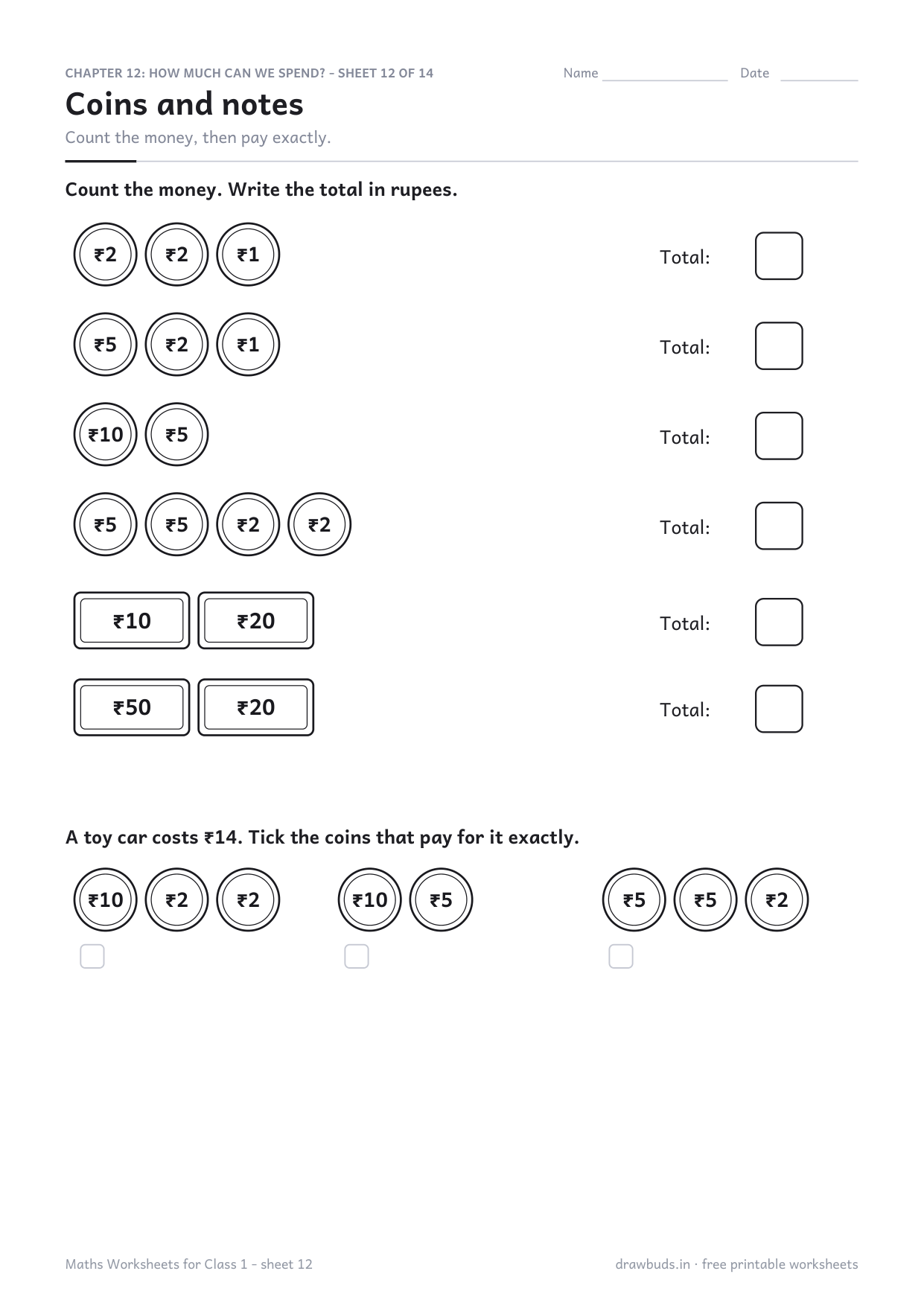
Sheet 12 counts rupee coins and notes, from three small coins to a 50 and a 20 note, and then asks which set of coins pays exactly 14 rupees for a toy car. Only one of the three does. Paying an exact amount is a different skill from adding up a pile of coins, and it is the one children use in a shop.
Before this book, and after it
For more practice on single topics, addition within 10 has pictures to count, comparing numbers goes further with more than and less than, and counting Indian money has a full book of coins and notes. The solid shapes from sheet 2 continue in 2D and 3D shapes, and writing numbers to 100 is in number tracing worksheets 1-100.
Printing this one correctly
In your printer dialog set Scale to 100% or Actual size, not Fit to page. Fit to page shrinks the tracing letters and they stop matching the size a child's hand is learning.
Plain paper is fine for crayons and pencils. If your child uses felt pens, 100 gsm paper stops the ink bleeding to the next sheet.