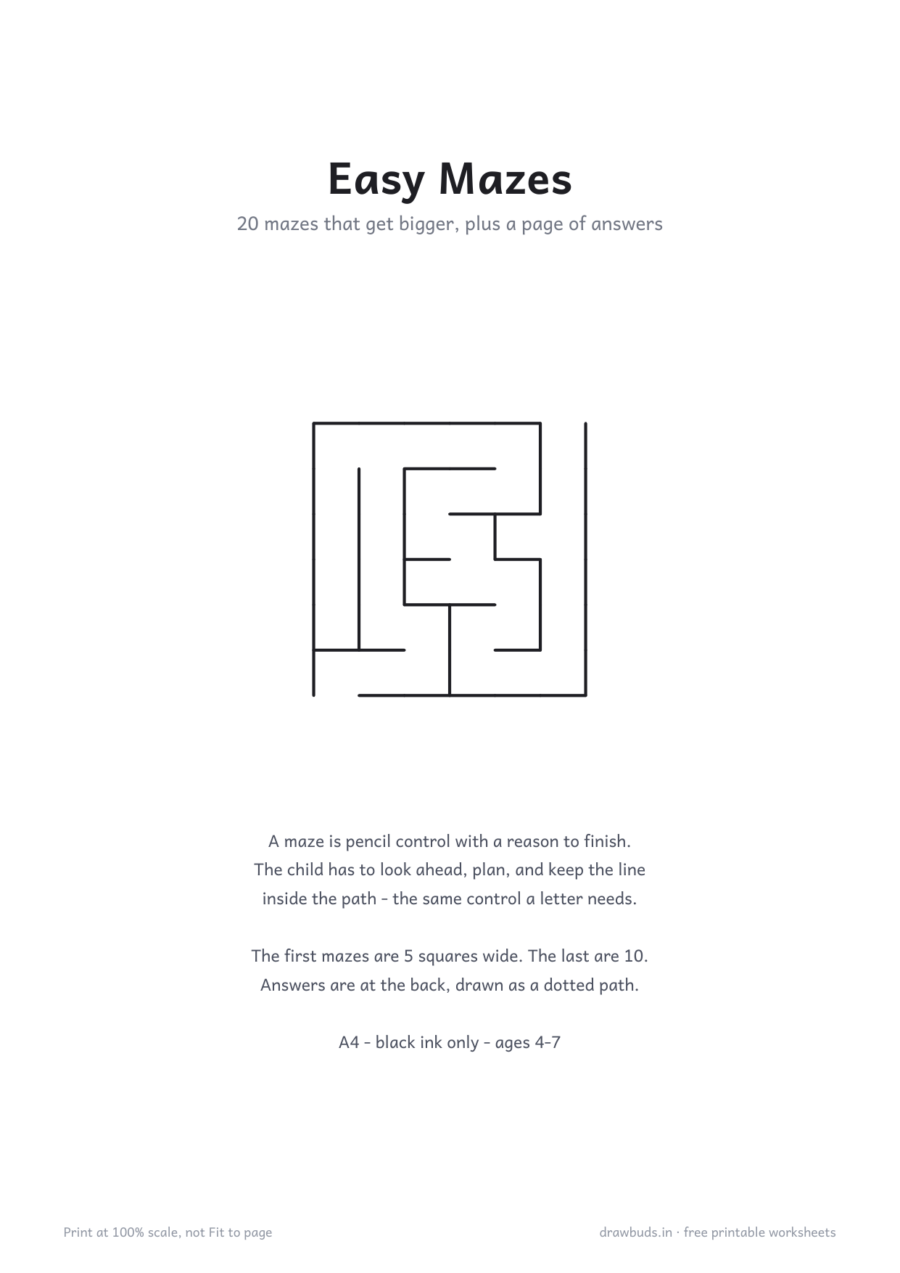
Easy Mazes for Preschoolers
25 printable pages. Twenty mazes that grow from five squares wide to ten, with a solution page at the back. Pencil control with a reason to finish.
- Pages
- 25
- Ages
- 4-7
- Paper size
- A4
- Black ink only
Free to print at home, at school, and in a classroom of thirty.
Twenty mazes from five squares wide to ten, answers at the back
A maze is handwriting practice that a child will do twice. It asks for exactly what a letter asks for — keep the line where you meant to put it, look ahead, do not lift the pencil — and it does not feel like practice at all.
How they are built
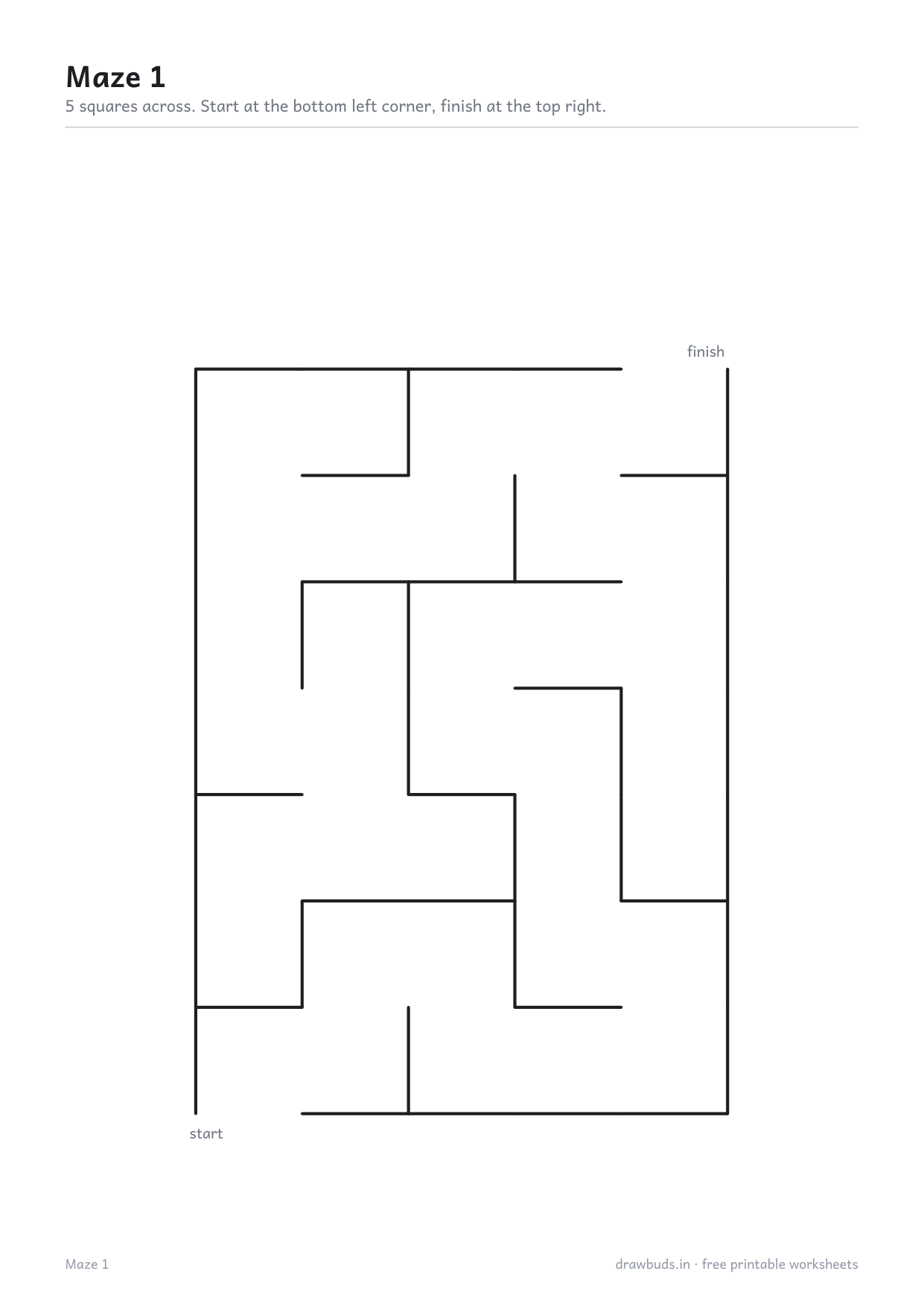
Every maze in this book has exactly one route from start to finish. They are generated rather than drawn by hand, using a recursive backtracker, which is the algorithm that produces a maze with no loops and no unreachable corners: there is always a way through, and there is never a second one.
Each has two openings and no more. The start is the gap in the bottom-left corner; the finish is the gap in the top-right.
The size curve
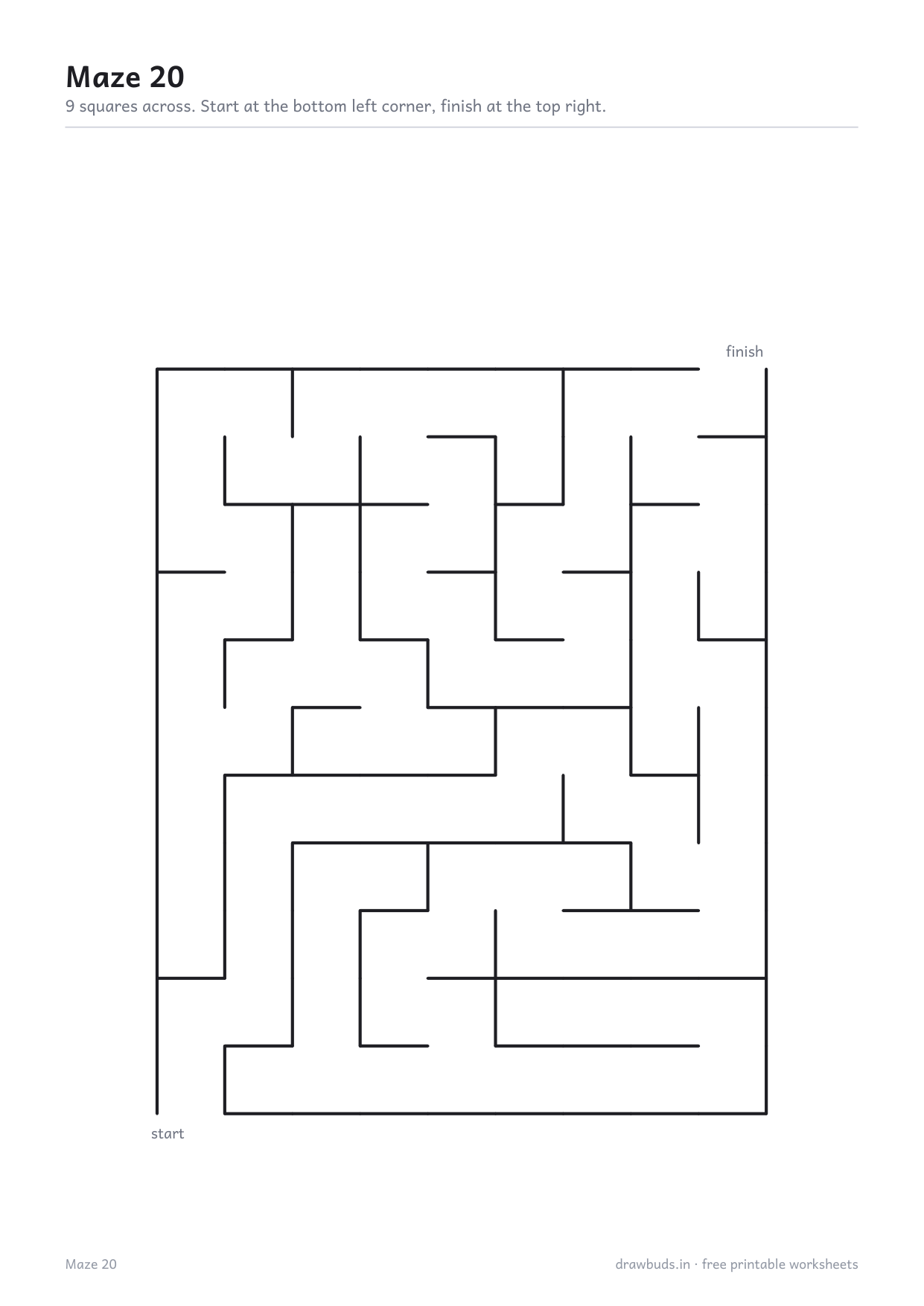
Mazes 1 to 4 are five squares across, and take a four-year-old about a minute. It widens by one square every four mazes, so mazes 17 to 20 are ten across. The squares stay large enough for a crayon the whole way through — a maze that needs a sharp pencil has stopped being a preschool maze.
The answers
The last four pages show all twenty solutions as a dotted path. They are at the back rather than on the same page for the obvious reason, and they are there at all because a stuck child who is shown the answer will usually go back and do the maze again properly.
Using them with a very young child
Trace the route with a finger first, then with a crayon. A three-year-old who cannot yet plan ahead can still enjoy following a route that has already been found, and that is genuinely useful practice for the hand.
What comes next
Pre-Writing Lines works the same muscles on the specific strokes letters are made from.
Printing this one correctly
In your printer dialog set Scale to 100% or Actual size, not Fit to page. Fit to page shrinks the tracing letters and they stop matching the size a child's hand is learning.
Plain paper is fine for crayons and pencils. If your child uses felt pens, 100 gsm paper stops the ink bleeding to the next sheet.