4 Digit Addition Worksheets with Carrying
4 digit addition worksheets: 192 column sums in six stages, from nothing to carry through to carrying three times, with carry boxes and answers. Free PDF.
- Pages
- 27
- Ages
- 8-10
- Paper size
- A4 and US Letter
- Black ink only
Same worksheets, two paper sizes. Free to print at home, at school, and in a classroom of thirty.
192 column sums under Th, H, T and O in six stages, carry boxes, answers
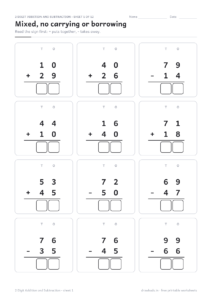
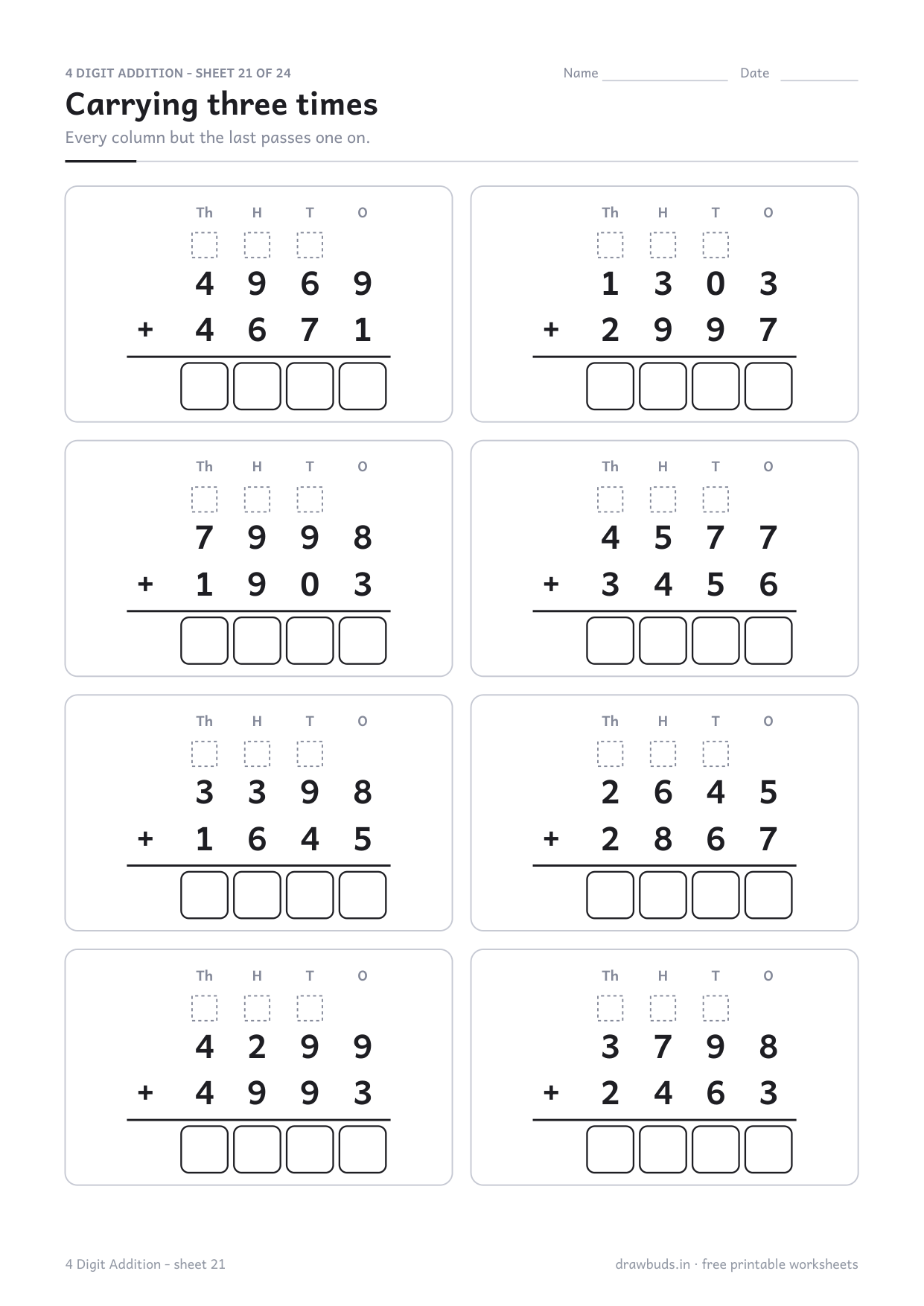
These 4 digit addition worksheets add one carry at a time, and the sheet that decides whether a child has understood it is sheet 21. By then a sum like 4969 + 4671 passes a digit on out of the ones, out of the tens and out of the hundreds, and each carry has to be added to a column the child has not looked at yet.
What is in the 27 pages
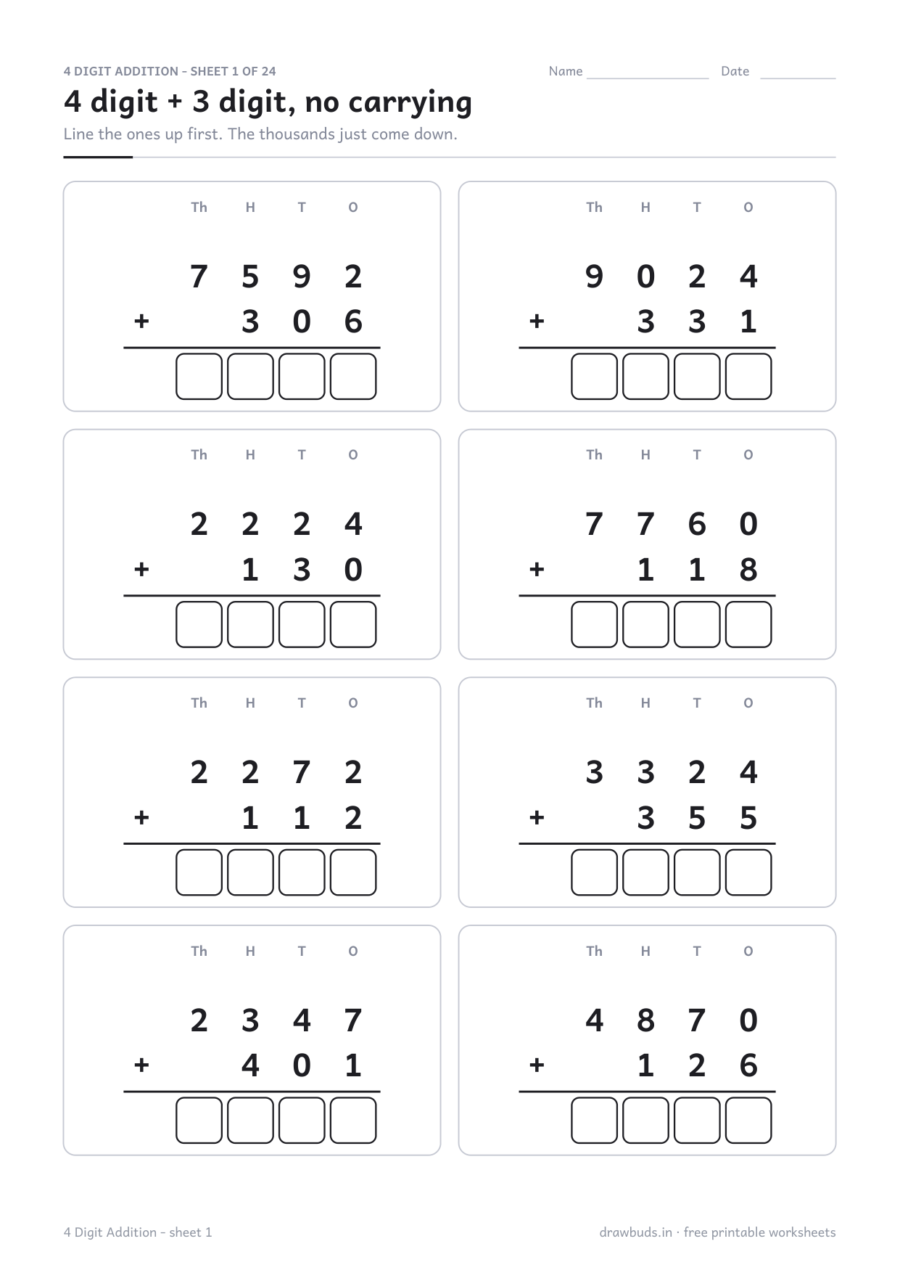
- Sheets 1-4: 4 digit + 3 digit, nothing to carry (7592 + 306).
- Sheets 5-8: 4 digit + 4 digit, nothing to carry.
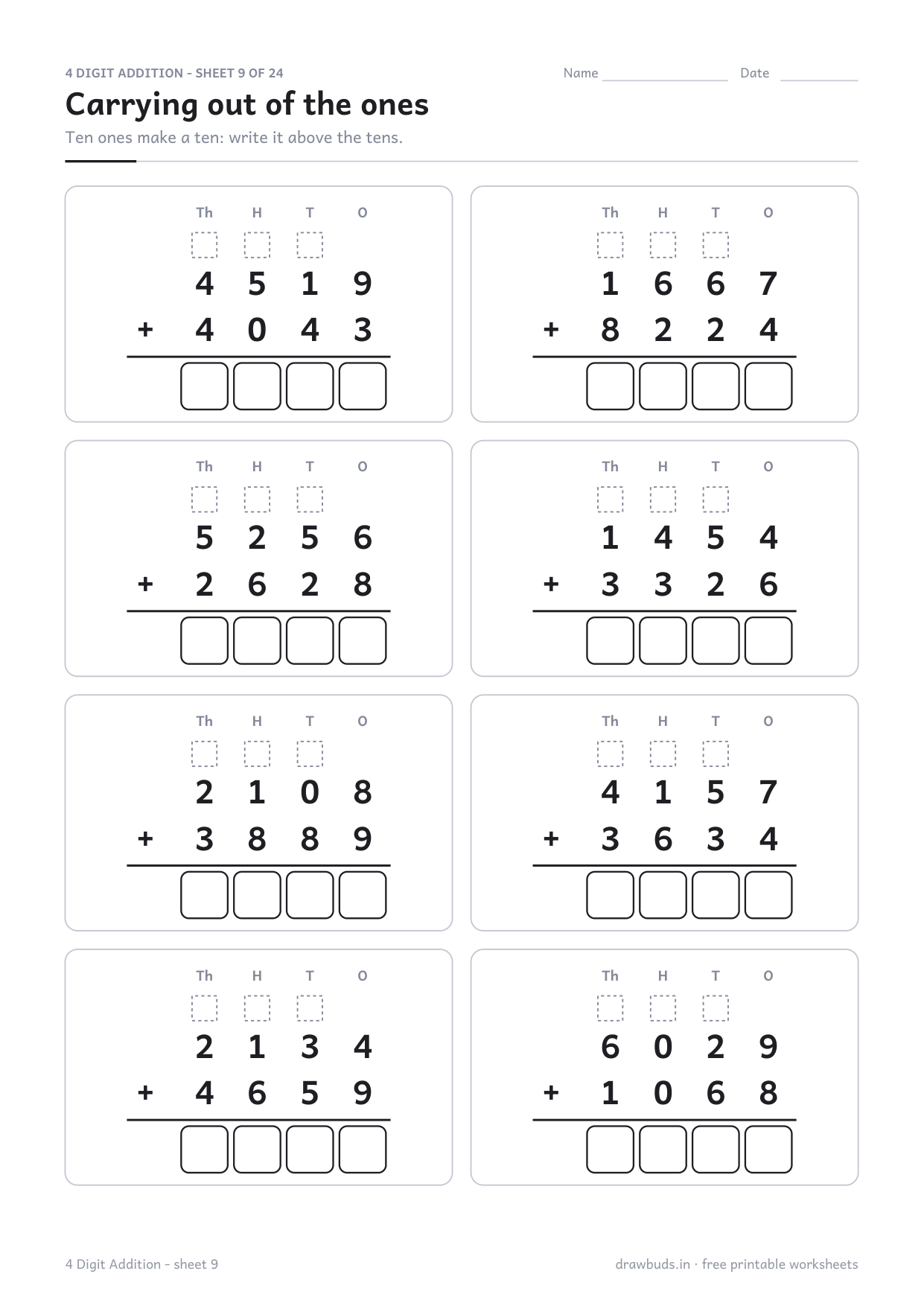
- Sheets 9-12: carrying out of the ones only (4519 + 4043).
- Sheets 13-16: carrying out of the tens only.
- Sheets 17-20: carrying twice, out of the ones and then the tens.
- Sheets 21-24: carrying three times (4969 + 4671).
- Last two pages: every answer, sheet by sheet.
Eight sums a sheet, 192 in all, under printed Th, H, T and O headings. No sum appears twice in the book.
Eight sheets before anything carries
A third of the book carries nothing. That looks like filler and it is the opposite. Four-column addition asks two separate things of a child, keeping four digits in their own columns and exchanging ten for one, and meeting both on the same sheet teaches neither. The first eight sheets drill the lining up until it stops needing attention, and the carry then arrives on a page that already looks familiar.
Carrying out of the tens, on its own
Sheets 13-16 are the ones most sets leave out. They carry out of the tens while the ones stay quiet, so a child meets the idea that a carry can start anywhere, not only in the first column they touch. Children who skip this stage tend to carry correctly out of the ones and then ignore a tens carry completely, because every sum they have seen so far started its carry on the right.
Where the thousands column is different
The thousands never carry here. Nothing in the book goes past 9999, so a fifth column never appears and the answer box is always four digits wide. That is deliberate. A sum that suddenly grows a column is a different lesson, and it is worth meeting after this book rather than during it.
The small boxes above the columns
From sheet 9 a dashed box sits above each column that can receive a carry. 9 + 3 makes 12: the 2 goes in the ones answer and the 1 goes in the box above the tens, waiting to be added. Sheets 1-8 show no boxes at all, because a child should never be looking at a space they have no use for.
Class 3, class 4, or grade 3
In most Indian schools four-digit addition is class 3 into class 4. In US schools it is grade 3, and in England year 4. The sheets are numbered rather than labelled by class, so you can start where the child actually is. If three-digit sums still need counting, 3 digit addition worksheets run the same six stages one column smaller, and place value hundreds and thousands is where to go if the Th, H, T and O headings themselves are the problem.
For the take-away version of exactly these stages, see 4 digit subtraction worksheets.
Printing this one correctly
In your printer dialog set Scale to 100% or Actual size, not Fit to page. Fit to page shrinks the tracing letters and they stop matching the size a child's hand is learning.
Plain paper is fine for crayons and pencils. If your child uses felt pens, 100 gsm paper stops the ink bleeding to the next sheet.