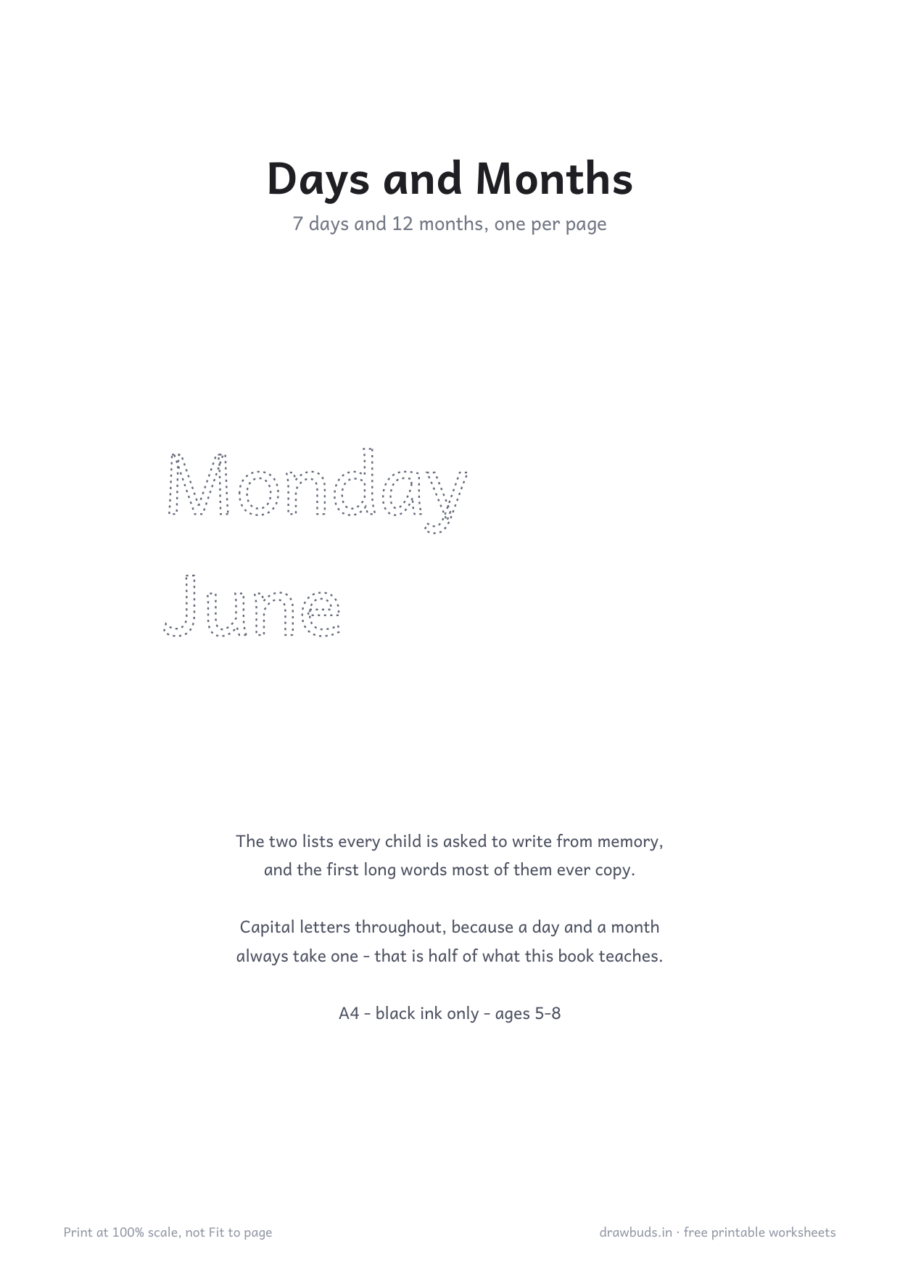
Days and Months Tracing Worksheets
20 printable pages. Seven days and twelve months, each with its three-letter short form — the two lists every child is eventually asked to write from memory.
- Pages
- 20
- Ages
- 5-8
- Paper size
- A4
- Black ink only
Free to print at home, at school, and in a classroom of thirty.
Seven days and twelve months, each with its short form
Days and months are the first long words most children are asked to write, and the first words where a capital letter is not optional. Wednesday is nine letters with a silent d. February is eight with an r almost nobody says. This book gives each one a page.
What is on each page
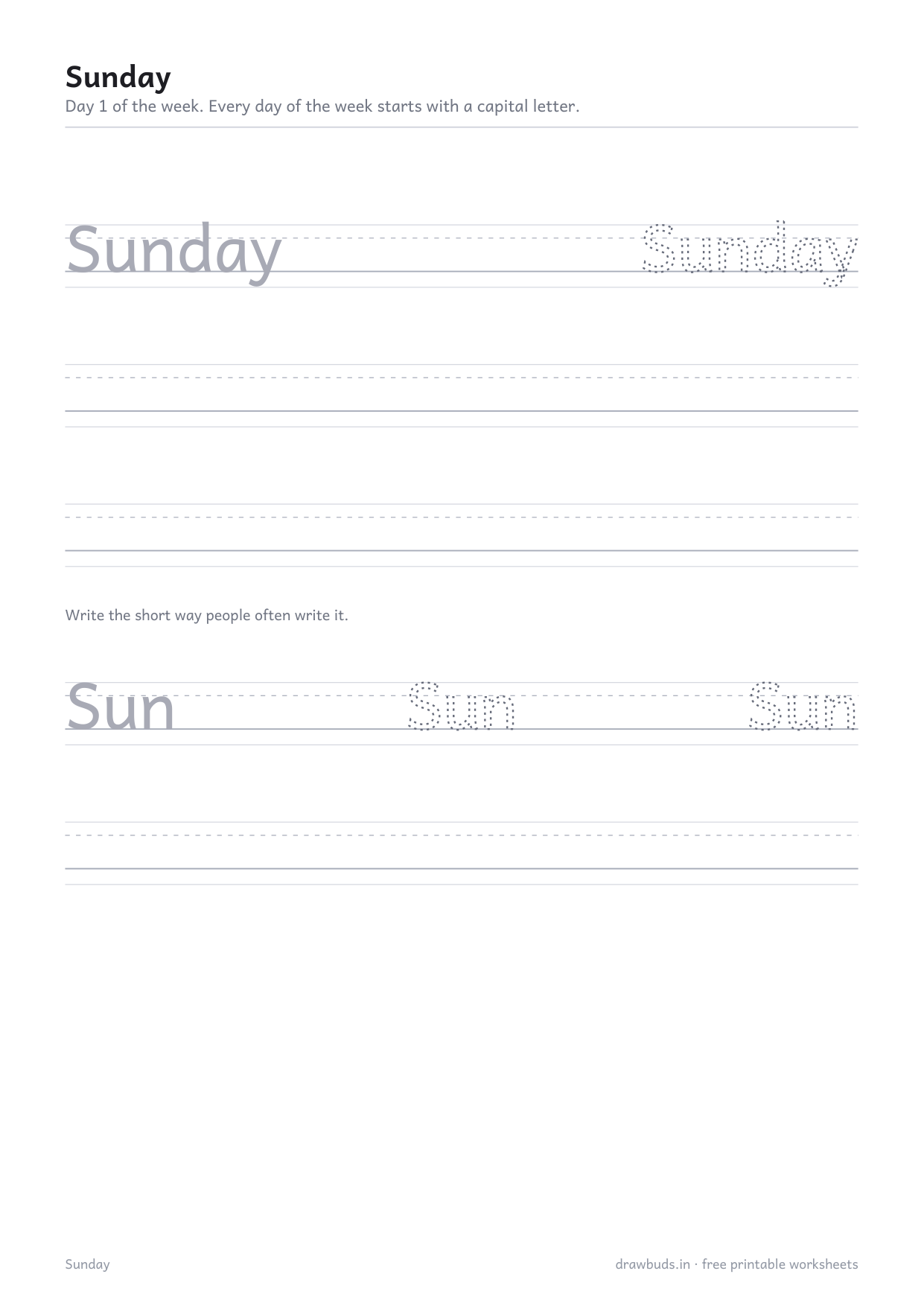
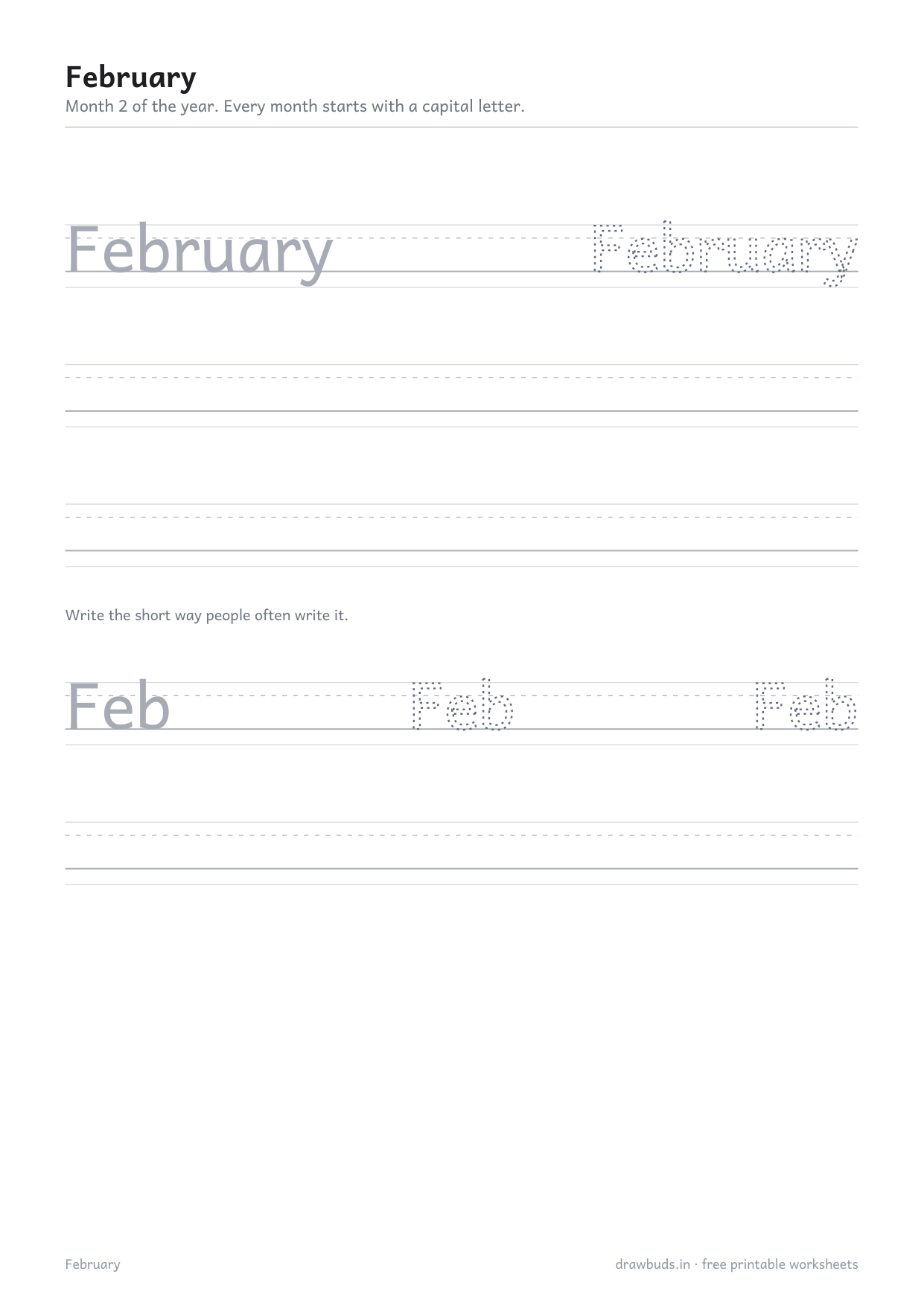
The full word on three ruled rows — one grey copy, one dotted, then two blank rows — followed by the three-letter short form on two more rows. Mon, Tue, Wed. Jan, Feb, Mar. The short forms are on the same page as the full word because that is where a child will look for them, and because a calendar, a timetable and a form all use them.
The capital letter is half the lesson
Every page says it: days and months always take a capital. This is a rule with no exceptions in English, which makes it one of the very few capitalisation rules worth teaching early. Seasons do not take one, which is worth mentioning at the same time.
The hard ones
Wednesday — teach it as Wed-nes-day, said wrongly on purpose, and it becomes spellable in an afternoon. February — the first r. August — no e. Tuesday and Thursday both start with T and get swapped constantly; do them a week apart.
Order
Days first, Sunday through Saturday, then months, January through December. Sunday is first rather than Monday because that is how nearly every printed calendar and school planner lays the week out, and a child copying from a wall calendar should not have to translate.
What comes next
These are long words, so a child who tires halfway through one is telling you the letters themselves are not automatic yet — Lowercase Tracing a-z is the book to go back to.
Printing this one correctly
In your printer dialog set Scale to 100% or Actual size, not Fit to page. Fit to page shrinks the tracing letters and they stop matching the size a child's hand is learning.
Plain paper is fine for crayons and pencils. If your child uses felt pens, 100 gsm paper stops the ink bleeding to the next sheet.