Cursive Words and Sentences: Joining Worksheets
Cursive words and sentences worksheets: 93 words and 8 sentences, sorted by the kind of join each letter makes, to copy, trace and write. Free PDF.
- Pages
- 25
- Ages
- 7-10
- Paper size
- A4 and US Letter
- Black ink only
Same worksheets, two paper sizes. Free to print at home, at school, and in a classroom of thirty.
24 sheets: cursive joins one kind a sheet, words to copy and trace, then sentences, then write from memory
These cursive words and sentences worksheets start where single cursive letters stop, at the join. A child who can write every cursive letter on its own often still writes “on” wrongly, because o finishes at the midline and has to join across the top, while a finishes on the baseline and joins from the bottom. The sheets are sorted by that difference, not by the alphabet.
What is in the 25 pages
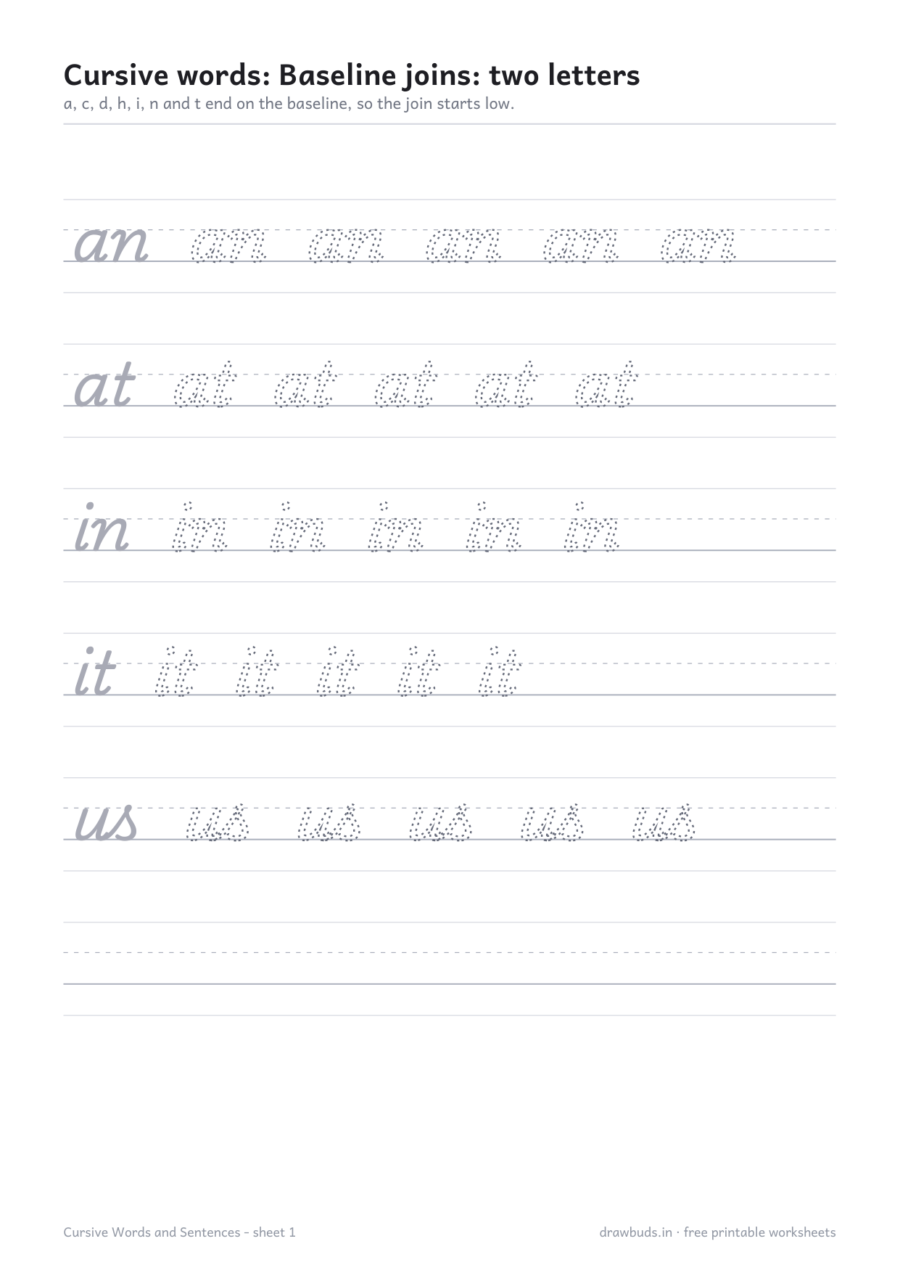
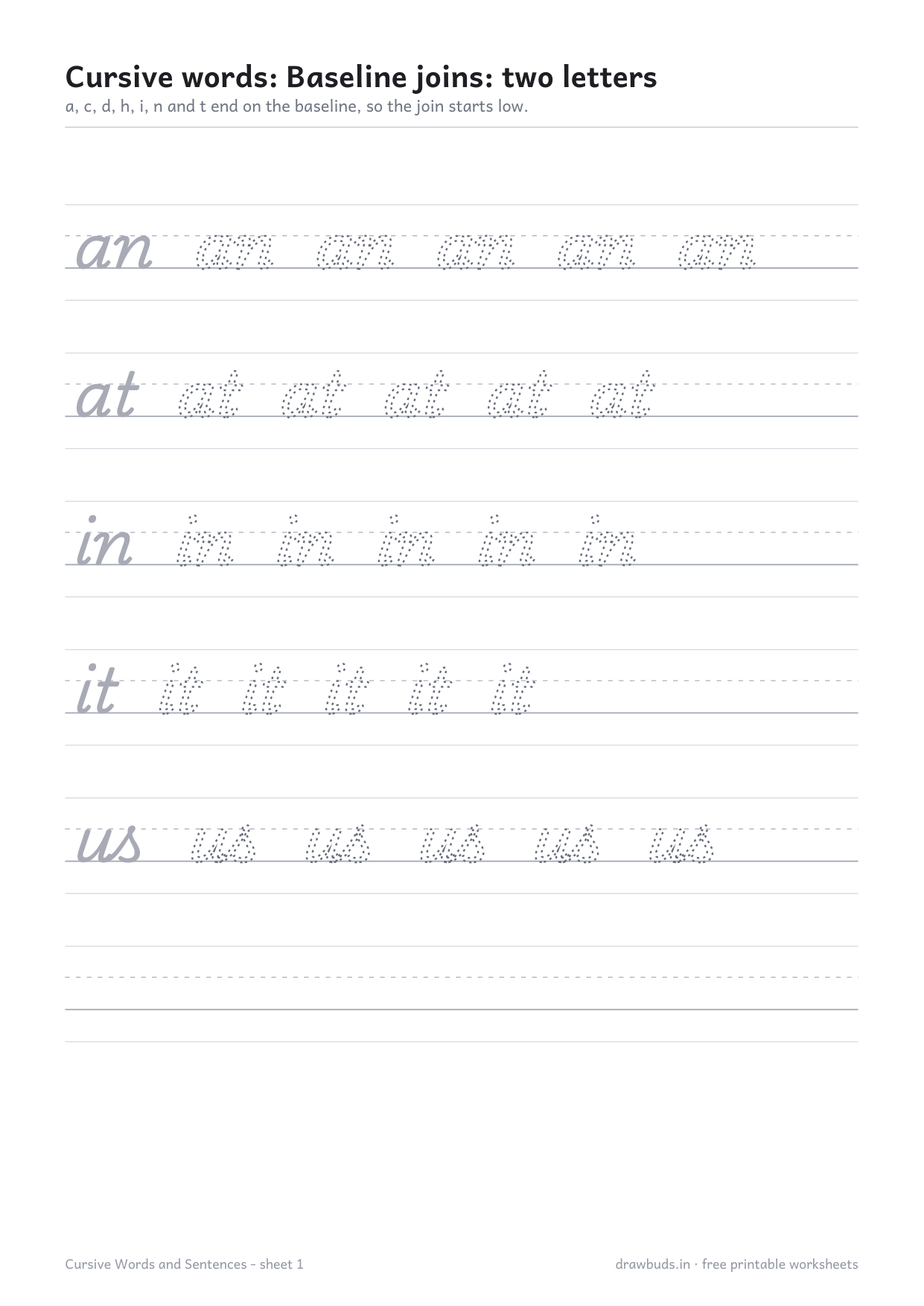
- Sheets 1-3: baseline joins, from two letters (an, at, in) up to four (tent, milk, sand).
- Sheets 4-5: joining into e and into the tall letters l, h, k and b.
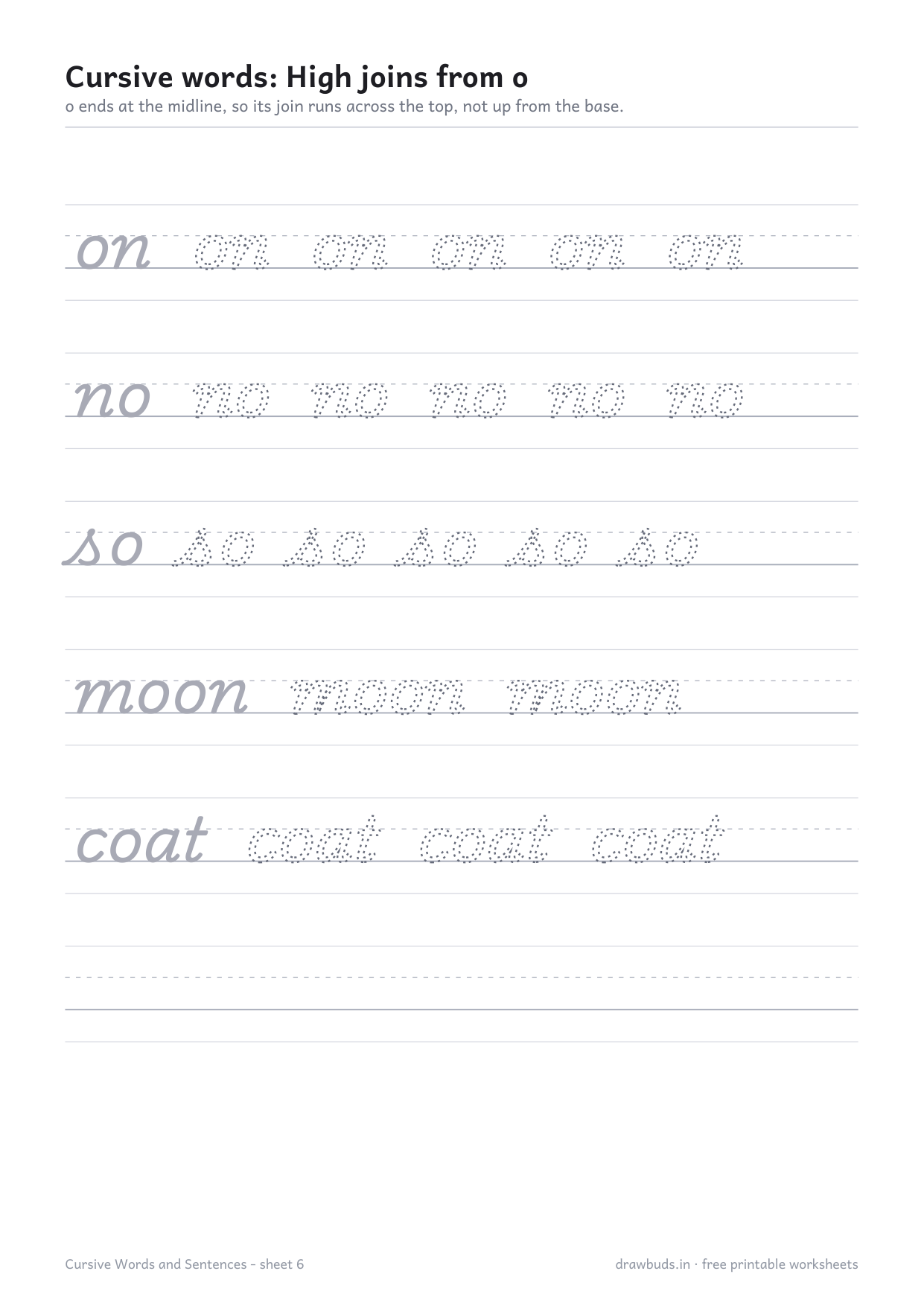
- Sheets 6-8: the high joins out of o, v, w and b.
- Sheets 9-13: r and s, the tail letters g, j, y, p, q and z, the double-looped f, and crossing t and x last.
- Sheets 14-19: double letters, color words, number words, the days of the week and names with capitals.
- Sheets 20-23: eight short sentences, each one to copy, then trace, then write on an empty line.
- Sheet 24: blank cursive lines to write your name, the day and a sentence of your own.
Every word sheet has five words or four, one to a line. The first copy is solid grey to look at, the rest of the line is dotted to trace, and the last line is left empty.
Low joins and high joins
Most lowercase cursive letters end on the baseline, and the join to the next letter climbs up from there. Four do not. o, v, w and b all finish with a small curl at the midline, so the join leaves from the middle of the line and runs across. A child who joins every letter from the bottom makes “on” look like a different word. Sheet 6 is all o words for that reason, and sheets 7 and 8 do the same for v, w and b.
When to lift the pencil
Inside a word the pencil stays down. It comes up between words, and for two letters inside a word as well: the t and the x are crossed after the whole word is written, which is what sheet 13 practices with box, six, fox, tent and taxi. Capitals are the other lift. In this cursive style several capitals, T and W among them, do not join to the letter after them, so on the days of the week and the names sheets the grey model shows which ones lift and which carry on.
Sentences with a finger space
A cursive sentence fails in a different way from a cursive word. The joins are usually fine by then and the words run into each other instead. The model sentences on sheets 20 to 23 are set with a gap wider than the typeface’s own space, about the width of a child’s finger, so the copy shows the gap that is being asked for. Sheet 23 is the fox and the lazy dog, which uses all 26 letters and so every join in the book.

Before this book, and after it
Joins need the single letters to be secure first. If a cursive letter still needs thinking about, go back to cursive lowercase letters a-z, and for names and the days of the week, cursive capital letters A-Z. For printed handwriting at the same stage, with the same habits of spacing and full stops, there is penmanship practice, copy the sentence, and empty ruled paper for free writing is in handwriting practice paper.
Printing this one correctly
In your printer dialog set Scale to 100% or Actual size, not Fit to page. Fit to page shrinks the tracing letters and they stop matching the size a child's hand is learning.
Plain paper is fine for crayons and pencils. If your child uses felt pens, 100 gsm paper stops the ink bleeding to the next sheet.