Place Value Worksheets: Hundreds and Thousands
Place value worksheets for hundreds and thousands: blocks, the Th H T O chart, expanded form, the value of a digit, number names and comparing. Free PDF.
- Pages
- 23
- Ages
- 7-9
- Paper size
- A4 and US Letter
- Black ink only
Same worksheets, two paper sizes. Free to print at home, at school, and in a classroom of thirty.
20 sheets: blocks, Th H T O chart, expanded form, value of a digit, number names, compare, answers
These place value worksheets for hundreds and thousands turn on sheets 13 to 16, where a digit is printed in bold and the child says what it is worth. A child who reads the 4 in 3,428 as four has learned the names of the columns. A child who reads it as four hundred has understood place value, and nothing before that sheet can tell the two apart.
What is in the 23 pages
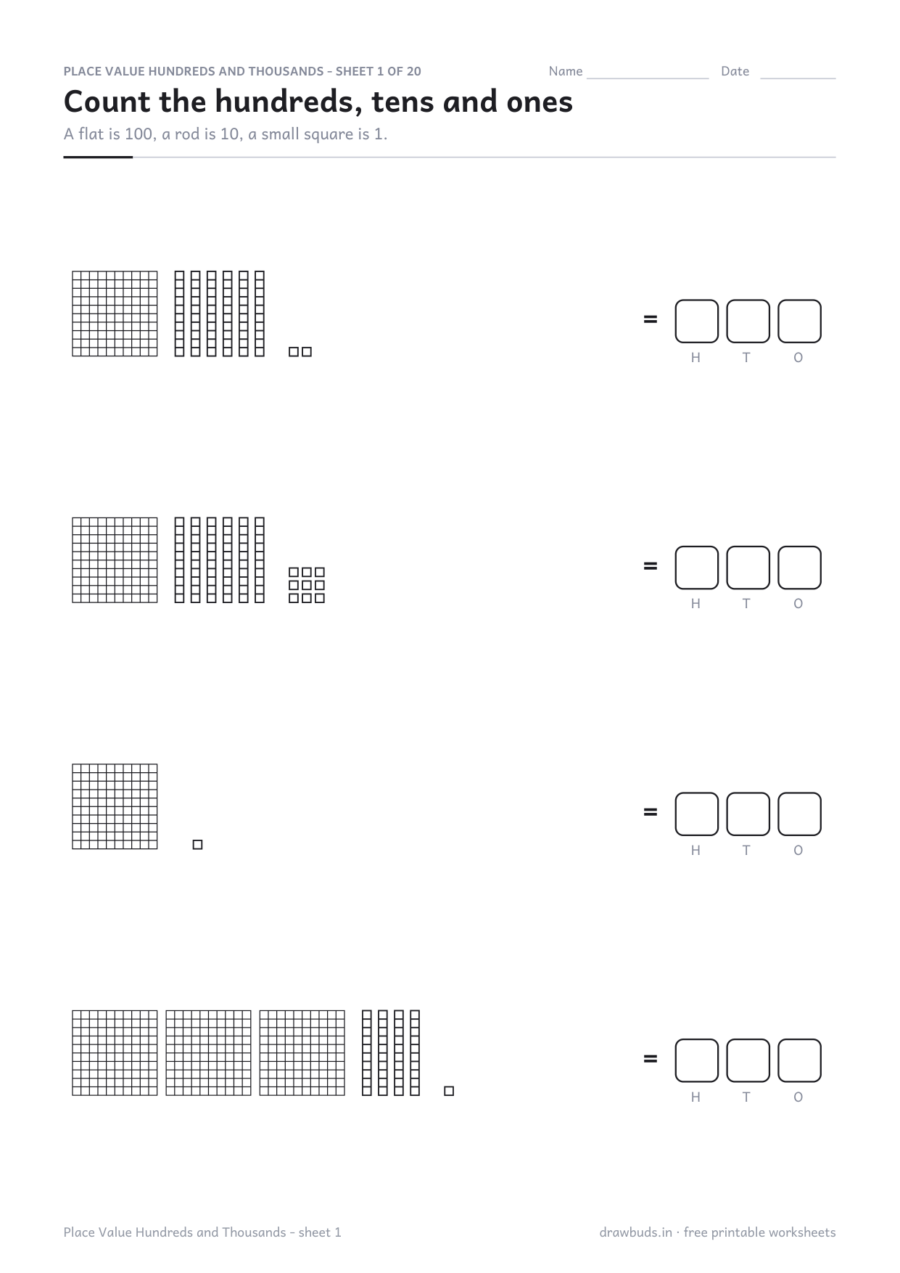
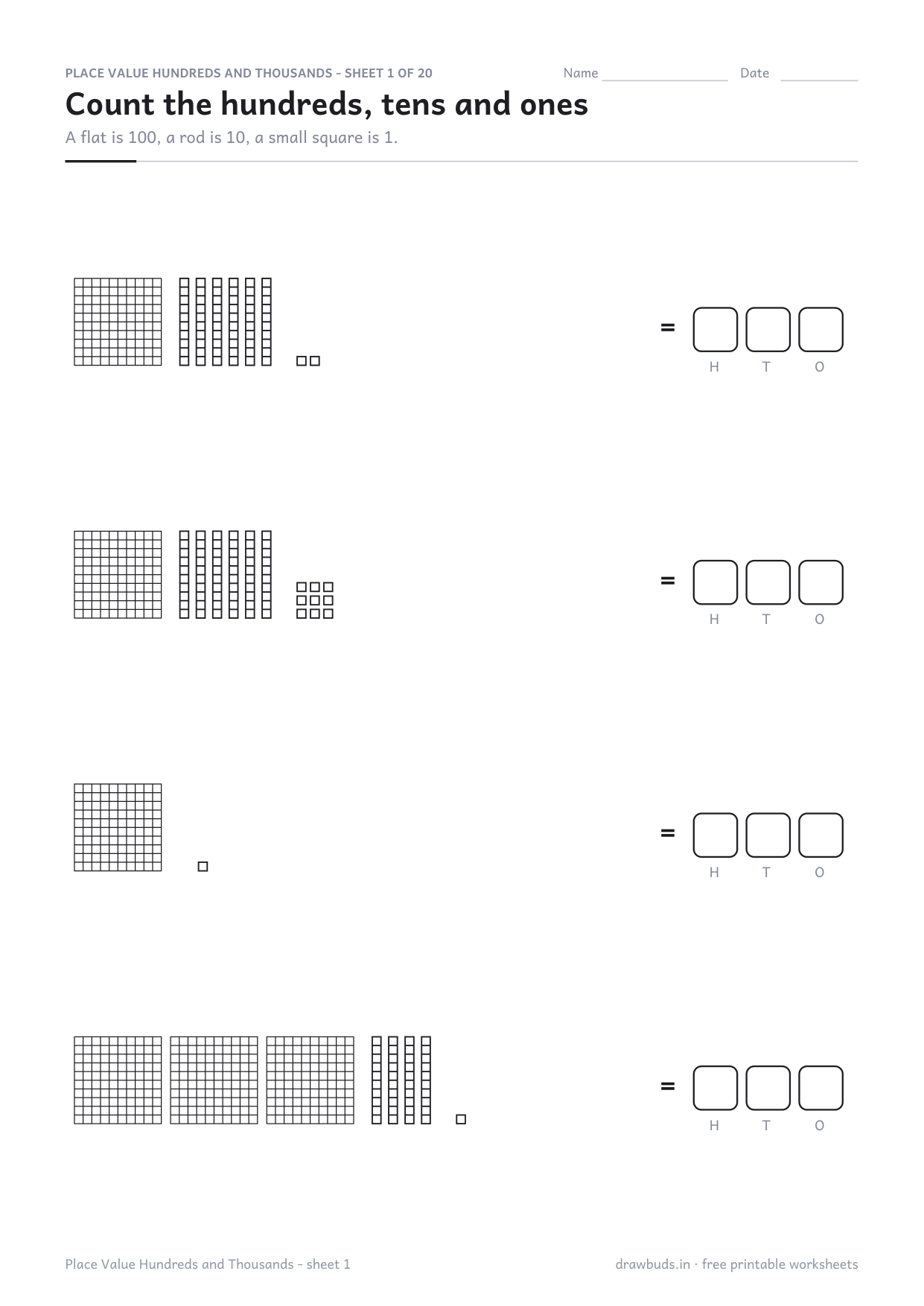
- Sheets 1-4: count the flats, rods and squares and write the number.
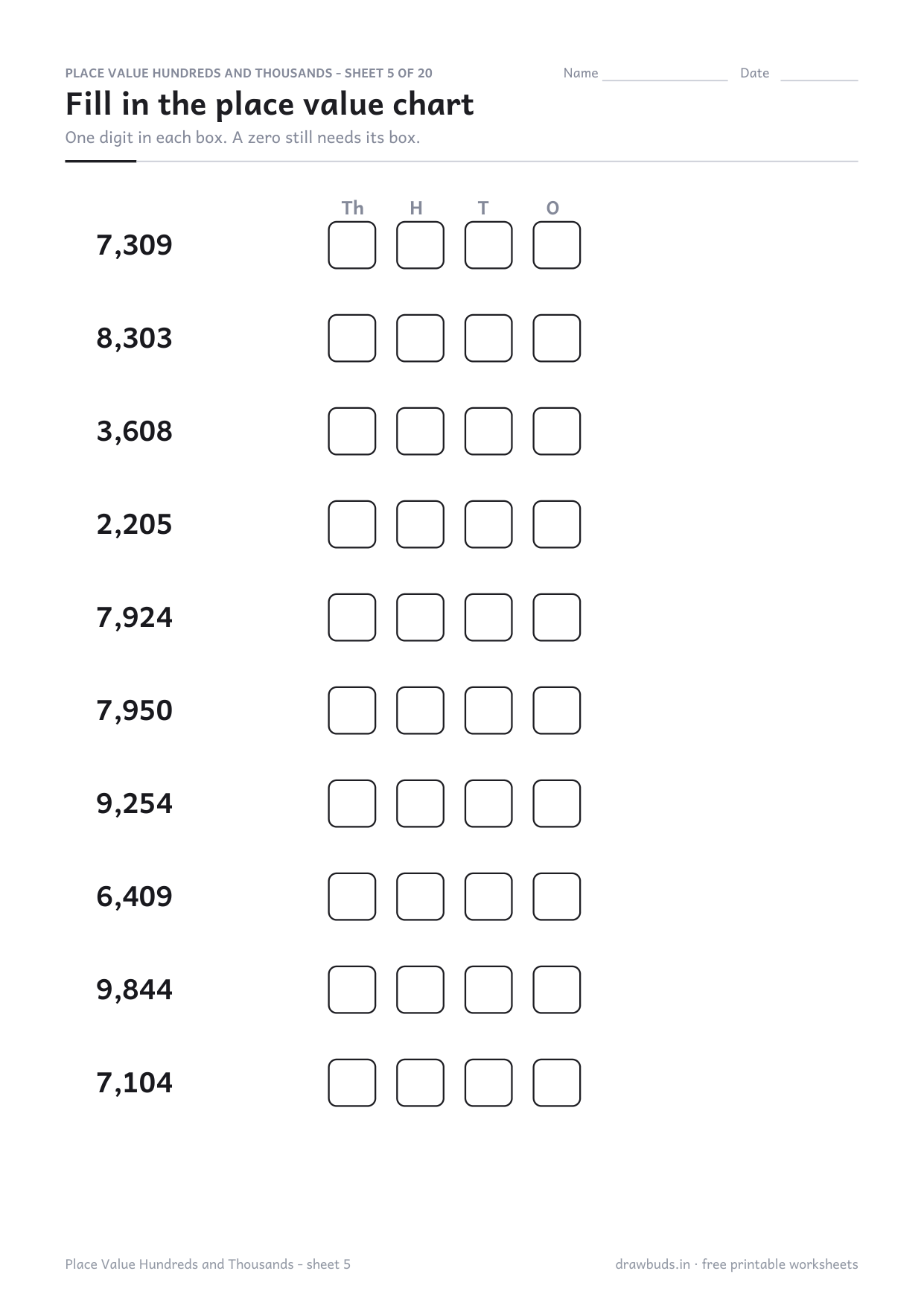
- Sheets 5-8: fill in the Th, H, T and O chart, zeros included.
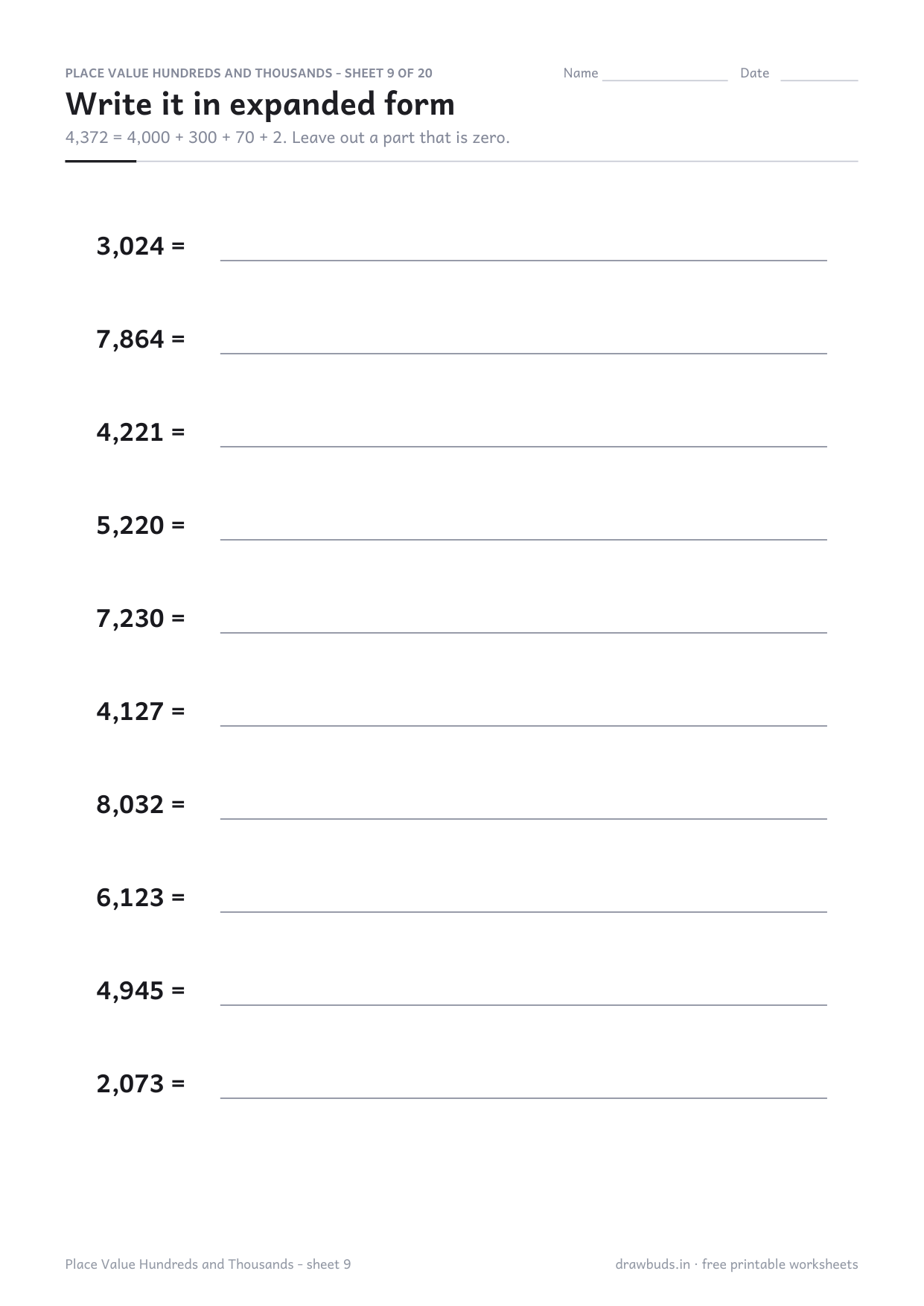
- Sheets 9-10: write it in expanded form.
- Sheets 11-12: go the other way, from expanded form back to the number.
- Sheets 13-16: what is the bold digit worth.
- Sheets 17-18: write the number in digits, from its name.
- Sheets 19-20: compare with the greater than and less than signs.
- Last two pages: every answer, sheet by sheet.
Blocks first, for four sheets
Flats, rods and single squares are the only part of this book a child can hold in their hand, and the sheets start there because the chart means nothing without them. A hundred is a square of a hundred squares. Once that picture exists, the H column has something behind it. If real base ten blocks are at home, use them alongside these four sheets.
Zeros are the reason the chart has boxes
The chart sheets include numbers like 3,040, where two columns have nothing in them. A zero is not an absence here, it is a placeholder holding a column open, and a child who leaves the box blank instead of writing 0 has written a different number. This is the single most common error in the whole topic and the boxes exist to make it visible.
Expanded form, and then back again
Sheets 9 and 10 break a number apart, 3,428 into 3000 + 400 + 20 + 8. Sheets 11 and 12 put it back together. Both directions are needed because they are not the same skill: a child can split a number reliably and still stall when handed the parts. Going backwards is also the thinking behind column addition.
Class 2, class 3, or grade 2
Indian schools do hundreds in class 2 and thousands in class 3. US schools cover it in grade 2 into grade 3. This book is the one to reach for when column arithmetic keeps going wrong for no obvious reason, because misaligned columns are almost always a place value problem rather than an addition one. The arithmetic that depends on it is in 4 digit addition worksheets and 4 digit subtraction worksheets, and tens and ones worksheets is the smaller book before this one.
Printing this one correctly
In your printer dialog set Scale to 100% or Actual size, not Fit to page. Fit to page shrinks the tracing letters and they stop matching the size a child's hand is learning.
Plain paper is fine for crayons and pencils. If your child uses felt pens, 100 gsm paper stops the ink bleeding to the next sheet.